Showing posts with label Eamon Kelly. Show all posts

Saturday, 8 December 2012

The Irish Times of Eamon Kelly


A crime boss who changed with the times

  • 65-year-old career crimina
CONOR LALLY, Crime Correspondent
Eamon Kelly had witnessed the transformation of the underworld – and became a paid consultant to other criminals – before his murder this week
Eamon Kelly, the 65-year-old crime boss and father of nine who was shot dead on Tuesday, lived through changes in the criminal landscape that he couldn’t have imagined as a teenager.
He had come up in the era when hold-up-style bank robberies were common and gun murders infrequent. He survived into the cocaine-fuelled modern era, in which the criminal fraternity has morphed into a macho subculture where guns are commonplace and people are killed if they are even suspected of having wronged their fellow gang members.
Kelly, who had once worked as a labourer, began his crime career in the 1960s. His earliest convictions were for housebreaking and shopbreaking.
After initial brushes with the law he began to project an image of an upwardly mobile young businessman, eager to make his way in legitimate business. He became involved, with his brother Matt Kelly, in the Kelly’s Carpetdrome business, though it collapsed with huge debts in 1981.
At this time, republican bank robberies across the State were regular occurrences, and a heroin “epidemic” was sweeping Dublin, making certain crime families rich. But by the mid 1980s, with his carpet business wound up, as well as a property business he had been involved in, Eamon Kelly had joined his peers in carrying out major cash robberies.
At that time, still in his mid to late 30s, Kelly became known as a man who schooled and advised others engaged in major robberies. One of them was Gerry Hutch, who, like Kelly, was originally from Dublin’s north inner city. Hutch would go on to settle a multimillion-euro case with the Criminal Assets Bureau, which presented evidence in court claiming that he was linked to some of the biggest armed robberies in the State in the 1990s; two of those crimes netted almost £4 million.
Like Kelly, Hutch left the poor inner city to settle in a middle-class neighbourhood. He currently lives in Clontarf, less than a kilometre from the home outside which Kelly was shot this week in Killester.
Kelly was associating with figures in the Official IRA in the early 1980s and was jailed after stabbing a man in a row outside the Workers’ Party’s social club on Gardiner Street in Dublin’s north inner city.
Serious criminal 
When he came out of prison in the mid 1980s, Kelly, now a serious criminal with a bodyguard, once again stepped back into a crime scene dominated by IRA-fundraising bank robberies. By then, though, nonparamilitary gangs were finding their feet, despite the stifling influence of the Provisional IRA.
John Gilligan was specialising in robbing factories. Martin Cahill – “the General” – and his gang were proving successful at robbery-based enterprises, and the families that were among the first to corner the Dublin drugs market were continuing with their trade.
As the recession of the 1980s eased and yuppie culture reached Irish shores, Kelly decided to move into the fledgling cocaine market. His plans to develop an almost direct cocaine route from Colombia to Ireland via Miami, using a Cuban female drugs mule, were new to Ireland.
They were met by some equally pioneering Garda tactics. The force modified a van into a surveillance vehicle and used it to uncover Kelly’s plan. When he went to Jurys Hotel in Ballsbridge, Dublin, in September 1992 to collect £500,000 in smuggled cocaine, he was arrested and later jailed for 14 years.
The details of the case seem almost quaint when set against the hauls of up to €10 million captured in recent years. The technology now at the Garda’s disposal lets gardaí eavesdrop on mobile-phone calls and read text messages without needing physical access to the phones they are monitoring.
The man who led the 1992 investigation was Martin Callinan, then a detective sergeant and now the Garda Commissioner.The links to Cuba and Colombia set out in court were very exotic in the Dublin of the early 1990s, and the trial was heavily covered in the newspapers.
When Kelly emerged from jail for this crime, just over a decade ago, the landscape had changed significantly. The Provisional IRA now had little influence, and the economic boom had fuelled a huge drugs trade.
Members of John Gilligan’s gang had shot dead the journalist Veronica Guerin, resulting in the jailing of key members, the dismantling of the gang’s cannabis network and the setting up of the Criminal Assets Bureau.
The drugs market was now nationwide, and new gangs of young men in parts of Limerick and Cork had cornered much of the regional market.
In Dublin, Brian Rattigan and his enemies were beginning their bloody feud in the suburbs of Crumlin and Drimnagh, and Shane Coates and the Sugg and Glennon brothers – all of whom have since been shot dead – had become the group of Blanchardstown drug dealers and killers known as the Westies.
In Finglas, in north Dublin, Martin Marlo Hyland was running the biggest drugs gang in the State and the Bradley brothers, Alan and Wayne, were emerging as prolific armed robbers.
Scale of death 
The Crumlin and Drimnagh gangs, Hyland’s group, the Westies and the Keane-Collopy and rival McCarthy Dundon gangs in Limerick have all engaged in feuds in which dozens have died – a scale of death unheard of before Kelly was jailed for cocaine offences.
So Kelly – robber, drug dealer, forger and gang mentor – became a sort of paid consultant to many of the new breed in Dublin. Kelly was especially close to Eamon Dunne, who took over the large drugs and robbery gang in Finglas after Marlo Hyland’s murder and who himself would be shot dead in April 2010.
In the end it was that consultancy work that saw Kelly shot dead this week. When the Real IRA in Dublin began trying to extort money from some of the Dublin gangs, a number of the rival groups joined forces to fight off the well-structured dissidents.
The coalition led to the murder of Alan Ryan in September. The Real IRA believed Kelly was central to organising that killing and was also frustrated that Kelly had himself refused to pay up when extortion demands were made of him.
They had tried to kill him two years ago outside his house on Furry Park Road in Killester, north Dublin, but the gun jammed and the gunman ran off.
But with Kelly very much under suspicion for aiding the killers of Alan Ryan, he once again rose to the top of Real IRA’s list of targets. After more than four decades in the thick of organised crime, he was shot dead outside his Dublin home on Tuesday afternoon.

Monday, 26 November 2012

An Seanachai Eamon Kelly Aris!


Custom Search

Site Index | Kids | Kitchen | Shopping | Poetry | Weddings | Travel | Basic Irish | Quotes | Books | Music | Movies | Trivia | Blessings | Jokes | Links|


News Page
History Page
Traditions, folklore, history and more. If it's Irish, it's here. Or will be!
"People will not look forward to posterity who never look backward to their ancestors."
-Edmund Burke
Home Page

Index

Kids Page
Kitchen Recipe Page


Irish Wedding


Shops Ireland


Himself/Herself

Write to Us

Readers Write..
Links/Link to Us

Advertise with us


In My Father's Time
by Mattie Lennon

It was 1959. The National Council for The Blind of Ireland gave my visually impaired mother a wireless. It was our first radio. At the time my contemporaries were clued in to the highlights of Radio Luxemburg and the Light Programme. But, always one to live in the past, I had a preference for the folk programmes on Radio Eireann. My adrenalin was really let loose by the prologue to one in particular:
The rick is thatched
The fields are bare,
Long nights are here again.
The year was fine
But now 'tis time
To hear the ballad-men.
Boul in, boul in and take a chair
Admission here is free,
You're welcome to the Rambling House
To meet the Seanachi.
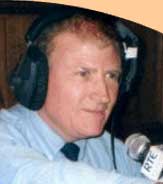
The Seanachi was, of course, Eamon Kelly.

I was to follow Eamon's stories, on the air, and later in Dublin theatres, through his one-man shows, for decades.

His trademark introduction was: "In My Father's Time" or "Ye're glad I came." In between tales of "The King of England's son" and "The Earl of Baanmore" he would tell his own life-story.

And those who knew his style could always differentiate between the fact and the fiction.

He was born in Rathmore, Co. Kerry, in March 1914. In his autobiographical work "The Apprentice" he tells of how the family moved when he was six months old. He was brought to Carrigeen on Maurice O'Connor's sidecar. (Of course when he'd be wearing his Seanachi's hat he'd tell you he remembered it).

Eamon grew up in a Rambling House and in later life said: " ... my ears were forever cocked for the sound that came on the breeze. It wasn't the Blarney Stone but my father's house which filled me with wonder".

He was only a child when this country gained independence but he had his Kerry ear cocked long before that to accumulate stories such as this: " 'Will I get in this time' the sitting MP said once to one of our neighbours, coming up to polling day. 'Of course you will' the neighbour told him. 'Didn't you say yourself that it was the poor put you in the last time and aren't there twice as many poor there now?' "

Eamon didn't lick his storytelling ability off the ground. He said of his father that he was " ... a friendly person, a good talker. Neighbours and travelers were attracted like moths around a naked flame into his and my mother's kitchen". Their kitchen had " ... all the rude elements of the theatre; the storyteller was there with his comic or tragic tale, we had music, dance, song and costume".

When he left school Eamon became apprentice to his father who was a master carpenter and wheelwright.

The young apprentice missed nothing; seventy years on he could mimic a verbose mason who described how to put a plumb-board against the rising walls to "ascertain their perpendicularity".

He also began taking a correspondence course with Bennett College in England. Then it turned out that the architect of a hotel enlargement project that he was working on was the craftwork teacher at the local Technical School. Eamon enrolled for a night course. The teacher's name was Micheal O' Riada and, in his autobiography, Eamon told how he " ... was the means of changing the direction of my footsteps and putting me on the first mile of a journey that would take me far from my own parish. He taught me and others the craft of wood and in time we passed examinations set by the technical branch of the Department of Education in carpentry, joinery and cabinet making. He taught the theory of building and how to read plans: he taught solid geometry which holds the key to the angles met with in the making of a hip roof or staircase".

No matter how far from home Eamon was working he cycled two nights a week to Tech. He was soon to learn that Micheal O'Riada's interests were not confined to sawing and chiseling. He introduced his pupils to books, writers and the theatre. On the head of this Eamon went to see Louis Dalton's company, at the town hall, in "Juno and the Paycock".

"It was my first time seeing actors on a stage and the humour, the agony and the tragedy of the play touched me to the quick".

He was mesmerized by the actors and " ... their power to draw me away from the real world and almost unhinge my reason long after the curtain had come across".

Micheal O'Riada was impressed with Eamon's reaction to the theatre. He discussed O'Casey, Synge and Lennox Robinson with the young carpenter and advised him if he ever went to Dublin to go to the Abbey Theatre.

Mr. O'Riada also told him that if he kept making headway in his studies and passed the senior grade in the practical and theory papers he would enter him for a scholarship examination, to train as a manual instructor, in Dublin. Since Eamon had left school at fourteen he also had to do additional study in English, Irish and Maths. He passed his scholarship examination, and the interview in Dublin, with flying colours.

He trained and worked as a woodwork teacher for years until he became a full time actor. His first acting role was as Christy Mahon in "The Playboy of the Western World" along with the Listowel actress, Maura O'Sullivan. He would later marry, and spend the rest of his life, with Maura.

They moved to Dublin and Eamon was employed by the Radio Eireann Repertory Players and later by the Abbey Theatre Company. He drew large audiences in villages during the '50s as he traveled around Ireland with his stories. He was to spend more than 40 years as a professional actor. Working with the top actors and leading producers of his day, he performed in New York, London and Moscow.

As a storyteller, his vivid and evocative descriptions are unsurpassed. Whether it was about an emigrant-laden train gathering speed before fading from view at Countess Bridge or sparks flying when the blacksmith struck red hot iron, nobody could tell it like Eamon. Once, in the Brooklyn Academy, while telling one of his famous stories he mentioned an Irish town and drew a graphic word-picture of emigrants at the station. From the audience he heard; "Divine Jesus" and a man crying. Ever the professional, Eamon instantly changed gear, swung to comedy and in seconds had the homesick exile laughing.

Watching him on the stage, the Paps-of-Dana and Dooncorrig Lake almost materialized around you. There was a temptation to look up for the rising ground above Barradov Bridge.

In the Peacock Theatre in the 1980s, you were standing beside the young Eamon Kelly as he made a Tusk Tenon at the workbench beside his father or walked barefoot on the submerged stepping-stones with his first-love, Judy Scanlon.

As Anette Bishop described it in the Irish American Post:
"It's a case of the past returning to raise a charming blush on the cheek of the present". Everything Eamon Kelly did was tried, tested and honed to perfection. And he always expressed appreciation of the crafts, skills and talents of others. "The correct actions of a craftsman sawing, planning or mortising with the chisel were as fluid as those of an expert hurler on the playing field".

When rehearsing for Seamus Murphy's "Stone Mad", which he adapted as a one-man show, he spent days observing stonecutters at a quarry in the Dublin mountains. In the course of the show he "lettered" a stone on stage.

With little or no interest in money himself, he was always on the side of the underdog and the marginalized. He was playing S.B. O' Donnell in "Philadelphia Here I Come" on Broadway, in January 1972, when he heard the tragic news of Bloody Sunday. There and then he decided to play his part in trying to rectify man's inhumanity; he became a vegetarian.

Eamon was shy, by nature. And even in his eighties he would be, by far, the most nervous artist backstage. This was because he was a perfectionist. A year before he died I saw him in a hotel about to do a piece he had performed hundreds of times. With the utmost humility he asked a staff member about facilities to do a last minute rehearsal: "Do you have anywhere where I could talk to myself for a while?"

While the great storyteller won't ever again stand on a stage or sit by the fire of a rambling house, his voice lives on. Rego Irish Records have brought out a video "Stories of Ireland, as told by Eamon Kelly" and a cassette "Eamon Kelly, the Irish Storyteller". (You'll find Rego Records at http://www.regorecords.com)

Kerryman, Brendan O'Shea (O'Sheas Tailoring, Lower Gardiner Street, Dublin) told me the following story:

At the end of September 2001, Eamon Kelly brought a suit in to Brendan for some alterations. The suit was fifteen years old. Prior to one of his trips to America, Eamon had it made by another Dublin tailor who left the jacket minus an inside pocket and the trousers without belt-loops or a back-pocket. Now, Eamon, the perfectionist, asked his fellow-Kerryman to rectify the sartorial omissions, which he did.

When Eamon died on 24th October 2001, he had left detailed instructions with his wife, Maura, about the funeral arrangements and which suit he wanted to be laid out in. Yes, you've guessed it!

Did the man who wrote so lovingly of Con-the-tailor, who made his first Communion suit, and who had portrayed an unforgettable tailor in "The Tailor and Ansty" want to somehow, bring the work of a Kerry tailor out of this world with him? I don't know. And neither does Brendan O'Shea.

As his coffin left the church, the Congregation gave a round of applause. The show was over and this time there was no encore. The final curtain had fallen on a one-man show, performed by a man of many parts. Actor, storyteller and writer, loving husband, devoted father and great Kerryman.

Shortly before his death, while lecturing North American Literature and Theatre students in the art of storytelling, he said: "My journeying is over. If the humour takes me, I may appear in some Alhambra, where angels with folded wings will sit in the stalls, applaud politely and maybe come round after and say;' that was great' ".

As he walked into that great Rambling House in the sky, can't you imagine the opening line?: "Ye're glad I came".

NOTE: Our thanks to Mattie for his contribution; if you'd like to read more of his stories, you'll find them on his website, please click Mattie Lennon.

BIO:
Mattie Lennon was born in the first half of the last century at Kylebeg, Lacken, Blessington, Co. Wicklow. He was not at any stage called "the black sheep of the family" mainly because he was (and is) an only child. He spent the first 25 years of his life at home on a small farm. He claims to identify with Patrick Kavanagh's "burgled bank of youth" (and says he is one of the few of his generation who knows how to make a bush-harrow). As a young fellow whenever he was blamed in the wrong he would compose a derogatory ballad about his accuser. There weren't many false accusations so he wasn't very prolific.

He was nicknamed "the Poet" but emphasises that the term wasn't always complimentary. He agrees that what is said behind ones back is their standing in the community and his favourite quotation is a comment made about him by a neighbour: "Wouldn't you think someone would tell him he's an eejit, when he doesn't know himself".

He has spent most of the last thirty years in Dublin but when asked "Will you ever go back to Kylebeg"? the answer is always Joycean. When James Joyce was asked, in Trieste; "Will you ever return to Dublin?" he said; "I never left".

Mattie Lennon has written articles (mostly humorous) for The Sunday Independent, The Irish Times, The Irish Post, Irelands Own, Irelands Eye, Kerry's Eye, The Wicklow People, The Leinster Leader as well as numerous on-line publications. He claims that he was once told; "You have the perfect face for radio" and he compiled and presented his own programmes in the "Voiceover" series on RTE Radio One. He has presented ballad programmes on KIC FM and is currently doing a Saturday morning ballad show at 11.03AM, on Liffey Sound 96.4 FM. (You can listen to it on the Net. Go to www.liffeysound.com and follow the links)
He also does pre-recorded programmes for other stations. One such programme is "The Story And The Song" in which he plays a number of ballads, having first told the story behind each one.
In 2005 his One Act Play, “A Wolf By The Ears” got a public reading in Teac Siamsa, Tralee.
In 2006 he produced a DVD ,”Sunrise On The Wicklow Hills” and compiled a book of Dublin Bus-workers writings, “There’s Love And There’s Sex And There’s The 46A ”.
He was in the final of the “Eamon Kelly Story–telling Competition” at Listowel Writer’s Week in 2007.
Most years since 2000 he has been in the final of the Sean McCarthy Ballad Competition in Finuge. He still writes the occasional ballad (not all of them fit for human consumption).

Thu, Nov 15, 2012
The Islands
There are hundreds of islands around the Irish coast. Achill is the biggest, the Arans the most romantic; Skellig Michael the most dramatic and Tory the most menacing - at least in legend. The Blaskets offer the most fertile ground for literature and Clare island is the most meticulously studied. But, whichever island you may visit, you can be sure each of them has its own superlative. For example, Little Skellig off St. Finian's Bay in Co. Kerry, is known for its gigantic colony of white seabirds called gannets.
Content edited and adapted from the book "Ireland - Atmosphere & Impressions" by Dr. Christopher Moriarty.
Photo Credits:
Skellig Archway from Travel Publishing

Click for More Culture Corner.


According to Custom
by Eamon Kelly
One of the most common sources for Bridget's articles and comments. A rich store of, what else, Irish customs. Eamon Kelly has written many books and told countless stories; fascinating reading and filled to the brim with the world of Irish history and tradition.Click here for According to Custom.


Site Index | Kids | Kitchen | Shopping | Poetry | Weddings | Travel | Basic Irish
Quotes | 
Books | Music | Movies | Trivia | Blessings | Jokes | Links | 

All contents copyright © 2001 through 2011 inclusive - all rights reserved.
March 4, 2011
Irish Gifts
Rollover button Images:
Wedding LaRose, Kids Reading & Kitchen Apples and Tea from All Posters prints.
The information provided on this site is offered as-is, without warranty. This site's owners, operators, authors and partners disclaim any and all liability from the information provided herein.
Any trademarks or registered trademarks on this site are the property of their respective owners.