Showing posts with label PENSIVE. Show all posts

Saturday, 4 October 2014

MUSIC FOR PENSIVE VVANKERS


 TAGGED UNDER: 

Fuck It, I Quit

Guest writer, the Parisian domiciled Frankie McKillen with his views on the drugs issue.


TPQ's Belfast Rockabilly Frankie McKIllen


Fuck it, I quit.

Charlo Greene famously said those words live on KTVA after she reported on a segment about pot to concentrate on legalizing marijuana in Alaska. What she said before dramatically quitting her job was ...

Everything you've heard is why I, the actual owner of the Alaska Cannabis Club, will be dedicating all of my energy toward fighting for freedom and fairness, which begins with legalizing marijuana here in Alaska. And as for this job, well, not that I have a choice but, fuck it, I quit.
Earlier this year Professor Nutt gave a lecture in the Isle of Man called The truth about drugs. In October 2009 he was the Labour Governments chief medical adviser and was sacked from his job because he wrote paper and claimed that alcohol and tobacco were more harmful than many illegal drugs, including LSD, ecstasy and cannabis. In the paper he argued that some top scientific journals had published "horrific examples" of poor quality research on the alleged harm caused by some illicit drugs, Nutt called for a new way of classifying the harm caused by both legal and illegal drugs. Part of what he said in his report was ...
Alcohol ranks as the fifth most harmful drug after heroin, cocaine, barbiturates and methadone. Tobacco is ranked ninth. Cannabis, LSD and ecstasy, while harmful, are ranked lower at 11, 14 and 18 respectively.

 Richard Garside, director for Centre for Crime & Justice Studies had this to say about Nutt's report ...
Professor Nutt's briefing gives us an insight into what drugs policy might look like if it was based on the research evidence, rather than political posturing and moralistic positioning. The Centre for Crime and Justice Studies is a strong advocate of research evidence informing policy making and it is delighted to be publishing this very timely and important contribution by one of the country's top drugs experts.
I personally smoke pot openly, I've never hidden the fact. I'm at a total loss as to why in certain countries it's illegal. It is only a 'gate-way' drug because it's illegal. It doesn't lead people to harder, more harmful drugs. That is one of the biggest myths.

The Truth About Heroin - UK documentary is an eye opener. It is a bit long but worth a watch. And listen to experts not government spin doctors.

Durham chief constable Mike Barton claimed the war on drugs had failed and decriminalisation was the best way to wrestle power away from criminal gangs. "Not all crime gangs raise income through selling drugs, but most of them do in my experience. "

So offering an alternative route of supply to users cuts off the gang's income stream. If an addict were able to access drugs via the NHS or some similar organisation, then they would not have to go out and buy illegal drugs.
 "Drugs should be controlled. They should not, of course, be freely available. I think addiction to anything - drugs, alcohol, gambling, etc - is not a good thing, but outright prohibition hands revenue streams to villains."

What doesn't work is prohibition and the war against drugs is as phoney as the war against terrorism. What is needed is a proper debate with fact not fiction.

Now I'm going for a spliff ... but I'll never smoke weed with Willie again.


7 Comments :

larry hughes said...
Is the Gerry 'I never had a beard' Adams in the photo lol
sean bres said...
Nice one Frankie and an interesting topic. Strange that ecstasy was ranked as less dangerous than pot though
Tain Bo said...
Frankie,

the massive profits made in the drug trade would be an incentive not to win the war on drugs as the cash gets woven into the economy one way or the other.
Pablo Escobar had enough cash to finance a small country, after they stiffed him where did all his cash go the same for any drug kingpin they catch or kill.

Any dirty money seized has to end up somewhere I am fairly certain it is not to feed the poor, more likely it ends up funding some covert ops.

I know one bloke who smokes the weed and has done so longer than I care to remember his other drug of choice cigarettes and the drink. I think when they figure out how to get the maximum profit they will make things legal.

The cigarette industry has something in common with the impure dope peddlers they lace tobacco with all sorts of dangerous chemicals with about 70 known to be lethal.
I am not saying weed is chemical free but I don’t know if a person would smoke 20 or 40 joints a day like a chain smoker.
grouch said...
frankie me aul flower, i quit last christmas eve (taxi broke down and i nearly did too) feelin great thank God but still miss it. i do think the skunk thats out there now is lethal and can drive delicate people schizo. I think grass is a very dangerous drug to be honest. I only met a few people who cud have the odd joint and i wish i cud have done that instead of being a big fatskinny baked bean every night. i useta be a total paranoid hemaroid. i took magic mushroooms 20 years ago and i actually wanted to go over to serbia and give some to all the different factions coz i was convinced theyd stop fighting. however the next trip i had was a living nightmare and havent touched them since. i love paris, u are a lucky swine.
DaithiD said...
Well I had heard the stories of the Ulster pirate Auld Green Beard, but I dismissed them as folklore… are you sure the spliffs have no undesirable effects Frankie?
grouch said...
u luk like a cross between jim morison, gerry adams and darby o gill
frankie said...
Larry, Daitih & grouch... I bet you'd all love to grow a beard like mine. And before anyone ask 'is it photo shopped?' Nope. It's totally natural and Daithi is on the right path. It's a side effect from smoking too much Purple haze.. Any resemblance to Gerry Adams is down to the lighting.

Friday, 18 July 2014

PENSIVE EGO DRIVEN MASTURBATION AND ARSEHOLES


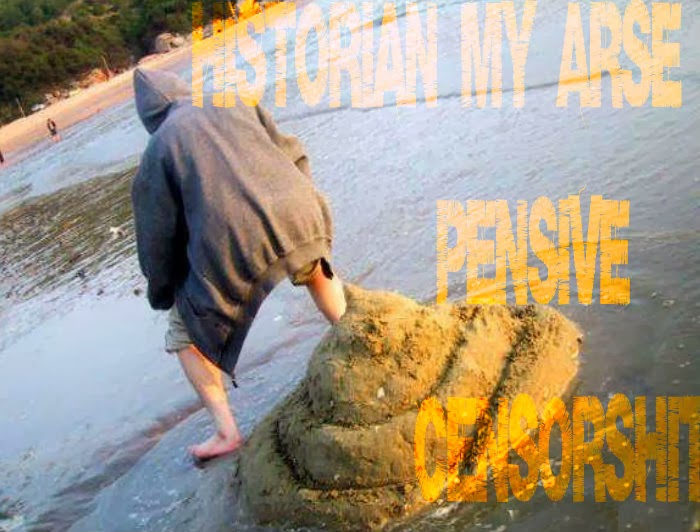
The following article found its way into my inbox unsolicited and since I and many other Irish republicans are censored by Fascist Stalinism with regard to debating it, I present the picture above as my opinions on the matter. MI5 destroyed the British Left, at a critical time by creating endless passionate division, with ego driven revisionist polemics. As I have said before, Opinions are like Arseholes, everyone has got one and nobody has a monopoly on the truth !

SOME HARD QUESTIONS FOR SERIOUS REPUBLICANS

FRIDAY, JULY 18, 2014 AM

Guest writer Liam O'Ruairc poses a number of serious questions to contemporary republican thought.

There are a number of hard questions republicans should pay more attention to and discuss more thoroughly. The first one is the concept of the nation. For Des Dalton:

The Republican position is based on the premise of the existence of the historic Irish nation. Documents issuing from the Irish College in Louvain, in what is now Belgium, 400 years ago used terms ‘naisiun’ with regard to Ireland and ‘Eireannach’ instead of ‘Gael’ and ‘Gael-Ghael’ in reference to an Irish person. We are not a revolted colony nor as Thomas Davis said ‘a sandbank thrown up by caprice of wind and wave’, but an ancient people. - (Sinn Fein President address university conference, Saoirse, April 2014).
But what is this ‘historic Irish nation’? In Des Dalton’s speech, it appears as a quasi-biological entity. But there is nothing natural about the nation. One has to ask if the nation is a product of nationalism rather than the other way around. Like Irish republicanism is an ‘invented tradition’, the Irish nation is an ‘imagined community’.

Far from being ‘ancient’ it is a product of modernity. It is no accident that the documents from the Irish College in Leuven mentioned by Dalton are the first printed Irish ones; as Benedict Anderson has shown the development of nationalism is dependent upon things like printing. The issue of how many nations there are in Ireland is also a vexed question. On the basis of six different frameworks it is possible to answer that question with anything from zero to three. (Michael Gallagher (1995), How many nations are there in Ireland? Ethnic and Racial Studies, 18 :4, 715-739).

It is interesting to note that in a letter to the Freeman’s Journal of 20 June 1916, Father Michael O’Flanagan (vice-president of Sinn Fein from 1917 and president of the party in 1933-35) wrote :


Geography has worked hard to make one nation out of Ireland; history has worked against it. The island of Ireland and the national unit of Ireland simply do not coincide. In the last analysis the test of nationality is the wish of the people.

O’Flanagan concluded by stating that as Antrim and Down looked to London as "the centre of their patriotic enthusiasm", it would be wrong to compel them to love the rest of Ireland by force.

A tentative republican concept of the nation would be a political community organised around universal values. All cultural and ethnic aspects are subordinate to the political one. It is not based on the so-called rights of an allegedly ‘ancient people’ but on universal values. (Terry Eagleton, Nationalism and the Case of Ireland, New Left Review, Issue 234, March-April 1999). It is no accident that under UN laws of self-determination, the international community has opted to define the ‘self’ entitled to self-determination in terms of a territorial criterion rather than an ethnic or cultural one.

Which brings us to the second hard question; that of the relation between nation and state. There are currently 195 independent states, 60 dependent areas and 5 disputed territories in the world; but if every nation was to be entitled its own state there would be hundreds more. While the nationalist militant writes about the ‘eternal nation’ the materialist historian only writes about how the idea of the nation can mobilise certain social groups at specific times and how this can in exceptional circumstances lead to the formation of a state. The island of Ireland is divided between two states, but there is nothing that entitles it automatically to one state -Hispaniola, Tierra del Fuego, Borneo, New Guinea and St Martin are also cases of islands under divided sovereignty. Republican Sinn Fein organised a campaign last year on "Derry is an Irish City" – "Derry is as Irish as Cork, Dublin or Belfast". (We must prove ourselves worthy of the historic title deeds of nationality, Saoirse, September 2013).

In a geographical sense Doire is an Irish city, however there is nothing anomalous with Londonderry being constitutionally part of the United Kingdom. The reconcilation of southern Irish nationalist identities with the 26 Counties state rather than a 32 Counties one should also be emphasized. In the early 1960s, Eamon de Valera commented that 'France was France without Alsace and Lorraine, Ireland is Ireland without the north.' (quoted in : John M. Regan (2007), Southern Irish Nationalism as a Historical Problem, The Historical Journal, 50 :1, 218).

Republicans have not paid sufficient attention to the issue of a growing proportion of people seeing the Irish nation as co-extensive with the 26 Counties. In 1988 Danny Morrison declared:


People of the 26 Counties that don’t want the 6 Counties, let us know. If they’re telling us to fuck off, telling us they’re happy with the state they’ve got and fuck 1916, then tell us … If they think the’ve got an Irish nation inside the 26 counties they should build a wall and lock us out. » (quoted in : Henry Patterson, The Politics of Illusion : Republicanism and Socialism in Modern Ireland, London : Hutchinson Radius, 1989, 206).

‘Tell us’ and ‘let us know’ got its answer in 1998 when the people of the 26 counties voted 94.4% in favour of the Nineteenth Amendment of the Constitution Bill, partition if not embraced was recognised.

If 26 counties voters have effectively ‘built a wall’ and ‘locked out’ the six counties, it is also worth noting that the republican struggle in the north was much more a case of "ghetto corporatism" (Henry Patterson, op.cit., 207) and specific northern phenomenon than a national project. In 1989, Danny Morrison was arguing that:


the IRA doesn’t claim to be representing the people in the 26 Counties … the IRA isn’t killing people in the name of the people of Limerick or Dublin.

In 1993 Morrison wrote from prison that 'no one I know in this jail has lifted a gun or planted a bomb in the name of the people of the 26 Counties.' (quoted in : Brian Hanley, Attitudes to the IRA in the Irish Republic since 1969, Irish Historical Studies, 38 :151, May 2013, 455). With re-unification now a low-intensity aspiration in the 6 Counties and the reconciliation of a sufficient proportion of nationalists to its state institutions, partitionist identities have never been stronger. The difference between nation and state has not lead to a legitimacy crisis for state institutions either north or south of the border.

The third difficult question is that of self-determination. Who has the right to self-determination and what is the legitimate unit for its exercise? (Michael Gallagher (1990) Do Ulster Unionists have a right to self-determination? Irish Political Studies, 5 :1, 11-30) The prevailing interpretation of the principle of self-determination is that it is the right of the majority to establish an independent state within any area administered as a political entity by a colonial power. For republicans, Northern Ireland was an artificially created entity; its genesis was illegitimate not merely because it partitioned the island but because of the particular boundaries drawn. Consequently Northern Ireland’s inclusion within the United Kingdom constitutes a denial of the right to self-determination of the majority within the island. But after the 1998 Belfast Agreement in terms of international law it is no longer possible to argue that London denies the Irish people the right to self-determination:


Both the Irish and British governments have accepted Northern Ireland as the appropriate unit for the exercise of the right of self-determination based on the principle of consent. As the Good Friday Agreement and subsequent referendums firmly established, there will be no change in the legal status of the jurisdiction unless such changes are premised in a majority democratic vote by referendum. In short, the historical claims of alien occupation, or a de facto war of national liberation is likely to be dismissed in the Northern Ireland context. (Fionnuala Ni Aolain, The Politics of Force, Belfast : The Blackstaff Press, 2000, 237)
Post-Belfast Agreement it is difficult to argue in terms of international law that self-determination is denied to the Irish people or that there is still a conflict about it. The problem for republicans is to prove that the 32 counties is the legitimate unit for self-determination. How can the 32 counties be the legitimate unit when the 6 counties is the internationally recognised one? Some say that partition was ‘artificial’ therefore implying that a united Ireland is somehow ‘natural’. But:


There is much to substantiate tbe Irish nationalist claims…that the administrative boundaries of the Irish colonial state constituted the obvious historical (not natural) unit within which the exercise of self-determination should be decided. (Joe Cleary, Literature, Partition and the Nation State, Cambridge University Press, 2002, 34)

How one can move from the historical unit to the legal unit is still to be determined.

Some serious thinking by republicans is required on the concept of nation, the relation between nation and state, who has the right to self-determination and what is the legitimate unit for its exercise and on what grounds. But above all, how do these issues relate to emancipatory politics and the project of universal liberation and freedom? If they are not connected to something universal, then the national question in Ireland becomes just another border dispute and is no more significant than say the South Tyrol problem or the issue of the Comoros islands. What Edward W. Said said in a Palestinian context also applies to an Irish one:

It struck me as implicit in the Palestinian struggle … that we from the very beginning as a movement said that we were not interested in another separatist nationalism. That’s when I joined the movement. We were not interested in just anothern nationalism, resisting theirs in order to have ours, that we were going to be the mirror image of them … But rather that we are talking about an alternative in which the discriminations made on the basis of race and religion and national origin would be transcended by something that we called liberation. That’s reflected in the name of the Palestine Liberation Organisation. That, it seems to me, is the essence of resistance. It’s not stubbornly putting your foot in the door, but opening the window. (Edward W.Said, The Pen and the Sword : Conversations with David Barsamian, Edinburgh : AK Press, 1994, 165-166)

How to ‘open the window’ should be the first thing on the agenda for Irish republicans today.


Posted in: Irish nationalism,republican thought

Email ThisBlogThis!Share to TwitterShare to Facebook


Newer PostOlder PostHome


5 comments:

larry hughes says:
10:26 AM, July 18, 2014Reply


Interesting article. Certainly there was greater movement of people centuries ago than we may be conscious of. At the time of the Flight of the Earls 1607 Spain were building Intramuros in Manila, Philippines (begun 1606) which were a stronger, more expansive and a significantly more robust version of Derry's Walls (1613-18). The Spanish were also in the process of conquering Latin America and the Irish Earls turned their back on Ireland after the Nine Years War to seek their fortunes with the Spanish and French Catholic forces. (Today they'd just enter Stormont). Throw into the mix that there was never a unified Irish nation under any single leader up to this time and the idea of nationhood is something of a myth.

Brehon laws existed but institutions or authority of rule over a unified state never did. Advanced nationalism after the Famine created the idea of a Gaelic Ireland in response to the popularity of Queen Victoria's visit in 1849 when the Famine wasn't even over. This was done in much the same way as Sir Walter Scott 'invented' Scottish national identity incorporating Highland tartan and kilts and bagpipes into the modern notion of a Scots culture.

Rather than unionists/loyalists retreating into an ever decreasing area in isolation from the rest of the island it might be better in advance to study the likes of Switzerland and Belgium where they seem to have managed different national and religious aspirations very successfully. The idea of loyalist Gaza strip type geographical area in Ireland is a ridiculous notion, but unfortunately something the Unionist 'leadership' are well capable of contemplating.

Maybe with regard to the size of an area feasible for designation as a nation, this might be relevant to Israel just now; trying to reduce Palestine to almost zero.

ozzy says:
11:00 AM, July 18, 2014Reply


Well Tyrone ( the County Council) voted itself out of the 6 Counties in 1922..The Unionists ignored this attempt at self determination..This act alone undermines the 6 County credability.As for the GFA. The people in Ireland were told from a very young age, that Ireland, South Africa and Palestine would never have peace.
So, it is no surprise that they voted yes. But that cannot be seen as a vote on articles 2 and 3. Or a rejection of same.
In the Irish Times of 2011 over 56% of the Free State are in favour of a UI.With about 20-odd % don't knows and an even smaller 20-odd % in favour of partition.

As for articles 2 and 3 The Free State never had any intention of acting on them..So Why is their loss significant?.Oh If the Free State bought some SU-35 Jets from Russia, Some S-300 missiles. some tanks, Bullets, etc..Then Articles 2 and 3 may be significant.
But the "Irish Army" is a joke outfit in terms of equipment.
Has the Free State even used soft power with regards articles 2 and 3?
I don't recall ever reading any attempts at using these at the UN for instance.
In short I never give much thought to them.
Where we are now, seems to be where we have been since 1922..The vast majority of Irish people don't seem to favour partition but no one seems to know how to end it.
That I think sums it up.

Fionnuala Perry says:
3:39 PM, July 18, 2014Reply


A challenging piece that poses a lot of complex questions.
Not to intentionally single Moriison out, but his name was mentioned several times in the piece!
Five years after that quote he was complicit in bringing about all that he allegedly found so repugnant.
Not from a position he would have undoubtedly like to have been in, more a position of ( big Gerry is our true God and there will be no false ones before him.),
They could worship money and power of course, as the leader had well and truly succumbed to that.
Nationalism was reduced to a by product and all power was thrown behind this sorry excuse for a state.

Fionnuala Perry says:
3:52 PM, July 18, 2014Reply


Apologies, if my comment was slightly off thread in relation to this piece which presents a lot of question, that as Liam says needs to be given serious consideration.not least, the whole idea that the 'six counties' now enjoys International recognition.
I wonder, how those who poured the cement over the guns and the cracks in their own principles would answer this Enigma given the fact they profess to be on course for Unification??

Michael Craig says:
6:19 PM, July 18, 2014Reply


A very interesting discussion, but how many will take any note of it.
U.I. under capitalism will make absolutely no diference to my life, neither will patriotism, or even identifying myself with a 'nation'.
I find this part of the article of most interest;

' A tentative republican concept of the nation would be a political community organised around universal values. All cultural and ethnic aspects are subordinate to the political one. '

Even at my age I'm still trying to work out what is meant by 'culture'. I enjoy opera and classical music, reading and conversation, to me this is culture. I can enjoy this no matter what my nationality.

Wednesday, 5 February 2014

PENSIVE CENSORSHIT

How can a Censor Offender be a trustworthy Historian ????


THE BELFAST PROJECT AND THE FUTURE OF ORAL HISTORY PROJECTS

Brooke Gladstone interviews Anthony McIntyre and Jack Dunn. The transcipt initially featured in Boston College Subpoena News on 4 February 2014.

On The MediaWNYC
National Public Radio
31 January 2014

Begun in 2000, the Belfast Project was an oral history project that aimed to document combatants’ stories in the clashes between the Irish Republican Army and the Ulster Volunteer Force in the 1970s through the 1990s. But the charged nature of what interviewees told the project has brought immense pressure on the project’s organizers to release records of the interviews, which they’d promised to keep secret. Brooke talks with Anthony McIntyre who recorded many of the interviews for the project.


THE BELFAST PROJECT
Brook Gladstone: It seems that oral histories are generally ignored unless they make history. The Belfast Project is an archive of taped recollections of members of the Provisional Irish Republican Army and the Irish Loyalist Army [sic] who warred against each other from the 70s into the 90s.

News Report: The bomb blew apart the Horse and Groom pub in Guildford killing five people and injuring 50 more. An hour later another pub 200 yards up the road was also bombed. Then a month later at Woolwich in South London another soldiers’ pub was bombed and two people were killed.

BG: They were promised that their stories would stay secret until after their deaths. That promise was broken this month aggravating a wound that has never healed despite 15 years of peace. Some thirty five hundred people were killed in Ireland’s so called time of troubles. The Belfast Project intended to preserve the IRA stories inside the Boston College Library. But when reports emerged about the substance of two of the interviews the British government used the Mutual Legal Assistance between the US and the UK to obtain them and much more. In particular the British authorities wanted access to interviews that touched on the unsolved murder of Jean McConville.

News Report: Jean McConville’s abduction, torture, murder and secret burial by the IRA nearly 40 years ago leaves many unanswered questions. The mother of ten’s body was dumped on a County Louth beach and despite extensive searches was only found in 2003 by a passing walker.

Beth McMurtrie, whose magisterial piece about the Belfast Project ran recently in theChronicle of Higher Education, called McConville’s case a uniquely tragic atrocity. The widowed mother of ten was dragged from her house in front of her then kids in 1972 and murdered as a suspected informer. Among the interviews archived in the Belfast project are some that implicate Gerry Adams, leader of the Sinn Fein party, often called the IRA’s political wing.

Anthony McIntyre whose credentials include a PhD in political science began recording the oral histories in the spring of 2001, for nearly six years collecting 26 interviews with IRA members, people who had every reason to trust him.

AM: I served a life sentence for IRA activity including the killing of a member of the Ulster Volunteer Force. And I have been involved … in the hunger strikes back in 1981 and 1980. And on the blanket protest along with Bobby Sands. I first went to prison when I was 16 and released when I was 18. I returned to prison when I was 18 and was released when I was 35. And I was known to these people to be trustworthy.

BG: What promises did you make to them?

AM: that these interviews would not be released until their death or with their consent prior to that. And that neither the Provisional IRA nor the British state would be allowed to access those interviews.

BG: One of your interviewees, Brendan Hughes, died and a book came out by your collaborator on the project, journalist Ed Moloney. In the book Brendan Hughes figured prominently. He told you that Gerry Adams was involved in the murder of Jean McConville, something that Adams has denied. Here is a little bit of Brendan Hughes’ tape.

I never carried out a major operation without the OK or the order from Gerry. And for him to sit in his plush office in Westminster or Stormont or wherever, and deny it … I mean it is like Hitler denying that there was ever a Holocaust.
AM: Well, during the course of the interview, Brendan revealed a lot of his life in the IRA. Gerry Adams was his operational commander in Belfast, and that Gerry Adams had ordered the killing of Jean McConville, had ordered the London bombings and had ordered a lot of IRA activity. Brendan Hughes and Gerry Adams were very close comrades in the IRA back in the day.

BG: Boston College having been confronted with this order to turn over the entire archive calls it a victory that it doesn’t have to turn the whole thing over, only eleven documents.

AM: What Boston College secured was a minimising of the defeat. That is what we secured. The state seemed to have a view that ‘we were dealing with pushover professors and we will get anything we want out of them.’ And they weren’t far wrong.

BG: Pushover professors?

AM: Yes.

BG: And they weren’t very far wrong you were saying?

AM: No, they weren’t very far wrong. There should never have been a discussion about whether we do this or we don’t. They should have been straight out of the traps and said ‘We will face this head on.’

BG: Hmm Hmm.

AM: Rather Boston College were transmitting messages to the Justice Department and law enforcement that ‘we are willing to fold if you give us the right opportunity.’ But unfortunately for Boston College, myself, my wife, and Ed Moloney decided to stand and fight. And because we fought Boston College then were embarrassed.

BG: Okay. Let’s, let’s consider the arguments on both sides of this issue. The British Secretary of State for Northern Ireland said in a special on CNN that nobody is above the law:

News Report featuring Owen Paterson: We have been quite clear as a government there can be no concept of an amnesty. So, we have to support the police in bringing those who committed crimes to justice.
AM: That’s fine. What he actually means is that nobody outside law enforcement is above the law. Because the British authorities have withheld vital information from the relatives of the murdered human rights lawyer, Pat Finucane, murdered by agents of the British state. The British state have withheld vital documents from the victims and families of the people killed in the Dublin Monaghan bombings in May 1974.

BG: I hear what you are saying. That they are, they are having a double standard.

AM: Well, absolutely. But I mean people in Boston and America should know about British double standards from the War of Independence out there …

BG: (laughs)

AM: So I don’t think you should be too surprised about British double standards.

BG: Okay then. The argument for the lawyer for the McConville family says that the wounds of the troubles can never heal while injustice like the murder of Mrs McConville is allowed to fester.

AM: I have a great deal of sympathy for the lawyer’s sentiment and I have enormous sympathy for the family of Jean McConville and the family of any person killed. But it is not the task of a researcher to become a gatherer of evidence for law enforcement. Even for clergy men – now one can argue that researchers produce knowledge and clergymen produce nonsense …

BG: (laughs)

AM: …, yet clergymen are allowed to maintain confidentiality and researchers aren’t. It seems to me to be a bizarre situation. There are certain obstacles that have to stand in the way of the state for the betterment of society. And I think that academics and journalists need to be protected from this sort of encroachment and incursion. If the only view of society that we have, the only view of the past is that of law enforcement we will learn very little from it.

BG: But how can it really effect policy and improve somebody’s life if you don’t get to look into it until thirty years hence and the people who committed the wrongdoing on both sides of the struggle are never brought to account.

AM: Well, I mean we have a situation in the North where the British Prime Minister, Tony Blair, said that the Criminal Justice system had to be turned on its head in order to bring about the Good Friday Agreement. Basically politics in the North of Ireland did trump justice. And it has also trumped truth.

Truth in the North of Ireland is used for recrimination not for reconciliation. They want to use it to – yesterday’s issues to fight the political battles of today.

This information wasn’t gathered by ourselves as researchers to hand over to relatives. Because people are simply going to clam up. All the knowledge that could have been brought to the families at some point under a variety of processes about truth recovery and the past has now been sabotaged by this issue.

It is very sad that the McConvilles cannot get the truth. I think that the McConville family are behaving nobly and honourably. It’s just that I represent a different constituency of knowledge and ‘ne’er the twain shall meet.’

BG: Ed Moloney, your colleague in the Belfast Project, has said that the release of the tapes could endanger your life. Do you really think that’s a realistic concern?

AM: I am going to see people coming for me even when they are not coming for me...

BG: (laughs)

AM: ... because I am in the eye of the storm and I am sensitive. Former colleagues can be very vitriolic and bitter. Some of them with great audacity and chutzpah …

BG: (laughs) …

AM: ... who many of us have for a long time suspected of being informers are now calling the participants of the Boston College project informers. It’s a load of old hooey. But we must be very cautious. But if you are asking me do I live under the bed fearful that I am going to be attacked imminently? No I don’t.

BG: Anthony McIntyre is an independent scholar. 


THE FUTURE OF ORAL HISTORY PROJECTS

Brooke speaks with Jack Dunn, the Director of the Boston College News and Public Affairs office about what Boston College has done to protect the tapes from the Belfast Project and the future of academic oral history projects.
BG: Jack Dunn is the director of the news and public affairs office at Boston College. He says Boston College did everything in its power to protect the interviews.

JD: We hired the best lawyer available to fight the subpoenas and we won a significant court case that reduced the number of recorded materials from 85 to 11 interviews that were ultimately required to go over to the Police Services of Northern Ireland.

BG: McIntyre says that rather than lobbying politicians to protect the manuscripts the College instead set about undermining him and Moloney. Now you claim, I think, that the comments by McIntyre and Moloney hurt your efforts to protect …

JD: Oh they did.

BG: … the manuscript.

JD: What happened is the first subpoena occurred shortly after Ed Moloney published his book Voices from the Grave and after his video of the same name was released in Ireland. There is no doubt in our mind that the children of Jean McConville – who are victims themselves in this – they heard that there was a university that had in its archives recordings of conversations with IRA members that could shed light on their mother’s murder. So they apparently sought the help of the Police Services of Northern Ireland to issue a subpoena to the United States. And then to our astonishment Ed Moloney said in interviews in American newspapers that Boston College should burn the tapes and that sort of rhetoric that we might somehow burn materials which is something no university would ever consider, no doubt prompted the second subpoena.

BG: McIntyre says that the loss to history of this whole episode is very grave: it irreparably harms the possibility that people will really know what happened during the Troubles. And Boston College should have had the courage to stand up and engage in an act of civil disobedience.

JD: It is just a clash of cultures between an American university that is obviously going to be respondent to a US court subpoena and an individual from Northern Ireland with a long, criminal record who just seems to have a utter disregard for the legal process and a suspicion of any authority.

BG: What about the issue of the loss to history?

JD: The shame of it is that Anthony conducted the interviews with the IRA members and those who have heard the tapes said his work was very weak. Kevin O’Neill Boston College said that he was stunned by how leading the questions were.

BG: You feel he conducted shoddy interviews?

JD: A lot of critics such as Danny Morrison, a former IRA member himself, have been critical of Anthony McIntyre suggesting that he interviewed only people who held the same viewpoint that he did, people who would be critical of Gerry Adams.

BG: McIntyre has pushed back and said that the efforts by the Irish police to get the tape is part of a campaign against Gerry Adams. So everyone is charging this is a campaign against Gerry Adams. But perhaps not admissible as evidence. Right?

JD: Probably not. I think Mr McIntyre and I would agree on that, that the information would probably not have value in a court of law. As we all have pointed out one of the great ironies is that Boston College in this very Burns Library holds the recordings of the conversations that led to the various paramilitary groups laying down their arms. And the condition is they will not be available to anyone for thirty years. The Police Services of Northern Ireland have gone after the tapes of the IRA members but never requested the tapes of UVF members.

BG: Has Boston College changed its procedures for gathering oral histories?

JD: I think everyone in the world will change the way they undertake oral histories. When this project began in 200o everyone followed the Colombia University model which said oral histories really wouldn’t be subject to Institutional Review Board. I think that has changed. There would certainly be a heightened scrutiny today. All of the participants entered into this agreement with good intentions. Some good came of it. Clearly mistakes were made on all four of the parties involved. And the reality is that the promise of the Belfast project has been lessened. The political reality clearly got in the way and now I think we have all learned a need for heightened caution as anyone embarks on such a project.

BG: Jack, thank you very much.

JD: Thank you for having me.

BG: Jack Dunn directs the News and Public Affairs office at Boston College.


10 comments:

10:38 AM, February 05, 2014Reply
AM, I don't know you but I greatly admire you, without coming across as a sycophant, it takes a great deal of balls to do what you do, and if it wasn't for yourself Tommy McKearney and Gorman, Gerard Hodgins and others fuck knows were we'd be.
I 've got to ask you however regarding Jean mcConville what else could be done with her? The whole disappearing lark is counter-productive nonsense acting more like the mafia than a revolutionary army, but regarding touts what else could be done? We all know now the one ordering the executions were the biggest touts, but back then how where the volunteers who carried out their orders supposed to know that?
while as a human being I have greatest sympathy with any grieving family members, I just think given the circumstances your generation faced you all had to face serious moral dilemmas, which for what its worth I thought the p.i.r.a volunteers handled well.
Volunteers will always be heroes in my eyes and i think in the quest for justice noble as it is, we could demonise our own. Cause lets face it mein furher will never be held accountable.
It is a thorny issue which I think on the whole you handle well and bravely, I just worry that in our quest to show what the leadership was actually like we could make problems for past volunteers who I think should be treated with the greatest respect, that's my bit for what it's worth
11:02 AM, February 05, 2014Reply
Important and valuable work Anthony. No doubt some bias may have slipped in but overall from my perspective your integrity is in tact on this historical project.
11:05 AM, February 05, 2014Reply
David,

you are right. In conflict of this type spies get killed. Although we now know that the spy catchers contained more than a few spies in their midst. And many of those killed on the basis of what real spies judged them to be, can no longer be regarded as spies. Or at least they deserve the benefit of the doubt. Could republicans ever risk relying on that treacherous combination of Stakeknife and P O'Neill?

Given Jean McConville's circumstances they could as easily have put her out of the country.

The war crime dimension of it lies in the process of secretly burying her and keeping her disappeared for decades. So there is no way the allegation of war crime could be levelled at all involved.

Outside of wanton cruelty I can think of reasons for that, but none that would be compelling.

And there is always the dilemma that comes with applying a peace time moral calculus to actions carried out during a war.

On this type of matter I have never reached a position I am comfortable with. I put out views here and people come along and challenge them and if I find them as having merit they act as a form of corrective to my thinking. There are no gurus here nor do we want there to be.

While I might have arrived at it very late in the day I think there is an onus on us to avoid war rather than seek to wage it just because we can.
11:24 AM, February 05, 2014Reply
Will Danny Morrison now be so stupid as to cite Jack Dunn to back up his own hatred of the oral history project?
11:28 AM, February 05, 2014Reply
HJ,

on the matter of bias, while your point is sound, there will be more shortly that will help explain this and give the lie to the Dunn rubbish.
11:30 AM, February 05, 2014Reply
Boyne Rover,

you mean as stupid as Jack Dunn to have ever cited him to begin with? Of course he will be that stupid. I will bet my house on it. And then I will watch his house fall like a deck of cards.

But keep watching this space!
1:53 PM, February 05, 2014Reply
AM

You and Ed must feel a terrible sense of betrayal at the hands of Boston College with its "pushover professors" and O'Neill, the head librarian who forgot to make some rather essential enquiries. Protected clergy you certainly are not, just unholy historians and journalists. I wonder if any American institution of higher learning would have had the guts to reject attempts by the PSNI to snatch tapes from your highly sensitive collection. Doubtful. If Boston College was embarrassed, as you say, so be it. Boston, and the whole country for that matter, has all but forgotten the arrogant grip of the British and the sacrifices necessary to create a republic: a highly flawed, unwieldy republic, but a republic nonetheless. As for Northern Ireland, politics has indeed trumped justice. Would that it were otherwise, but that's the reality, and maybe the necessity, at this juncture, at this time which allows more dispassionate consideration of what was most definitely a war.
2:07 PM, February 05, 2014Reply
I look forward to the next instalment AM.

It's extremely difficult to avoid a certain bias in qualitative research. It's only in the last year or two since 'Clean Language' techniques have been adapted and applied in research interviews that the potential to avoid all bias has been achieved, I'm of the opinion some bias is unavoidable unless 'CL' is used.
With regards to the featured article, there is some bit of 'ad hominem' misdirection in JD's comments, not so skilled in masking his own biases or prejudices, is he?
2:33 PM, February 05, 2014Reply
Morrison and Dunn = Bangers and Mush
AM says:
3:14 PM, February 05, 2014Reply


Michael,

and to add insult to injury Dunn is now calling us criminals. What a cretin.

The Canadian academics could teach them a lesson. Some good work coming out of there. If you don't push back in these issues you will get pushed under the bus as my wife says.

HJ,

I wonder if too much is lost as a result of clean language. My view of oral history is that it should be a conversation and ultimately the listener has to be able to hear it all rather than just a sanitised version of what the researcher wants to put out. The listener can then decide how much the interviewer shaped the interview. I think any question by definition has to be leading. It must lead somewhere or there is little point in asking it. That would be different from a loaded question. I think you are right to say it is 'extremely difficult to avoid a certain bias in qualitative research.' I wonder should we even try.

As for JD, when you and other readers read these so called leading questions and what Kevin O'Neill actually wrote you are free to make up your own mind about Dunn's use of Kevin O'Neill.