Showing posts with label brit. Show all posts

Saturday, 16 May 2015

RECOVERY FROM THE BRIT PROVO SWASTIKA


From experience, I have learned, that no one has a monopoly on the truth, including myself, that is why I detest censorship, along with political internment, which has been used so much, by the Blueshirts, up to the present day revisionist provos, to enforce the Bad Friday Agreement, for the British. In ancient Athens, they might spend days, discussing among themselves, some moot point, in order to ascertain the truth of the matter. Today the time factor of contemporary life, is often used to censor ongoing debate. It is coming up to the anniversary of Ray McCreesh, another particular hunger striker, with whom I feel a particular affinity, because of local history. 

After the death of Bobby and Francis, there were elements of the stickies, who were strong in Newry, still going around the housing estates of the people of no property in Newry, pulling young lads, who supported the hunger strike, into vans such as the above, (photo connected with Dublin, sent to me by a friend). Don't get me wrong, there were many good people with positive contributions, from the Officials but they certainly had elements like todays provos, that remind me of recent events in Belfast. 

They would go around the estates in their van, and pull young lads, who supported the Hunger Strikers, into the back of the van and give them a beating. They would justify it on spurious grounds, like some sort of anti-social behavior. They were simply spirited young lads, who were rebels, who simply needed to have a chat about a  better ways to rebel and needed to be listened to, who often had a drop too much of the Buckfast, supplemented with valium. 

This is what the present day provies in collaboration with the RUC/psni seem to be doing today. This started to change after the death of Raymond McCreesh. I honestly believe, some form of dialogue, needs to be initiated with these youth and they need to be patiently listened to. They have much to offer but are being manipulated for political reasons by British Intellegence and their collaborators. Perhaps if they were invited to some voluntary meetings of the 12 fucked steps on the right of this post, organized by some genuine Irish people, as opposed to British collaborators, it might be a start. I qualify this by saying, that communities may be forced, to give a clear warning to heroin dealers before any action is taken, to leave and go somewhere else, to get treatment, that the present Stormont Junta, does not provide. It requires a lot of patience, listening to talking heads, to hear the essence of the Spirit of Freedom.


The Perfection of Truth

by Gil Fronsdal

Without a commitment to truth there is no Buddhist path. Dharma is a synonym for truth and Dharma practice is synonymous with living a life of truth. In Buddhist mythology, it is said that, in his many lifetimes of training, the Buddha-to-be never lied. While there are stories in which he transgressed other ethical precepts, his dedication to truthfulness was unwavering.

One of the primary characteristics of psychologically or spiritually mature people is that they never lie to themselves. Being honest with oneself is a prerequisite to personal growth and a genuine liberation of the heart. This is so important that we can safely say, as an absolute truth in Buddhist practice, that deceiving oneself is never acceptable. Serious practitioners strive to be impeccably honest with themselves.

Truth brings inner peace by overcoming the conflicts and turmoil we carry within our own minds. Truth can bring an inner security that frees us from neurotically defending, apologizing for, hating, or hiding ourselves from ourselves. Truth can also help overcome conflict between people, as we have seen with the profound work done by South Africa’s Truth and Reconciliation Commission.

Truth is not the same as facts. Facts alone carry no power whereas truth does. Mahatma Gandhi expressed this in coining the term “satyagraha” or “the power of truth.” (Inspired by Gandhi, Martin Luther King translated truth as “soul,” and satyagraha became “Soul Power” in the American civil rights movement of the 1950’s and 60’s.)

A variety of forces come together to give truth its power. One is the force of inner purity and calm that can only be found in truth and honesty. Another is the confidence that comes with knowing what is true. Yet another is the strength of the good intentions that stand behind speaking the truth. Still another is the way that truth makes reconciliation and forgiveness possible. And finally there is the impact of the many beautiful qualities of heart released when truth helps liberate us from fear, hatred, or greed.

One place we see the power of truth is in AA and other twelve-step meetings. AA may have saved more lives than any other spiritual tradition in our modern times. It insists that alcoholics tell the truth. By admitting their powerlessness over the addiction and making a careful moral inventory, alcoholics learn how to use the truth to release themselves from their compulsions.

Buddhism also uses truth as a way to find release from clinging and the suffering that ensues. The Four Noble Truths are not meant to be truths in the sense of a creed that a Buddhist must believe. They are pragmatic truths, much like how it is true that if you cut yourself deeply with a knife, you will hurt and if you keep the wound clean, you promote its healing. The Four Noble Truths is the Buddha’s way of saying that, if you cling or grasp to anything, you will suffer; if you let go of that clinging, that suffering will end. The Four Noble Truths have no value in the abstract. They are verified through direct experience, by discovering how to be directly honest about our suffering and its causes.

The need for personal honesty is the reason that Buddhist practice depends on mindfulness. Mindfulness is sometimes defined as the practice of being honest about what is happening in the present moment. The awesome freedom and profound peace toward which the Buddhist path moves has nothing to do with how much we know, whom we know, how rich, smart, or beautiful we are, or who admires or even loves us. Rather, this path has everything to do with telling ourselves the truth and, in doing so, becoming a true person.

Through mindfulness we discover a truth that is deeper than beliefs. These truths will transform our character, our deepest sense of being. What we say and do comes to be in harmony with who we are. If we donĂ­t become someone who is true, we have no peace nor freedom. When our life is firmly based on truth, peace is not something we have-it is who we are.

Friday, 20 March 2015

SAINT PADDY WAS A BRIT


The homeless executive - part of Dublin City Council, spend in the region of €100 million euros every year on 'homeless services'. Yet tonight, children and adults will be handed a sleeping bag and told to sleep in the parks. The emergency number for beds is turning people away saying there are no beds and there is great uncertainty. Meantime 600 dwellings belonging to Dublin City Council lie empty as well as hundreds of council houses and flats that are boarded up waiting to be demolished for 'rejuvenation' that may never take place.

These residences need to be opened up immediately and refurbished so as people can be afforded their very basic human rights. So what happens the €100 million? How much is spent on fat cat salaries? How many of these so called non government organisations that receive the grants actually spend it on the homeless and ending homelessness?? These charity organisations are simply carrying out Government remits and they employ hundreds of individuals with the money that needs to be spent directly on the homeless. The 'economy of the poor', the 'economy of the homeless' is solely for the benefit and upkeep of the many agencies that are now falling foul of their original intention and their christian duty. They are in effect 'poverty pimps' and an arm of Government and have simply agency captured a lucrative market for their own pseudo sentimentalized, spiritualized culture. The housing of people is not a charity and never can be, it is a fundamental human and civil right. Open up the boarded up houses in our country, cities and towns and give the people a home.Greece's PM Tsipras Accelerates Russia Meetup

Mannix Flynn

US lawmakers told of ‘dishonourable silence’ over acts of collusion in Troubles


Author Anne Cadwallader testifies before congressional panel on ‘Glennane’ killings
Simon Carswell

Congressman Brendan Boyle, a member of the Commission on Security and Cooperation in Europe on Capitol Hill, described Anne Cadwallader’s evidence of collusion as “overwhelming”.
There has been “dishonourable silence” from the British government on evidence of deep collusion between the Northern Ireland security forces and Loyalist paramilitaries during the Troubles revealed in an investigative book, its author has told a US congressional panel.

Anne Cadwallader, a former journalist and researcher with human rights group, the Pat Finucane Centre, testified before the Commission on Security and Cooperation inEurope on Capitol Hill, discussing the findings in her 2013 book, Lethal Allies: British Collusion in Ireland.


The book covers the murders of more than 120 people from 1972 to 1978 in counties Tyrone, Armagh and Monaghan, providing evidence that Loyalists killers were helped by members of the Royal Ulster Constabulary and the Ulster Defence Regiment.

The murders were linked to the Glennane Gang in Tyrone and Mid-Ulster, a region that became known as the “Murder Triangle” during the 1970s because of the number of murders carried out on Catholics.


Ms Cadwallader testified before the committee, also known as the Helsinki Commission, about a bomb attack on the Step Inn bar in Keady, Co Armagh in August 1976 that killed two Catholics, mother of three Elizabeth McDonald (38) and Gerard McGleenan (22).

She told the committee that a paper trail has been found showing that the bomb was made, transported and detonated with the active involvement of members of the RUC, the police and the British Army.

“To this day, no one in authority has ever gone to any of the bereaved families or the injured to acknowledge the state’s involvement in these horrific crimes,” she told the committee. “The papers establishing the state’s guilt lay for over 30 years in locked police archives. Those who knew at the highest levels, and I mean the highest levels, must have hoped they would never be discovered.”

There has been “deafening silence” from the London government since her book was published, she said.

“It is, in my view, a most shabby, unworthy and dishonourable silence. The guilty silence of a disgraced establishment that hasn’t the courage to face the truth,” she said.

Ms Cadwallader appeared with Geraldine Finucane, widow of solicitor Pat Finucane who was murdered by Loyalists in 1989, and Kieran McEvoy, a law professor at Queen’s University Belfast.

The Pat Finucane Centre wants the British government to release all records showing collusion between the security forces and Loyalists and a public inquiry to be held into Mr Finucane’s killing.

The committee’s chairman, Congressman Chris Smith, remarked that the British government’s reputation had been tarnished by the refusal to hold a public inquiry into Mr Finucane’s murder and his committee was “not gonna let up” until all the information about the killing is “laid bare” and the people responsible are held to account.

“It is bewildering how a mature democracy like the United Kingdom could be so obstinate in not letting this information out,” said Mr Smith, who was chairing his 15th hearing since 1997 on human rights in Northern Ireland, nine of which involved members of the Finucane family providing testimony.

Congressman Brendan Boyle, a member of the commission, described Ms Cadwallader’s evidence of collusion as “overwhelming”.

“It’s time for Britain to finally deal openly and honestly with this issue and release all of the evidence,” he said.

Greek Prime Minister Alexis Tsipras reschedules meeting visit with Russian President Vladimir Putin for 8 April. Does this mean the indebted eurozone state could be the next Eurasian Economic Union member soon?


Greece Sailing Toward Eurasian Economic Union


Desperate for cash, and playing all the cards in his hands, Greece's newly elected PM is in a pinch. Having vowed to end austerity in his country, Tsipras is "all in" in a forieign policy game of high stakes poker between Greece, the EU, and unlikely table partner Russia. With a final installment of a €240 billion euro bailout in the offing, Greece must have a four month extension for the broke government to carry on.

News today that Tsipras bumped up his visit to meet with Russia's president by a month seems a sure sign the EU and Greece's biggest creditor Germany are not going to budge. The hasty revamp of the PM's schedule also foretells of just how sour negotions have turned since Greece's guru of finance Yanis Varoufakis began hammering out viable debt repayment options going forward. A stoic German position, and Greece's desire to breath some fresh air outside crippling austerity has led to the current situation. The rushed Russia meetings are actually the next logical progression of economic relations gone bad. First Germany said "no", then Greece said "please", and after more "no's" the Spartans demanded their gold back from the days of Nazi Germany. Tsipras has framed the hurried meetings as necessary to relieve "stifling economic conditions" set by Europe's creditors.

Beyond the war of words between Athens and Berlin though, the Great Game is still afoot in between world powers trying to soidify and extend inluence. Russia's worst critic in the region, US diplomat Victoria Nuland flew in for hastended talks with Greece’s foreign minister, Nikos Kotzias on the hurry up the other day. In the wake of that guarded discussion, Tsipras hopes tp meet with key partners in the European Commuission and with the European Central Bank tomorrow.


Alexis Tsipras - via FrangiscoDer and Creative Commons

This news, the latest up card in Greece's hand, will play out in front of German Chancellor Merkel in a meeting in Berlin on Monday next. With Nikos Kotzias having openly questioned EU sanctions agains Russia because of its annexation of Crimea, it's a safe bet Merkel, US President Barack Obama, and Vladimir Putin understand Greece and Tsipras (above) are no strangers to high stakes.

As for Greece dropping out of the EU and the eurozone, many experts say this is inevitable. Whether or not Alexis Tsipras and his ministers are prepared to give NATO heart palpatations by joining Putin's Eurasian Union, only time will tell. With ground breaking on the new Russia-Turkey pipeline project, and several eastern European players leaning heavily toward Russia these days, Greece going over to join Russia and the BRICs would be a foreign relations catastrophe for the western powers. If Greece does go, Bulagia, Serbia, and several others may well follow suit. On the "currency" side of things, many experts debate about the possible drachma's reintroduction if Greece dumps the euro and not the EU altogether. One big plus for Russia and rouble futures for this move would be, bargain basement export prices from Greece if their currency is devalued. The stimulus there, may just be enough to push Moscow into bailing out Athens.

This Speigel Online report frames the sitution fairly well if Russia and Greece do come to some agreement in April. Zero Hedge was spot on early in the new Greek adminitration's strategy in framing the Greek attitude at least. The point there being, with nothing much left to lose and no love lost between Greece and the EU, Russia could play out as the white knight for a country that was dealt a deadly economic blow. In the end however, all the experts are speculating today. What matters now is the last up card in this back and forth portrait of wheeling and dealing. On Russia's side? Well, this Pew Research Poll says the Greek people favor Russia over the EU 2 to 1. Looking at this report, it's also clear Russia's reputation is not as bad as the American perspective suggests. Even after a massive negative media onslaught these last 14 months the world tone on Russia is as equally postive as it is negative. This is actually fabulous if you're Putin and being assailed.

In the end it all comes down to Greece's leaer though. As a politician, Tsipras could do a lot worse than giving his people what they ask for.

Monday, 19 May 2014

STATE OF CLOCKWORK ORANGE BRIT BRAIN OCCUPIED SCUM


A Clockwork Orange

From Wikipedia, the free encyclopedia
This article is about the novel. For the film, see A Clockwork Orange (film). For other uses, see A Clockwork Orange (disambiguation).
A Clockwork Orange
Clockwork orange.jpg
Dust jacket from the first edition
AuthorAnthony Burgess
CountryUnited Kingdom
LanguageEnglish/Nadsat
GenreScience-fictionNovellaSatire,Dystopian fiction
Published1962 (William Heinemann, UK)
Media typePrint (hardback & paperback) & audio book (cassetteCD)
Pages192 pages (hardback edition) &
176 pages (paperback edition)
ISBN0-434-09800-0
OCLC4205836


A Clockwork Orange is a dystopian novellaby Anthony Burgess published in 1962. Set in a not-so-distant future English society that has a culture of extreme youth violence, the novel's teenage protagonist, Alex, narrates his violent exploits and his experiences with state authorities intent on reforming him.[1] When the state undertakes to reform Alex—to "redeem" him—the novel asks, "At what cost?". The book is partially written in a Russian-influenced argot called "Nadsat". According to Burgess it was a jeu d'esprit written in just three weeks.[2]

In 2005, A Clockwork Orange was included onTime magazine's list of the 100 best English-language novels written since 1923,[3] and it was named by Modern Library and its readers as one of the 100 best English-language novels of the 20th century.[4] The original manuscript of the book is located at McMaster University in Hamilton, Ontario, Canada since that institution purchased the documents in 1971.[5]


Contents [hide]
1 Plot summary
1.1 Part 1: Alex's world
1.2 Part 2: The Ludovico Technique
1.3 Part 3: After prison
2 Omission of the final chapter
3 Characters
4 Analysis
4.1 Background
4.2 Title
4.3 Point of view
4.4 Use of slang
4.5 Banning and censorship history in the US
4.6 Writer's dismissal
5 Awards and nominations and rankings
6 Adaptations
6.1 Music
7 Release details
8 See also
9 References
10 Further reading
11 External links


Plot summary[edit]
Part 1: Alex's world[edit]

Alex, a teenager living in near-future dystopian England, leads his gang on a night of opportunistic, random "ultra-violence". Alex's friends ("droogs" in the novel's Anglo-Russianslang, 'Nadsat') are: Dim, a slow-witted bruiser who is the gang's muscle; Georgie, an ambitious second-in-command; and Pete, who mostly plays along as the droogs indulge their taste for ultra-violence. Characterized as a sociopath and a hardened juvenile delinquent, Alex is also intelligent and quick-witted, with sophisticated taste in music, being particularly fond of Beethoven, referred to as "Lovely Ludwig Van".

The novel begins with the droogs sitting in their favorite hangout (the Korova Milk Bar), drinking "milk-plus", a drink consisting of milk, prodded with the customer's choice of certain drugs, including "vellocet", "synthemesc", or "drencrom" (which is what Alex and his droogs were drinking, according to Alex's own first-person narration). This drug, referred to as "knives", would "sharpen you up", as it did for Alex, in preparation of the night's mayhem. They assault a scholar walking home from the public library, rob a store, leaving the owner and his wife bloodied and unconscious, stomp a panhandling derelict, then scuffle with a rival gang. Joyriding through the countryside in a stolen car, they break into an isolated cottage and maul the young couple living there, beating the husband and raping his wife. In a metafictional touch, the husband is a writer working on a manuscript called "A Clockwork Orange," and Alex contemptuously reads out a paragraph that states the novel's main theme before shredding the manuscript. Back at the milk bar, Alex punishes Dim for some crude behaviour, and strains within the gang become apparent. At home in his dreary flat, Alex plays classical music at top volume while fantasizing about more orgiastic violence.

Alex skips school the next day. Following an unexpected visit from P. R. Deltoid, his "post-corrective advisor," Alex meets a pair of ten-year-old girls and takes them back to his parents' flat, where he serves them scotch and soda, injects himself with hard drugs, and then rapes them. That evening, Alex finds his droogs in a mutinous mood. Georgie challenges Alex for leadership of the gang, demanding that they pull a "man-sized" job. Alex quells the rebellion by slashing Dim's hand and fighting with Georgie, then in a show of generosity takes them to a bar, where Alex insists on following through on Georgie's idea to burgle the home of a wealthy old woman. The break-in starts as farce and ends in tragic pathos, as Alex's attack kills the elderly woman. His escape is blocked by an attack by Dim, as payback for the earlier fight, leaving Alex incapacitated on the front step when the police arrive.
Part 2: The Ludovico Technique[edit]

Sentenced to prison for murder, Alex gets a job at the Wing chapel playing religious music on the stereo before and after services as well as during the singing of hymns. The prison chaplain mistakes Alex's Bible studies for stirrings of faith (Alex is actually reading Scripture for the violent passages). After Alex's fellow cellmates blame him for beating a troublesome cellmate to death, he agrees to undergo an experimental behaviour-modification treatment called the Ludovico Technique. The technique is a form of aversion therapy in which Alex receives an injection that makes him feel sick while watching graphically violent films, eventually conditioning him to suffer crippling bouts of nausea at the mere thought of violence. As an unintended consequence, the soundtrack to one of the films —Beethoven's Ninth Symphony — renders Alex unable to listen to his beloved classical music.

The effectiveness of the technique is demonstrated to a group of VIPs, who watch as Alex collapses before a walloping bully, and abases himself before a scantily-clad young woman whose presence has aroused his predatory sexual inclinations. Although the prison chaplain accuses the state of stripping Alex of free will, the government officials on the scene are pleased with the results and Alex is released into society early as a result.
Part 3: After prison[edit]

Since his parents are now renting his room to a lodger, Alex wanders the streets homeless. He enters a public library where he hopes to learn a painless way to commit suicide. There, he accidentally encounters the old scholar he assaulted earlier in the book, who, keen on revenge, beats Alex with the help of his friends. The policemen who come to Alex's rescue turn out to be none other than Dim and former gang rival Billyboy. The two policemen take Alex outside of town and beat him up. Dazed and bloodied, Alex collapses at the door of an isolated cottage, realizing too late that it is the house he and his droogs invaded in the first part of the story. Because the gang wore masks during the assault, the writer does not recognize Alex. The writer, whose name is revealed as F. Alexander, shelters Alex and questions him about the conditioning. During this sequence, it is revealed that Mrs. Alexander died of injuries inflicted during the gang-rape, while her husband has decided to continue living "where her fragrant memory persists" despite the horrid memories. Alex reveals in his description that he has been conditioned to feel intolerable deathly nausea on hearing certain classical music. Alexander, a critic of the government, intends to use Alex's therapy as a symbol of state brutality and thereby prevent the incumbent government from being re-elected, but a careless Alex soon inadvertently reveals that he was the ringleader during the night two years ago. Frightened for his own safety, Alex blurts out a confession to the writer's radical associates after they remove him from F. Alexander's home. Instead of protecting him, however, they imprison Alex in a dreary flat not far from his parents' residence. They pretend to leave, and then while he is sleeping in a locked bedroom subject him to a relentless barrage of classical music, prompting him to attemptsuicide by leaping from a high window.

Alex wakes up in a hospital, where he is courted by government officials anxious to counter the bad publicity created by his suicide attempt. With Alexander placed in a mental institution, Alex is offered a well-paying job if he agrees to side with the government. As photographers snap pictures, Alex daydreams of orgiastic violence and reflects upon the news that his Ludovico conditioning has been reversed as part of his recovery: "I was cured, all right".

In the final chapter, Alex finds himself half-heartedly preparing for yet another night of crime with a new trio of droogs. After a chance encounter with Pete, who has reformed and married, Alex finds himself taking less and less pleasure in acts of senseless violence. He begins contemplating giving up crime himself to become a productive member of society and start a family of his own, while reflecting on the notion that his own children will be just as destructive—if not more so—than he himself.
Omission of the final chapter[edit]

The book has three parts, each with seven chapters. Burgess has stated that the total of 21 chapters was an intentional nod to the age of 21 being recognised as a milestone in human maturation. The 21st chapter was omitted from the editions published in the United States prior to 1986.[6] In the introduction to the updated American text (these newer editions include the missing 21st chapter), Burgess explains that when he first brought the book to an American publisher, he was told that U.S. audiences would never go for the final chapter, in which Alex sees the error of his ways, decides he has lost all energy for and thrill from violence and resolves to turn his life around (a slow-ripening but classic moment of metanoia—the moment at which one's protagonist realises that everything he thought he knew was wrong).

At the American publisher's insistence, Burgess allowed their editors to cut the redeeming final chapter from the U.S. version, so that the tale would end on a darker note, with Alex succumbing to his violent, reckless nature—an ending which the publisher insisted would be 'more realistic' and appealing to a U.S. audience. The film adaptation, directed byStanley Kubrick, is based on the American edition of the book (which Burgess considered to be "badly flawed"). Kubrick called Chapter 21 "an extra chapter" and claimed[7] that he had not read the original version until he had virtually finished the screenplay, and that he had never given serious consideration to using it. In Kubrick's opinion, the final chapter was unconvincing and inconsistent with the book.
Characters[edit]
Alex: The novel's anti-hero and leader among his droogs. He often refers to himself as "Your Humble Narrator". (Having seduced two girls in his bedroom, Alex refers to himself as "Alexander the Large" while ravishing them; this was later the basis for Alex's claimed surname DeLarge in the 1971 film.)
George or Georgie: Effectively Alex's greedy second-in-command. Georgie attempts to undermine Alex's status as leader of the gang. He is later killed during a botched robbery, while Alex is in prison.
Pete: The most rational and least violent member of the gang. He is the only one who doesn't take particular sides when the droogs fight among themselves. He later meets and marries a girl, renouncing his old ways and even losing his former (Nadsat) speech patterns. A chance encounter with Pete in the final chapter influences Alex to realize that he grows bored with violence and recognises that human energy is better expended on creation than destruction.[8]
Dim: An idiotic and thoroughly gormless member of the gang, persistently condescended to by Alex, but respected to some extent by his droogs for his formidable fighting abilities, his weapon of choice being a length of bike chain. He later becomes apolice officer, exacting his revenge on Alex for the abuse he once suffered under his command.
P. R. Deltoid: A criminal rehabilitation social worker assigned the task of keeping Alex on the straight and narrow. He seemingly has no clue about dealing with young people, and is devoid of empathy or understanding for his troublesome charge. Indeed, when Alex is arrested for murdering an old woman, and then ferociously beaten by several police officers, Deltoid simply spits on him.
The prison chaplain: The character who first questions whether it's moral to turn a violent person into a behavioural automaton who can make no choice in such matters. This is the only character who is truly concerned about Alex's welfare; he is not taken seriously by Alex, though. (He is nicknamed by Alex "prison charlie" or "chaplin", possibly an allusion to Charlie Chaplin.)
Billyboy: A rival of Alex's. Early on in the story, Alex and his droogs battle Billyboy and his droogs, which ends abruptly when the police arrive. Later, after Alex is released from prison, Billyboy (along with Dim, who like Billyboy has become a police officer) rescue Alex from a mob, then subsequently beat him, in a location out of town.
The prison governor: The man who decides to let Alex "choose" to be the first reformed by the Ludovico technique.
The Minister of the Interior, or the Inferior, as Alex refers to him. The government high-official who is determined that Ludovico's technique will be used to cut recidivism.
Dr. Branom: Brodsky's colleague and co-developer of the Ludovico technique. He appears friendly and almost paternal towards Alex at first, before forcing him into the theatre and what Alex calls the "chair of torture".
Dr. Brodsky: The scientist and co-developer of the "Ludovico technique". He seems much more passive than Branom, and says considerably less.
F. Alexander: An author who was in the process of typing his magnum opus A Clockwork Orange, when Alex and his droogs broke into his house, beat him, tore up his work and then brutally gang-raped his wife, which caused her subsequent death. He is left deeply scarred by these events, and when he encounters Alex two years later he uses him as a guinea pig in a sadistic experiment intended to prove the Ludovico technique unsound.
Cat Woman: An indirectly named woman who blocks Alex's gang's entrance scheme, and threatens to shoot Alex and set her cats on him if he doesn't leave. After Alex breaks into her house, she fights with him, ordering her cats to join the melee, but reprimands Alex for fighting them off. She sustains a fatal blow to the head during the scuffle.
Analysis[edit]
Background[edit]

A Clockwork Orange was written in Hove, then a senescent seaside town.[9] Burgess had arrived back in Britain after his stint abroad to see that much had changed. A youth culture had grown, including coffee bars, pop music and teenage gangs.[10] England was gripped by fears over juvenile delinquency.[9] Burgess claimed that the novel's inspiration was his first wife Lynne's beating by a gang of drunk American servicemen stationed in England during World War II. She subsequently miscarried.[9][11] In its investigation of free will, the book's target is ostensibly the concept of behaviourism, pioneered by such figures as B. F. Skinner.[12]

Burgess later stated that he wrote the book in three weeks.[9]
Title[edit]

Burgess gave three possible origins for the title:
He had overheard the phrase "as queer as a clockwork orange" in a London pub in 1945 and assumed it was a Cockney expression.[citation needed] In Clockwork Marmalade, an essay published in the Listener in 1972, he said that he had heard the phrase several times since that occasion. He also explained the title in response to a question from William Everson on the television programme, Camera Three in 1972, "Well, the title has a very different meaning but only to a particular generation of London Cockneys. It's a phrase which I heard many years ago and so fell in love with, I wanted to use it, the title of the book. But the phrase itself I did not make up. The phrase "as queer as a clockwork orange" is good old East London slang and it didn't seem to me necessary to explain it. Now, obviously, I have to give it an extra meaning. I've implied an extra dimension. I've implied the junction of the organic, the lively, the sweet – in other words, life, the orange – and the mechanical, the cold, the disciplined. I've brought them together in this kind of oxymoron, this sour-sweet word."[13][14] However, no other record of the expression being used before 1962 has ever appeared.[15] Kingsley Amisnotes in his Memoirs (1991) that no trace of it appears in Eric Partridge's Dictionary of Historical Slang.
His second explanation was that it was a pun on the Malay word orang, meaning "man." The novel contains no other Malay words or links.[15]
In a prefatory note to A Clockwork Orange: A Play with Music, he wrote that the title was a metaphor for "...an organic entity, full of juice and sweetness and agreeable odour, being turned into a mechanism."[15]

In his essay, "Clockwork Oranges,"[citation needed] Burgess asserts that "this title would be appropriate for a story about the application of Pavlovian or mechanical laws to an organism which, like a fruit, was capable of colour and sweetness." This title alludes to the protagonist's positively conditioned responses to feelings of evil which prevent the exercise of his free will. To induce this conditioning, the protagonist is subjected to a technique in which violent scenes displayed on screen, which he is forced to watch, are systematically paired with negative stimulation in the form of nausea and "feelings of terror" caused by anemetic medicine administered just before the presentation of the films.
Point of view[edit]

A Clockwork Orange is written using a narrative first-person singular perspective of a seemingly biased and unreliable narrator. The protagonist, Alex, never justifies his actions in the narration, giving a sense that he is somewhat sincere; a narrator who, as unlikeable as he may attempt to seem, evokes pity from the reader by telling of his unending suffering, and later through his realisation that the cycle will never end. Alex's perspective is effective in that the way that he describes events is easy to relate to, even if the situations themselves are not.
Use of slang[edit]
Main article: Nadsat

The book, narrated by Alex, contains many words in a slang argot which Burgess invented for the book, called Nadsat. It is a mix of modified Slavic words, rhyming slang, derived Russian (like baboochka), and words invented by Burgess himself. For instance, these terms have the following meanings in Nadsat: droog = friend; korova = cow; gulliver('golova') = head; malchick or malchickiwick = boy; soomka = sack or bag; Bog = God;khorosho ('horrorshow') = good; prestoopnick = criminal; rooka ('rooker') = hand; cal = crap; veck ('chelloveck') = man or guy; litso = face; malenky = little; and so on. ComparePolari.

One of Alex's doctors explains the language to a colleague as "odd bits of old rhyming slang; a bit of gypsy talk, too. But most of the roots are Slav propaganda. Subliminalpenetration." Some words are not derived from anything, but merely easy to guess, e.g. 'in-out, in-out' or 'the old in-out' means sexual intercourse. Cutter, however, means 'money,' because 'cutter' rhymes with 'bread-and-butter'; this is rhyming slang, which is intended to be impenetrable to outsiders (especially eavesdropping policemen). Additionally, slang like Appypolly loggy (Apology) seems to derive from school boy slang. This reflects Alex's age of 15.

In the first edition of the book, no key was provided, and the reader was left to interpret the meaning from the context. In his appendix to the restored edition, Burgess explained that the slang would keep the book from seeming dated, and served to muffle "the raw response of pornography" from the acts of violence. Furthermore, in a novel where a form ofbrainwashing plays a role, the narrative itself brainwashes the reader into understanding Nadsat.[citation needed] The fact that the reader is forced to buy a Russian dictionary, also forms part of the brainwashing.

The term "ultraviolence," referring to excessive and/or unjustified violence, was coined by Burgess in the book, which includes the phrase "do the ultra-violent." The term's association with aesthetic violence has led to its use in the media.[16][17][18][19]
Banning and censorship history in the US[edit]

In 1976, A Clockwork Orange was removed from an Aurora, Colorado high school because of "objectionable language". A year later in 1977 it was removed from high school classrooms in Westport, Massachusetts over similar concerns with "objectionable" language. In 1982, it was removed from two Anniston, Alabama libraries, later to be reinstated on a restricted basis. Also, in 1973 a bookseller was arrested for selling the novel. Charges were later dropped.[20] However, each of these instances came after the release of Stanley Kubrick's popular 1971 film adaptation of A Clockwork Orange, itself the subject of much controversy.
Writer's dismissal[edit]

Burgess in 1986

In 1985, Burgess published Flame into Being: The Life and Work of D. H. Lawrence, and while discussing Lady Chatterley's Lover in his biography, Burgess compared that novel's notoriety with A Clockwork Orange: "We all suffer from the popular desire to make the known notorious. The book I am best known for, or only known for, is a novel I am prepared to repudiate: written a quarter of a century ago, ajeu d'esprit knocked off for money in three weeks, it became known as the raw material for a film which seemed to glorify sex and violence. The film made it easy for readers of the book to misunderstand what it was about, and the misunderstanding will pursue me until I die. I should not have written the book because of this danger of misinterpretation, and the same may be said of Lawrence and Lady Chatterley's Lover."[21] Burgess also dismissed A Clockwork Orange as "too didactic to be artistic".[22]
Awards and nominations and rankings[edit]
1983 – Prometheus Award (Preliminary Nominee)
1999 – Prometheus Award (Nomination)
2002 – Prometheus Award (Nomination)
2003 – Prometheus Award (Nomination)
2006 – Prometheus Award (Nomination)[23]
2008 – Prometheus Award (Hall of Fame Award)

The novel was chosen by Time magazine as one of the 100 best English-language novels from 1923 to 2005.[24]
Adaptations[edit]

Stanley Kubrick film version'stheatrical release poster by Bill Gold

The best known adaptation of the novel to other forms is the 1971 film A Clockwork Orange by Stanley Kubrick, starring Malcolm McDowell as Alex.[25]

A 1965 film by Andy Warhol entitled Vinyl [26] was an adaptation of Burgess' novel.

After Kubrick's film was released, Burgess wrote a stage play titled A Clockwork Orange. In it, Dr. Branom defects from the psychiatric clinic when he grasps that the aversion therapy has destroyed Alex's ability to enjoy music. The play restores the novel's original ending.[citation needed]

In 1988, a German adaptation of A Clockwork Orange at the intimate theatre of Bad Godesberg featured a musical score by the German punk rock band Die Toten Hosenwhich, combined with orchestral clips of Beethoven's Ninth Symphony and "other dirty melodies" (so stated by the subtitle), was released on the album Ein kleines bisschen Horrorschau. The track Hier kommt Alex became one of the band's signature songs.
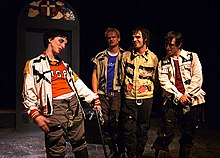
Vanessa Claire Smith, Sterling Wolfe, Michael Holmes, and Ricky Coates in Brad Mays' multi-media stage production ofA Clockwork Orange, 2003, Los Angeles. (photo: Peter Zuehlke)

Vanessa Claire Smith in Brad Mays' multi-media stage production of A Clockwork Orange, 2003, Los Angeles. (photo: Peter Zuehlke)

In February 1990, another musical version was produced at the Barbican Theatre in London by the Royal Shakespeare Company. Titled A Clockwork Orange: 2004, it received mostly negative reviews, with John Peter of The Sunday Times of London calling it "only an intellectualRocky Horror Show," and John Gross of The Sunday Telegraph calling it "a clockwork lemon." Even Burgess himself, who wrote the script based on his novel, was disappointed. According to The Evening Standard, he called the score, written by Bono and The Edge of the rock group U2, "neo-wallpaper." Burgess had originally worked alongside the director of the production, Ron Daniels, and envisioned a musical score that was entirely classical. Unhappy with the decision to abandon that score, he heavily criticised the band's experimental mix of hip hop,liturgical and gothic music. Lise Hand of The Irish Independent reported The Edge as saying that Burgess' original conception was "a score written by a novelist rather than a songwriter." Calling it "meaningless glitz," Jane Edwardes of 20/20 Magazine said that watching this production was "like being invited to an expensive French Restaurant - and being served with a Big Mac."

In 1994, Chicago's Steppenwolf Theater put on a production of A Clockwork Orange directed by Terry Kinney. The American premiere of novelist Anthony Burgess' own adaptation of his A Clockwork Orangestarred K. Todd Freeman as Alex. In 2001, UNI Theatre (Mississauga, Ontario) presented the Canadian premiere of the play under the direction of Terry Costa.[27]

In 2002, Godlight Theatre Company presented the New York Premiere adaptation of A Clockwork Orange at Manhattan Theatre Source. The production went on to play at the SoHo Playhouse (2002), Ensemble Studio Theatre (2004), 59E59 Theaters (2005) and theEdinburgh Festival Fringe (2005). While at Edinburgh, the production received rave reviews from the press while playing to sold-out audiences. The production was directed by Godlight's Artistic Director, Joe Tantalo.

In 2003, Los Angeles director Brad Mays[28] and the ARK Theatre Company[29] staged amulti-media adaptation of A Clockwork Orange,[30][31] which was named "Pick Of The Week" by the LA Weekly and nominated for three of the 2004 LA Weekly Theater Awards: Direction, Revival Production (of a 20th-century work), and Leading Female Performance.[32] Vanessa Claire Smith won Best Actress for her gender-bending portrayal of Alex, the music-loving teenage sociopath.[33] This production utilised three separate video streams outputted to seven onstage video monitors - six 19-inch and one 40-inch. In order to preserve the first-person narrative of the book, a pre-recorded video stream of Alex, "your humble narrator," was projected onto the 40-inch monitor,[34] thereby freeing the onstage character during passages which would have been awkward or impossible to sustain in the breaking of the fourth wall.[35]
Music[edit]
David Bowie referenced the book/film in various songs in his early 1970s oeuvre: "Suffragette City" mentions "droogie" in its lyrics, which is a reference to a term used in the book. Live appearances would include tracks from the soundtrack album, usually opening with Beethoven's Ninth Symphony segment "Ode To Joy" (as can be heard on live albums "Santa Monica '72" and the "Ziggy Stardust: The Motion Picture" soundtrack CD & DVD).
The English band Heaven 17 took their name from the fictional band at the 4th spot in the hit parade named by one of the girls in the scene inside the Chelsea Drugstore.
Korova was the name of a music label for which Echo and the Bunnymen and the Sound recorded during the 80's.
The music video for "The Universal", a single by English alternative rock band Blur is a tribute to the book/film, featuring the band members dressed up in costumes similar to those of Alex and the droogs.
The song "Sex and Violence" by American thrash metal band Carnivore (band) is aboutA Clockwork Orange.
The Brazilian heavy metal group Sepultura used the plot of A Clockwork Orange for their concept album A-Lex. The name of the album is a pun on the main character's name; in Latin, the expression a-lex means "without law."
Argentinian punk rock band Los Violadores wrote the song "1,2,Ultraviolento" inspired by the story.
German punk rock band Die Toten Hosen wrote an album based on A Clockwork Orange, titled Ein kleines bisschen Horrorschau or "A Tiny Bit of Horrorshow."
Metal band Slipknot's Chris Fehn and deceased Paul Gray's masks refer to the masks in the movie. Chris Fehn also stated that the self-titled album Slipknot is the unwritten soundtrack to the book. The songs on the album are said to reflect what is going on in Alex's head.
American industrial rock band The Electric Hellfire Club referenced the book, and movie in many of their songs, including the track "Ultraviolence".
English punk rock band the Adicts became known for their "droog" image inspired by Kubrick's movie. Their third studio album was also entitled smart alex, referring to the book's protagonist.
Rapper Cage previously rapped under the name of Alex, after the books protagonist, and he has since released the song Agent Orange which uses the title theme from the 1971 film as the beat
Arjen Anthony Lucassen's project band Star One wrote a song, the title track off the 2010 album Victims of the Modern Age, based on the novel/movie.
Rihanna sported "A Clockwork Orange"-inspired look in her music video, "You da One".
Rob Zombie's song "Never Gonna Stop (The Red Red Kroovy)" from the album "The Sinister Urge" has numerous references to the book, including a reference to the Durango 95, and "horrorshow". The video follows the theme and is a direct homage to the movie.
In her unreleased song "Hundred Dollar Bill," Lana Del Rey references the book: "Cause I love your ultra-violent swing, I like it when you treat me mean." In 2013, Lana Del Rey also announced that her new album would be titled "Ultraviolence."

Saturday, 22 February 2014

TALKING HEADS OUTSIDE THE BOX RUSSELL BRAND


Russell Brand is OUTSIDE THE BOX and this is why YOU SHOULD BE!
***** JOIN THE AWAKENING *****
www.russellbrand.tv www.davidicke.com www.infowars.com 


Talking Heads

From Wikipedia, the free encyclopedia
Talking Heads
Talking Heads band1.jpg
Talking Heads performing at the Horseshoe Tavern in Toronto, Ontario, Canada on May 13, 1978
Background information
OriginNew York City, United States
GenresNew wavepost-punkdance-rockart punkexperimental rock,funk
Years active1975–1991 (reunion: 2002)
LabelsSire/Warner Bros. RecordsEMI
Associated actsTom Tom ClubThe Modern LoversBrian Eno
Past membersDavid Byrne
Chris Frantz
Tina Weymouth
Jerry Harrison
Talking Heads were an American new wave band formed in 1975 in New York City[1] and active until 1991. The band comprised David Byrne (lead vocals and guitar), Chris Frantz (drums and backing vocals), Tina Weymouth (bass and backing vocals) and Jerry Harrison (keyboards, guitar, and backing vocals). Other musicians also regularly made appearances in concert and on the group's albums. The new wave style of Talking Heads combined elements ofpunk rockart rock, avant-garde, popfunkworld music, and Americana. Frontman and songwriter David Byrne contributed whimsical, esoteric lyrics to the band's songs, and emphasized their showmanship through various multimedia projects and performances.
Critic Stephen Thomas Erlewine describes Talking Heads as being "one of the most critically acclaimed bands of the '80s, while managing to earn several pop hits."[2] In 2002, the band was inducted into the Rock and Roll Hall of Fame. Four of the band's albums appeared on Rolling Stone magazine's 2003 list of the 500 Greatest Albums of All Time, and the Channel 4 100 Greatest Albums poll listed one album (Fear of Music) at number 76. On a 2011 update of Rolling Stone's "100 Greatest Artists of All Time", the band was ranked at No. 100.[3]


1974–1977: First years


Talking Heads at Horseshoe Tavern, Toronto in 1978
David Byrne, Chris Frantz and Tina Weymouth were alumni of theRhode Island School of Design in Providence, Rhode Island. There Byrne and Frantz formed a band called "The Artistics" in 1974.[4]Weymouth was Frantz's girlfriend and often provided the band with transportation. The Artistics dissolved within a year, and the three moved to New York, eventually sharing a communal loft.[5] Unable to find a bass player in New York City, Frantz encouraged Weymouth to learn to play bass by listening to Suzi Quatro albums.[6] They played their first gig as "Talking Heads" opening for the Ramones at CBGBon June 20, 1975.[1]
In a later interview, Weymouth recalled how the group chose the name Talking Heads: "A friend had found the name in the TV Guide, which explained the term used by TV studios to describe a head-and-shoulder shot of a person talking as 'all content, no action.' It fit."[7]
Later in 1975, the trio recorded a series of demos for CBS, but the band was not signed to the label. They quickly drew a following and were signed to Sire Records in 1977. The group released their first single, "Love → Building on Fire" in February of that year. In March 1977, they added Jerry Harrison (keyboards, guitar, backing vocals), formerly of Jonathan Richman's band The Modern Lovers.
Their first album, Talking Heads: 77, which did not contain the earlier single, was released soon thereafter.


1978–1982: Building a reputation


Tina Weymouth on bass in Minneapolis, Minn.
It was with their second album, 1978's More Songs About Buildings and Food that the band began its long-term collaboration with producer Brian Eno, who had previously worked with Roxy MusicDavid BowieJohn Caleand Robert Fripp; the title of Eno's 1977 song "King's Lead Hat" is an anagram of the band's name. Eno's unusual style meshed well with the group's artistic sensibilities, and they began to explore an increasingly diverse range of musical directions, from post-punk to new wave to psychedelic funk.[8] This recording also established the band's long term recording studio relationship with the famous Compass Point Studios inNassau, Bahamas. "Psycho Killer", from the debut album, had been a minor hit. More Songs... cover of Al Green's "Take Me to the River" broke Talking Heads into general public consciousness, and gave the band their firstBillboard Top 30 hit. [8]
The Eno-Talking Heads experimentation continued with 1979's Fear of Music, which flirted with the darker stylings of post-punk rock, mixed with white funkadelia and subliminal references to the geopolitical instability of the late 1970s. [9] Music journalist Simon Reynolds cited Fear of Music as representing the Eno-Talking Heads collaboration "at its most mutually fruitful and equitable."[10] The single "Life During Wartime" produced the catchphrase, "This ain't no party, this ain't no disco."[citation needed] The song refers to the Mudd Club and CBGB, two popular New York nightclubs of the time.
1980's Remain in Light, heavily influenced by the afrobeat of Nigerian bandleader Fela Kuti, to whose music Eno had introduced the band, explored West African polyrhythms, weaving these together with Arabic music from North Africa, disco funk, and 'found' voices.[11] These combinations foreshadowed Byrne's later interest in world music. In order to perform these more complex arrangements the band toured with an expanded group that included Adrian Belew and Bernie Worrell, among others, first at theHeatwave festival in August, and later in their concert film Stop Making Sense. During this period, Tina Weymouth and Chris Frantz also formed a commercially successful splinter group, the hip-hop influencedTom Tom Club, and Harrison released his first solo album, The Red and the Black. Likewise, Byrne – in collaboration with Eno – released My Life in the Bush of Ghosts, which incorporated world music, 'found' sounds, and included a number of other prominent international and post-punk musicians. All were released by Sire.
The Remain in Light album's lead single, "Once in a Lifetime", became a Top 20 hit in the UK but initially failed to make an impression upon its release in the band's own country. But it grew into a popular standard over the next few years on the strength of its music video.[12]
After releasing four albums in barely four years, the group went into hiatus and nearly three years passed before their next release, although Frantz and Weymouth continued to record with the Tom Tom Club. In the meantime, Talking Heads released a live album, The Name of This Band Is Talking Heads, toured the United States and Europe as an eight-piece group, and parted ways with Eno, [13] who went on to produce albums with U2.

1983–1991: Height of commercial success and break-up


As David Byrne experimented with world music and brought extra percussionists on tour, Chris Frantz and Tina Weymouth formed the dance group Tom Tom Club. They are pictured here performing in 1986.
1983 saw the release of Speaking in Tongues, a commercial breakthrough that produced the band's only American Top 10 hit, "Burning Down the House". Once again, a striking video was inescapable owing to its heavy rotation on MTV. The following tour was documented in Jonathan Demme'sStop Making Sense, which generated another live album of the same name. The tour in support of Speaking in Tongues was their last.
Three more albums followed: 1985's Little Creatures (which featured the hit singles "And She Was" and "Road to Nowhere"), 1986's True Stories(Talking Heads covering all the soundtrack songs of Byrne's musical comedy film, in which the band also appeared), and 1988's Naked. The sound of Little Creatures and True Stories was much more American pop-rock, while Naked showed heavy African influence with polyrhythmic styles like those seen on Remain in Light. During that time the group was falling increasingly under David Byrne's control, and after Naked the band went on "hiatus".
It took until December 1991 for an official announcement to be made that Talking Heads had broken up. Their final release was "Sax and Violins," an original song that had appeared earlier that year on the soundtrack to Wim WendersUntil the End of the World. Only Byrne and Harrison appear in the song's video, however, lending doubt to Frantz and Weymouth's participation on the track. During this breakup period, Byrne continued his solo career, releasing Rei Momo in 1989 and The Forest in 1991. This period also saw a revived flourish from both Tom Tom Club (Boom Boom Chi Boom Boom and Dark Sneak Love Action) and Harrison (Casual Gods and Walk on Water).

1992–2002: Post break-up and final reunion


After the band's break-up, Frantz, Harrison, and Weymouth released an album as The Heads and Frantz and Weymouth have continued in Tom Tom Club. The trio are pictured here at SXSW in 2010
Despite David Byrne's lack of interest in another album, Tina Weymouth, Chris Frantz, and Jerry Harrison reunited for a one-off album called No Talking, Just Head under the name The Heads in 1996. The album featured a number of vocalists including Debbie Harry of BlondieJohnette Napolitano of Concrete BlondeAndy Partridge of XTCGordon Gano of Violent FemmesMichael Hutchence of INXSEd Kowalczyk of LiveShaun Ryder of Happy MondaysRichard Hell, and Maria McKee. The album was accompanied by a tour which featured Johnette Napolitano as the vocalist. Byrne took legal action against the rest of the band to prevent them using the name "Talking Heads", something he saw as "a pretty obvious attempt to cash in on the Talking Heads name."[14]They opted to record and tour as "The Heads". Likewise, Byrne continues his solo career.
Meanwhile, Harrison became a record producer of some note – his rĂ©sumĂ© includes the Violent Femmes'The Blind Leading the Naked, the Fine Young CannibalsThe Raw and the CookedGeneral Public'sRub It BetterCrash Test DummiesGod Shuffled His FeetLive's Mental JewelryThrowing Copper andThe Distance To HereNo Doubt's song "New" from Return of Saturn, and in 2010, work by The Black and White Years and Kenny Wayne Shepherd.
Frantz and Weymouth, who were married in 1977, had been recording on the side as Tom Tom Clubsince 1981. Tom Tom Club's self-titled debut album sold almost as well as Talking Heads themselves, leading to the band appearing in Stop Making Sense. They achieved several pop/rap hits during the dance-club cultural boom era of the early 1980s, particularly in the UK, where they still enjoy a strong fan following today. Their best-known single, "Genius of Love", has been sampled numerous times, notably onold school hip hop classic "It's Nasty (Genius of Love)" by Grandmaster Flash and on Mariah Carey's 1995 hit "Fantasy". They also have produced several artists, including Happy Mondays and Ziggy Marley. The Tom Tom Club continue to record and tour intermittently, although commercial releases have become sporadic since 1991.
The band played "Life During Wartime", "Psycho Killer" and "Burning Down the House" together on March 18, 2002, at the ceremony of their induction into the Rock and Roll Hall of Fame. However, reuniting for a concert tour is unlikely. David Byrne states: "We did have a lot of bad blood go down. That's one reason, and another is that musically we're just miles apart."[15] Weymouth, however, has been critical of Byrne, describing him as "a man incapable of returning friendship"[15] and saying that he doesn't "love" her, Frantz, and Harrison.[6]

Influence

Talking Heads have been cited as influences by many artists, including Primus,[16] Bell X1[17] andRadiohead, who took their name from the Talking Heads song "Radio Head" from the 1986 album True Stories.[18][19]

What the Songs Look Like

What the Songs Look Like: Contemporary Artists Interpret Talking Heads Songs is a visual art book, first published in 1987 by Harper & Row. The book is inspired by of the music of Talking Heads. It contains full page artworks by over fifty contemporary artists. Each work is matched with a specific Talking Heads song. The artists in the book include David Byrne, Rodney Alan GreenblatKeith HaringBarbara Kruger, and Robert Rauschenberg.[20][unreliable source?]

Discography

References

  1. Jump up to:a b Talking Heads Rock and Roll Hall of Fame, retrieved November 23, 2008
  2. Jump up^ Talking Heads biography at allmusic
  3. Jump up^ "100 Greatest Artists of All Time"Rolling Stone. Rolling Stone. 2011. Retrieved April 19, 2012.
  4. Jump up^ Gittins, Ian, Talking Heads: Once in a Lifetime : the Stories Behind Every Song, Hal Leonard Corporation, 2004, p.140 ISBN 0-634-08033-4,ISBN 978-0-634-08033-3
  5. Jump up^ Simon Reynolds. Rip It up and Start Again: Postpunk 1978–1984. Penguin books (2005) pp. 159.
  6. Jump up to:a b Tina Talks Heads, Tom Toms, and How to Succeed at Bass Without Really TryingGregory Isola, Bass Player, retrieved December 6, 2008
  7. Jump up^ Weymouth, Tina (1992). In Sand in the Vaseline (p. 12) [CD liner notes]. New York: Sire Records Company
  8. Jump up to:a b Simon Reynolds. Rip It up and Start Again: Postpunk 1978–1984. Penguin books (2005) p. 163.
  9. Jump up^ Simon Reynolds. Rip It up and Start Again: Postpunk 1978–1984. Penguin books (2005) pp. 163.
  10. Jump up^ Simon Reynolds. Rip It up and Start Again: Postpunk 1978–1984. Penguin books (2005) pp. 163–164.
  11. Jump up^ Simon Reynolds. Rip It up and Start Again: Postpunk 1978–1984. Penguin books (2005) p. 165.
  12. Jump up^ Simon Reynolds. Rip It up and Start Again: Postpunk 1978–1984. Penguin books (2005) p. 169.
  13. Jump up^ Simon Reynolds. Rip It up and Start Again: Postpunk 1978–1984. Penguin books (2005) pp. 169–170.
  14. Jump up^ Levine, Robert (June 26, 1997). "Byrne-ing Down the House"Rolling Stone. DavidByrne.com. Retrieved October 31, 2009.
  15. Jump up to:a b Blackman, Guy (February 6, 2005)."Byrning down the house"The Age (Australia). Retrieved October 3, 2009.
  16. Jump up^ Primus press release. Retrieved 2012-08-12.
  17. Jump up^ Matthew Magee (July 27, 2003). "Clear as a Bell X1"Sunday Tribune. Retrieved March 4, 2011.
  18. Jump up^ About Radiohead, biography 1992–1995
  19. Jump up^ David Byrne interviews Thom Yorke forWired (November 11, 2007)
  20. Jump up^ Talking Heads (November 25, 1987). Frank Olinsky, ed. What the Songs Look Like. Harper & Row. ISBN 978-0-06-055117-9. Retrieved July 29, 2013.

Further reading

  • David Bowman, This Must Be the Place: The Adventures of Talking Heads in the Twentieth Century(New York: HarperCollins, 2001). ISBN 0-380-97846-6.
  • David Byrne, How Music Works (San Francisco: McSweeney's, 2012). ISBN 1-936365-53-7.
  • David GansTalking Heads (New York: Avon Books, 1985). ISBN 0-380-89954-X.
  • Krista Reese, The Name of This Book is Talking Heads (London: Proteus Books, 1982). ISBN 0-86276-057-7.
  • Talking Heads and Frank Olinsky, What the Songs Look Like: Contemporary Artists Interpret Talking Heads Songs (New York: Harper & Row, 1987). ISBN 0-06-096205-4.

External links