Thursday, 8 May 2014

DARK FORCES OF GERRY ADAMS SHATTERED


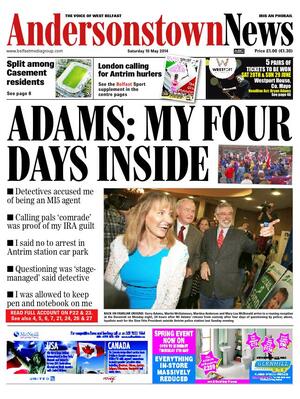
BnGbiwvIEAANU2r.jpg large“I was told that the interrogations were an evidence-gathering process, and that the police would be making the case that I was a member of the IRA; that I had a senior IRA managerial role in Belfast at the time of Jean McConville’s abduction; and that I was therefore bound to know about her killing.
I challenged my interrogators to produce the new evidential material. They said that this would happen at a later interview but they wanted to take me through my childhood, family history and so on. Over the following four days it became clear that the objective of the interviews was to get to the point where they could charge me with IRA membership and thereby link me to the McConville case. The membership charge was clearly their principal goal. The interrogators made no secret of this. At one point the male detective described their plan as “a stage-managed approach”. It later transpired that it was a phased strategy, with nine different phases.
The first phases dealt with my family history of republican activism. My own early involvement in Sinn Féin as a teenager – when it was a banned organisation. My time in the 1960s in the civil rights movement and various housing action groups in west Belfast, the pogroms of 1969 and the start of the Troubles.
It was asserted that I was guilty of IRA membership through association because of my family background – my friends. They referred to countless pieces of “open source” material that, they said, linked me to the IRA. These were anonymous newspaper articles from 1971 and 1972, photographs of Martin McGuinness and me at republican funerals, and books about the period.
If any of these claimed I was in the IRA, then that was, according to my interrogators, evidence. They consistently cast up my habit of referring to friends as “comrades”. This, they said, was evidence of IRA membership. They claimed I was turned by special branch during interrogations in Belfast’s Palace Barracks in 1972 and that I became an MI5 agent! They also spoke about the peace talks in 1972, and my periods of internment and imprisonment in Long Kesh. This was presented as “bad-character evidence…”
Gerry Adams.

NAZI ULSTER LOYALISTS BOMB PEACE PROCESS AGAIN


Alliance Party Office Bombed by Loyalists Second Time in 24 Hours


Naomi Long

Naomi Long said she would not be bullied by the recent Loyalist attacks on their premises. 
For the second time in 24 hours an office belonging to Belfast's cross-community Alliance party has been attacked by Loyalists.

The centrist Alliance party has come under sustained attack from loyalists for voting to restrict the flying of the sectarian loyalists flag over Belfast city hall.

Alliance's east Belfast MP, Naomi Long, said: "Another day, another fascist attack on our office. Martin McGuinness, claims the Loyalist Ulster Volunteer Force ARE behind the attacks on the Alliance party.

"The activities of Loyalists in east Belfast over the course of the last two years have been particularly disgraceful, criminality of the worst kind, he said. "The response of unionist leaders to the activity of these people has been inadequate and I also think the response of the police has been inadequate."


Wikipedia, encyclopedia

Historical loyalism

18th century North America

In North America, the term loyalist characterised colonists who rejected the American Revolution in favour of remaining within the empire. American loyalists included royal officials, Anglican clergymen, wealthy merchants with ties to London, demobilised British soldiers, and recent arrivals (especially from Scotland), as well as many ordinary colonists. Colonists with loyalist sympathies accounted for an estimated 20% to 30% of the white colonial population of the day, compared with those described as "Patriots", who accounted for about 40% of the population. This high level of political polarisation leads some historians to believe that the American Revolution was as much a civil war as it was a war of independence from the British Crown.[1][2][3]
British military strategy during the American Revolution relied on mobilising loyalist soldiers throughout the Thirteen Colonies. Throughout the war, the British military formed over 100[4] loyalist militia regiments. The rebels used tactics such as property confiscation to suppress loyalism and drive loyalists out of major colonial towns.[5] After the war, approximately 80% of the Loyalists stayed in the new United States, and adapted to the new conditions and changes of a republic. However, over 70,000 Loyalists sought refuge elsewhere in Lower Canada, Quebec (divided in 1791 into what is now Quebec andOntario), the Maritime provinces, Jamaica, the Bahamas and in the United Kingdom often with financial help from the Crown. Most of those who did not leave for London withGeneral Cornwallis' Army following his defeat and surrender at the Siege of Yorktown in October 1781, re-settled in the British North American Provinces of Quebec and Nova Scotia in present-day Canada. This migration also included Native American loyalists such as Mohawk leader Joseph Brant, the "Black Loyalists" – former slaves who had joined the British cause in exchange for their freedom, and Anabaptist loyalists (Mennonites).[6][7]These Loyalists are generally regarded as the founders of modern English-speaking Canada, and many of their descendants still identify themselves with the nominal hereditary title "UEL" (United Empire Loyalist) today.

18th century Ireland

The term loyalist was first used in Irish politics in the 1790s to refer to Protestant British settlers in Ireland who opposed Catholic Emancipation and Irish independence from Great Britain.[8] Prominent Irish loyalists included John Foster, John Fitzgibbon and John Beresford. In the subsequent Irish Rebellion of 1798, the term ultra loyalist was used to describe those who were opposed to the United Irishmen, who were in support of an independent Irish Republic. In 1795, Ulster loyalists founded the Orange Order and organised the Yeoman Militia, which helped to put down the rebellion. Some loyalists, such as Richard Musgrave, considered the rebellion a Catholic plot to drive Protestant colonists out of Ireland.[8]

England and Wales

During the early 19th century, nearly every English and Welsh county formed a Loyalist Association of Workers in an effort to counter a perceived threat from radical societies.[9]The first such association was founded in Westminster on 20 November 1792.

Australia

The Sydney and Parramatta Loyalist Associations, with approximately 50 members each, were formed in 1804 to counter radical societies in those counties, and subsequently helped to put down the Castle Hill convict rebellion later that year.[10][11]

Modern loyalism

Northern Ireland

Main article: Ulster loyalism
Generally, the term loyalist in Northern Ireland is typified by a militant opposition to Irish republicanism, and also often to Roman Catholicism. It stresses Ulster Protestant identity and community with its own folk heroes and events, such as the misfortunes and bravery of the 36th (Ulster) Division during World War I and the activities of the Orange Order. An Ulster loyalist is most commonly a unionist who strongly favours the political union between Great Britain and Northern Ireland, although some may also support an independent Northern Ireland.[12] In recent times, the term has been used to refer to several loyalist paramilitary groups, such as the Ulster Defence Association (UDA), Ulster Volunteer Force(UVF) and the Loyalist Volunteer Force (LVF).
Although Irish loyalists have claimed to speak on behalf of their communities and the unionist community in general, electoral results tend to suggest that their support is minimal and exclusively based in the urban working class. The Progressive Unionist Party, a pro-Belfast Agreement loyalist party, won seats in the Northern Ireland Assembly in 1998, 2003 and 2007, but lost them in 2011.

Republic of Ireland[edit]

Loyalism in the post-partition Republic of Ireland has declined since independence.[13]Many southern Irish loyalists and non-loyalists volunteered for service in the British Armed Forces in World War I and World War II, many of them losing their lives or settling in the United Kingdom after the wars.[14] Partition saw mass movements of southern loyalists to Northern Ireland or to Great Britain,[15] although loyalist or neo-unionist groups such as theReform Movement, the Border Minority Group and the Loyal Irish Union are active to this day.

Scotland[edit]

The Scottish loyalist movement originated during the Industrial Revolution when a significant number of Ulster Protestants migrated to Scotland from Ireland.[16] In Scotland, a loyalist is someone on the fringes of Scottish unionism who is often strongly supportive of loyalism and unionism, although mainly concentrating on the Irish union issue rather than on Scottish politics.[citation needed] Scottish loyalism is typified by militant opposition to Irish republicanism, Scottish independence and the Roman Catholic Church – particularly the existence of Catholic denominational schools.[citation needed]
Though only consisting of a small fraction of the Scottish population, Scottish loyalism has become more visible through prominent demonstrations of the beliefs of its members since the establishment of a Scottish Parliament. Scottish loyalism is visible through participation at Orange parades with supporters from Rangers, Heart of Midlothian F.C. and Airdrie United. Some loyalists in Scotland also support Ulster paramilitary groups.
Loyalists in Scotland mostly live in small working class enclaves in the major urban centres or industrial villages, notably Glasgow, Lanarkshire, Edinburgh, Renfrewshire, Fife, West Lothian and Ayrshire. There are relatively few loyalists in areas such as Aberdeen, theScottish Borders and the Scottish Highlands.

Wednesday, 7 May 2014

SHATTER THE DARK FORCES OF GERRY ADAMS

      
I do not endorse some of the content and language used in the linked article below. I feel using the word Jew rather than Zionist in this article is a grave error on several occasion. Some of my best friends and many of the most talented people I have known are Jewish. I personally do not believe that Alan Shatter is fair reflection of Jewish people in general. However I do believe he is a dark force in Irish politics, with a hidden agenda. That is just my opinion, I may well be wrong. He is an elected public official, paid handsomely by Irish taxpayer's hard earned money and is therefore fair game. What do you think ? I am really interested in other people's opinion on him, as other publications have been censored pending legal action. Please be aware of this when commenting, as I detest censorship of any kind, particularly of the Anthony Mcintyre, Pensive Quill variety. The linked article on him is below

 Alan Shatter Link

AGENT BLACKADDER ORDERED ARREST OF GERRY ADAMS


  • Margo_Sweetbread  comment
Sin Féin were getting uncomfortably popular in the polls........especially Gerry Adams.......Lo and behold our woeful, inept Coalition of blunderers said to themselves.."Let us make a cunning plan to destroy this abductor of our precious votes"... 
Lo and behold, again.....THE 'CUNNING' PLAN BACKFIRED bigtime...........Sin Féin/Gerry Adams more popular than ever and the Coalition of blunderers EXPOSED for the dumb hypocrites they are......even sacrificing the peace process in NI for their own GREEDY hold-on-to-their-fatcat-salaries no matter what the cost.............THE TRUTH WILL OUT 
(NB I do not support SF's stance on Abortion/Homosexual 'marriage')

Fintan O'Toole

Long after the British army’s Parachute regiment left the west Belfast estate of Ballymurphy in September 1971, one of its members, Harry McCallion, reflected with pride that “we had over 15 confirmed kills but had claimed many more . . . It was merely convenient for the IRA that most of them had not been sworn in as members.”
These “kills” had not been sworn in because they were not members of the IRA at all; they were innocent civilians. Eleven of those killed by the Paras between August 9th and August 11th, 1971, were unarmed. Among them were a Catholic priest, Fr Hugh Mullan – who was clearly carrying an improvised white flag made from a babygro – and a mother of eight children, Joan Connolly, who was shot multiple times as she went to help a wounded boy. These events happened in the chaos of the introduction of internment, when the IRA launched concerted attacks on the British base in Ballymurphy. But the evidence strongly suggests that the victims were not caught in crossfire – they were killed by enraged soldiers in what were, at best, acts of appalling recklessness and, at worst, deliberate murders.
Last week, shortly before Gerry Adams was arrested, Northern Ireland Secretary,Theresa Villiers announced there would be no independent inquiry into the Ballymurphy killings. Sinn Féin rightly pointed to the outrageous double standard implied here. But Villiers also announced that there would be no inquiry into the hideous La Mon hotel fire-bombing in 1978, when the IRA incinerated 12 members of, of all things, the Irish Collie Club. The families of the La Mon victims believe, rightly or wrongly, that transcripts of police interviews with IRA suspects relating to this disgusting crime were deliberately removed from the files in order to protect senior figures of importance for the peace process. Did Sinn Féin complain about the continuing failure to give the La Mon families the comfort of truth? Of course not – it has double standards about double standards.
The abduction, murder and disappearing of Jean McConville is an atrocity that cries out for accountability. But so were the Ballymurphy killings, the La Mon bombing, the McGurk’s Bar bombing by the UVF in which 15 people died, and murder after bloody murder. While the gunmen on all sides preened themselves with talk of “kills” and “war”, the truth is that the conflict was largely about people with guns killing people without guns. So-called republican and loyalist paramilitaries lost between them 563 members. Well over three times as many defenceless civilians were murdered (1,879) – mostly by paramilitaries but in some cases by so-called security forces in or out of uniform. The slaughter of the innocents was not a byproduct of the Troubles – it was the main event.Lingering outrage
It was not enough, though, for these poor people to die once, to be the human fuel for a conflict that careened obscenely onwards long after it had lost any semblance of logic. Like souls in Dante’s hell, they have been given an excruciating punishment;
they are recruited to fight, again and again, in the strange meta-conflict that replaced the real one – the fight over which of the perpetrators can claim the coveted status of victimhood. There is, rightly, lingering outrage about the IRA’s “disappearing” of victims like Jean McConville, the denial of a decent burial. But in a sense, most victims are still denied a decent burial. Their bodies are figuratively dug up and paraded through the streets or dumped back again into the abyss of amnesia, depending on who needs them for what political purpose. Tribal disputes are still conducted in part as a form of competitive necromancy.
There are just two decent ways of dealing with the legacy of these atrocities: all or nothing. The nothing option has a certain integrity – it at least prevents the political exploitation of the dead. But it denies to bereaved families the right to know what happened to their loved ones. The only way to counter the exploitation of the dead is to start with the most obvious thing about them – that they died horrible, untimely deaths. Death brings a terrible equality: it does not discriminate between Protestant or Catholic, uniformed policeman or masked gunman, or even between innocent and guilty. Every violent death was a rending in the fabric of the lives of spouses, children and families. Each deserves acknowledgement – not for any political purpose but for its own sake and as a condition of a civilised society.

Selective memory

If Gerry Adams had anything to do with the killing of Jean McConville, he should answer for his actions. But it would be far better if he gave those answers to an open, independent commission with a remit to investigate all unsolved killings by state forces or by paramilitary organisations. If, by design or accident, Adams seems to be singled out, while other crimes are ignored, the cycle of selective memory and selective amnesia will go on. There are no special victims and there must be no special perpetrators.


Link: ‘Shatter feels that he is above the law and should resign’ – Wallace