

I live a lot of the time, in what is regarded as a third world country, for the so called politically correct, a developing country. I have international super markets around me, with prices similar to Ireland. It does not rain for at least 4 months of the year here. I have a consistent Government piped, quality, water supply, for my 3 bedroom house of three showers and 2 bathrooms, that costs 10 euros annually in total, approximately. The people here, simply would not tolerate it being any more expensive because they have not been media washed yet ! Simple! The British cultural legacy of "Ruling by fooling" is still the norm in Ireland where the Government if it has it's way will charge an average of 1.000 euros annually for their water and licensed media. This "Ruling by fooling"culture has driven myself and millions like me out of my beloved land and away from my people! We are scattered to the extent of an 80 million diaspora across the world. For the vast majority of those who remain, the choice is simple, either indentured slavery or revolution. For those of you who agree, please share this post, because this perspective will be censored by both the BBC, RTE and most of the mainstream media.
The Irish Water debacle: why the State is heading towards being ungovernable
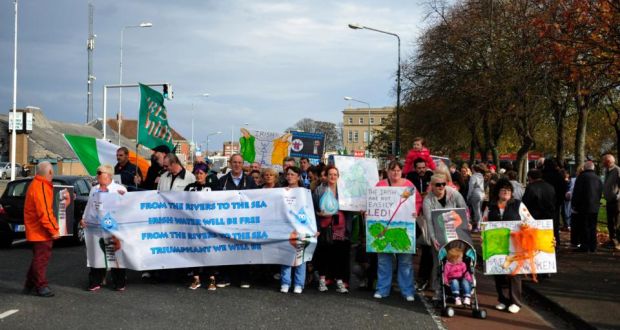
Opinion: The public revolt against water charges is about injustice, and it’s justified

Fintan O'Toole
News
Politics
First published:Tue, Nov 4, 2014, 12:01
It should be so easy. How much political brilliance does it take to persuade the population that it is necessary to change a water supply system that leaves whole cities (Galway) and almost entire counties (Roscommon) without drinkable water for long periods? That wastes through leakage half of all the expensively treated water it produces? That the State can’t do this tells us something about much more than the debacle of Irish Water. It tells us about the governability of the State itself. It would be hysterical to suggest that the State is ungovernable. But it would be naive to deny that it is heading gradually in that direction. And heading there for good reasons: a very significant part of the population has ceased to feel that the State is theirs, that it tries its best to treat them with care and dignity.
The public revolt against water charges is not, for the most part, a rebellion against the eminently sensible idea that a small State should have a single public utility to develop its water system. It’s an expression of anger about bigger things: command-and-control politics; trust-me- I’m-an-expert arrogance; rotten, feckless disregard for the realities of life at the bottom of the heap; the feeling that nobody gives a curse how you live or what you think.
It’s about injustice, and it’s justified. The recent budget was the fourth regressive budget in a row. Four times, the Government has coldly and deliberately decided to hit the weakest and poorest hardest. This has nothing to do with “austerity”. The “austerity” budgets under Fianna Fáil between 2008 and 2011 were mildly progressive – they hit the better-off harder than the worst-off. But every budget under Fine Gael and Labour (Labour!) has quietly reversed this trend. In last month’s budget, the average combined impact of the tax and welfare measures and of water charges on the lowest income households is to reduce their income by about 1 per cent. For the one-fifth of households with the highest incomes, there is a gain of about 0.5 per cent.
I use the word “quietly” with deliberation. The budget was greeted universally in the media as the end of austerity. There’s a reason for this: the Department of Finance refuses to release with its budget documents a distributional analysis of how all the combined measures will affect different income groups. This is a deliberate political policy. One of the clearest promises made in the Programme for Government was that “We will open up the budget process to the full glare of public scrutiny”. The Government may really have intended to do this – until it realised that opening the budgetary process would have revealed how decisions were being slanted against the poorest households. Better to keep it quiet and let a few eggheads do the sums afterwards.
– but it wasn’t for you. Your income is still being reduced by Government decisions right now. And of course a 1 per cent cut in the income of someone on the breadline has a vastly bigger impact on day-to-day life than on someone who’s comfortable. For those who matter least, money matters most.
Such people are quite right to feel that they live in a political world whose “reality” excludes them. This “reality” is a rhetoric of shared sacrifice that masks a deliberate programme of increasing the gaps between rich and poor. It is massive consultancy fees paid out by Irish Water and justified by Phil Hogan with the inanity that “you can’t make an omelette without breaking eggs”. It is bonuses for those who “require improvement”. It is being preached to about how we must all stop thinking of ourselves as citizens and start thinking of ourselves as customers – except, of course, when we expect actual customer services like someone to answer the phone when we call.
And if you create a political world in which many citizens are right to feel these things, the State slowly ceases to be able to function. This is what we’re seeing with the Irish Water debacle. There is nothing wrong in itself in having a single national utility to invest in a dilapidated water system. What’s wrong is that the State can’t articulate with any conviction the idea that a project like this (or any other) is being done fairly, openly, democratically and in the public interest. And in this Irish Water is a warning – a democracy that hollows out a sense of genuine common purpose slowly moves towards ungovernability. Too many people don’t believe that the State has their interests at heart. They don’t see the give-and-take of citizenship because they have experienced too much take and too little give.


 Analysis: Belfast Agreement is fragile and can be very quickly disrupted by events
Lo and behold, again.....THE 'CUNNING' PLAN BACKFIRED bigtime...........Sin Féin/Gerry Adams more popular than ever and the Coalition of blunderers EXPOSED for the dumb hypocrites they are......even sacrificing the peace process in NI for their own GREEDY hold-on-to-their-fatcat-salaries no matter what the cost.............THE TRUTH WILL OUT
(NB I do not support SF's stance on Abortion/Homosexual 'marriage')