Showing posts with label Bernadette Devlin McAliskey. Show all posts

Saturday, 24 January 2015

JE SUIS BLOODY SUNDAY Put Britain to ICC


Irish Blog has already attempted, to organize a Petition to bring Britain, before the International Criminal Court in the Hague, in the same way that the Palestinian Authority has taken Israel to the ICC. The Petition has been censored, as is Irish Blog, to a considerable extent, with intranets including Facebook, by British agents in Ireland.The Petition requires the same commitment, persistence and resistance to British interference in Ireland, as has the struggle of the last 45 years. 

People with a proven track record of integrity, such as Bernadette, Marian, Eamon, Martin, Francie, Kate and others, some of whom are not permitted by the British, to leave their own neighbourhoods, might consider organizing this initially, by a conference call, with technical help. As respected elders, with considerable experience, they could guide the mobilization of the Petition worldwide, for the sake of Unity, to overcome British elements, which will seek to divide and distract the organization of this petition throughout Ireland. I propose this, as a totally peaceful, civilized, alternative step, on the path to Irish liberation.

A successful Petition to bring Britain before the ICC for crimes against humanity in Ireland, can only be organized and mobilized effectively by a genuine party of the Irish people on the ground in Ireland, with a proven track record of integrity. I am calling on people of integrity in Ireland, to form a group along the lines of the 
H-BLOCK/ARMAGH COMMITTEE, to Petition, for Britain to be taken before the International Criminal Court in the Hague, for all it's war crimes, including genocide in Ireland, in the same manner as the Palestinian Authority is currently doing. Because of censorship, Irish Blog respectfully requests, that this proposal, is brought to the attention of those elders mentioned, for consideration by you, if you are acquainted with them. I believe this proposal, needs to transcend party politics, in order to be successful.

Bloody Sunday: Put Britain in the dock
I witnessed the events of Bloody Sunday and its violent legacy. The British government, not soldiers, should be held to account



Bernadette Devlin McAliskey

The outcome of the Saville inquiry has been published. A second British prime minister has apologised for the killing of unarmed and innocent protesters. This time the British government acknowledged the actions of members of the British army were unjustified and unjustifiable.

Prosecutions of individual foot soldiers are unlikely. Their own testimony cannot be used, and almost 40 years after the event, prosecution will raise a whole new series of concerns and debate about human rights violations oppressive litigation, and the application of the terms of the peace agreements. A respected human rights lawyer has already offered their services in prosecuting the real culprit, the British state. But Lord Saville has exonerated the state.

I was on the speaker's platform on Bloody Sunday. Despite burying the images in some deep mental archive, Bloody Sunday refuses to fade or mellow in my consciousness. Initially, disbelief gave way to fear, horror, anger, and then detachment. Finally, I was angry only with myself.

My political analysis had until then discounted any real belief – despite the long history of Anglo-Irish conflict – that the British government would countenance killing the people in order to suppress the protests. Now that it had happened, it made sense to me that it had always been going to happen and would continue; it was fundamental to the nature of the British state in Ireland. I felt I should have known that, and now I did, I was still up for the fight.

The key impact of Bloody Sunday was that a whole generation made a similar analysis and this fuelled some 25 years of violent political conflict, at least tolerated by the majority of the "minority population" and actively pursued by a significant but sustainable minority. It is responsibility for this legacy that sets Bloody Sunday apart from subsequent atrocities on all sides.

As a member of parliament at the time, I was denied the right to give parliament an eyewitness account. The home secretary,Reginald Maudling, lied to the House and the media willingly collaborated in uncritically repeating the government misrepresentation. In what was considered gross overreaction and disgracefully violent behaviour, I crossed the floor of the House and hit him.

I did not call for a public inquiry, did not welcome the Saville inquiry and only testified to respect the wishes of the bereaved families. I regret none of those things, but challenge the view that it was an expensive waste of time, energy and money. Had Bloody Sunday been no more than a violent and disgraceful overreaction or unlawful behaviour on the part of a few "squaddies" or overzealous commanders, it would not have required the British government and its military to create the complicated labyrinth of lies and deceit which has taken hundreds of testimonies, thousands of pages, millions of pounds and 38 years to unravel.

The Bloody Sunday Trust and the bereaved families have shown great stamina and courage in their quest for disclosure and truth. Respectfully, however, Bloody Sunday isn't just about the families or how the 13 individuals lost their lives that day; the 14th dying later of his wounds. It is about whether the British government committed a war crime in 1972 and in so doing started a war. It is the British government, not their anonymous and brutalised soldiers of their alphabet army who should be in the dock, at the international court of justice at The Hague. If Saville has closed that route to truth and justice, the British government will consider it worth every penny.

Had the British state been speedily held to account at The Hague, things might have been different for a lot of people, not least for nine Turkish human rights activists on their way to Gaza. They might not have been so confidently slaughtered by the state of Israel.

Tuesday, 11 November 2014

A FEW GOOD IRISH WOMEN


You can't Handle the Truth bitches - Brian Clarke


“I no longer have patience for certain things, not because I’ve become arrogant, but simply because I reached a point in my life where I do not want to waste more time with what displeases me or hurts me. I have no patience for cynicism, excessive criticism and demands of any nature. I lost the will to please those who do not like me, to love those who do not love me and to smile at those who do not want to smile at me. I no longer spend a single minute on those who lie or want to manipulate. I decided not to coexist anymore with pretense, hypocrisy, dishonesty and cheap praise. I do not tolerate selective erudition nor academic arrogance. I do not adjust either to popular gossiping. I hate conflict and comparisons. I believe in a world of opposites and that’s why I avoid people with rigid and inflexible personalities. In friendship I dislike the lack of loyalty and betrayal. I do not get along with those who do not know how to give a compliment or a word of encouragement.

 Exaggerations bore me and I have difficulty accepting those who do not like animals. And on top of everything I have no patience for anyone who does not deserve my patience.” _ Meryl Streep quoted it as words she lives by!
Update: originally written by José Micard Teixeira.


Bernadette Devlin McAliskey Link

Tuesday, 9 September 2014

SCOTLAND WALKS IN THE FOOTSTEPS OF JAMES CONNOLLY


Speaking with many people from across the political divide in Ireland currently , the general consensus privately, is that Irish Peace Process, is currently dying a slow death. One of its principal architects Gerry Adams in a statement recently stated, “The political process is in trouble. I believe that the political process faces its greatest challenge since the Good Friday Agreement negotiations in 1998. The anti-Good Friday Agreement axis within unionism; the pro-unionist stance of the British secretary of state Theresa Villiers; the refusal of Downing Street to honour its own obligations, are combining to create the most serious threat to the political institutions in the North in recent years.

“The result of all this is directly undermining power-sharing and partnership government. The unionist leaderships have been encouraged in their posture by a British government that has not been fully engaged with the political process for four years.” He added, that traditional pro-British Unionist were unwilling to participate positively in any of the Agreement's institutions, stating that “Instead it has adopted a tactical approach aimed at serving the political agenda of a fundamentalist rump in their party rather than the needs of the whole community,”

Again yesterday, Adams made a veiled attack, on the current Fine Gael regime in Government in the South of Ireland, which has traditionally protected the Unionists in the North, stating, "An anti-agreement axis has now emerged. There needs to be a pro-agreement axis and the two Governments need to be very, very focused on delivering on the agreement.” 

The Irish Government has been too passive in my view and the Taoiseach(Irish Prime minister) could well emulate the example of Albert Reynolds (Another Peace Process architect who died last week)  to get involved and press ahead but particularly to keep the British Government to its obligations.”

The traditional Unionist Leader in the north Peter Robinson statement in reply, "Once more we see the self-serving attempt by Sinn Fein to distract public attention from real problems by blaming everyone, except itself, for what it asserts is a crisis that impacts on the political institutions."

Last week Hilary Clinton's aide Nancy Soderberg said, “Today, too many in Ireland take two decades of a ceasefire for granted. They still focus on their own sense of victimhood of the past and fail to forge a new united community that can not only solidify the peace, but even build shared prosperity. A look back at the hard-fought ceasefire may encourage some broader thinking about the responsibility of leadership to build a better shared future for the people of Ireland.”

The British Conservative Government and their Vice Royal in Ireland, since coming to power, other than enforcing a heavy censorship of international media coverage of the ongoing low intensity war In Occupied Ireland, have irresponsibly taken a hands off approach with the Peace Process and essentially have failed to understand the critical small print of the dying Good Friday agreement.

In a recent statement the leader of Republican Sinn Fein, the traditional  Irish Republican voice, leader Des Dalton stated, "We are being asked to abandon the high ideals, that inspired that revolutionary generation of a century ago and instead embrace the mythology of empire. It is evident that in the decade of centenaries, the political establishments of Leinster House, Stormont and Westminster, are determined to draw a line under Irish history. By demonising and isolating Irish Republicanism and refusing it access to public debate, they hope, that it will simply fade from the public consciousness, robbed of historical or political legitimacy. Quoting from a Ronan Fanning article in the Irish Times, he added,  “…the propagation of a bland, bloodless, bowdlerised and inaccurate hybrid of history, which if carried to extremes, is more likely to provoke political outrage than to command intellectual respect, let alone consensus.”

The Freemasonry of the Orange Order are now front and centre in Unionist, Fine Gael and British politics. Its Chaplain, Rev Mervyn Gibson, the most influential person in all-party talks on flags, parading and the past, is even more influential after the DUP and UUP scuttled the talks by the recent US Government to try move the dying process on, with its envoys Richard Haas and Meghan Sullivan sent packing by the Orange Order, exercising its trump card, the Orange veto.This is one of many critical factors, that was not dealt with by The Peace process. Another was the issue of large numbers of political prisoners still languishing in British Gaols, in both parts of Ireland. This threatens to explode again at any moment, in the same way that, the Hunger Strike of Bobby Sands and the 11 other Irish Republicans, who starved to death on Hunger Strike, changing the face of Irish politics and giving the platform to the Adams voice, to be serious player he now is in Irish politics.


Now however, as the Orange Order have demonstrated themselves to be the real voice of traditional Unionism, while Adams clearly does not speak for traditional Irish Republicans. What Nancy Soderberg and the British Conservative Party in London have failed to grasp, is that the Good Friday Agreement will not stick, without a proper foundation, in the context of both the Orange and Green traditions of Ireland. These traditions are deep in the psyche of the majority of Irish people's consciousness. One of the principal lessons of the last 800 years of Irish History, which Ms Soderberg in the context of Ireland and many American citizens in the context of their own short history, fail to understand is "Old Europe."


In light of all of this, one does not have to be particularly bright to observe, that the Peace Process is past its sell by date on the ground in Ireland. It clearly needs to evolve into something more comprehensive and inclusive, with respect to the matter of Orange/Green traditions and their real voices. Clearly again for a more permanent solution, the "Peace Process needs to evolve from a superficially contrived short term solution into a bedded down Comprehensive Settlement Process.


Settlement Process


The English Oxford dictionary  defines "settlement"as "An official agreement intended to resolve a dispute or conflict." Obviously in any permanent settlement, compromise is critical and nobody is going to achieve their ideals.This needs to be first accepted by everyone at the negotiating table, however painful.The alternative is a war for total victory, the consequence of which, no sane mind can countenance. Most fair minded traditional Irish republicans will acknowledge, that the Orange tradition has made considerable sacrifices, with respect to their identity, particularly in the context of both World Wars and the recent ongoing war in Ireland, with tens of thousands losing their lives in all of this. This is a considerable factor in their tradition and identity. Any agreement that ignores this reality is doomed.


Likewise within the "green tradition," millions of Irish have died, as a result of British colonialism. This reality cannot simply be airbrushed out of Irish history by revisionism, because it is deeply embedded, consciously or unconsciously, within the Irish psyche, on the same scale as the Jewish Holocaust is with Israelites. It also must be addressed within any credible settlement.There are  many other pressing, critical social issues within Ireland, such as a Bill of Civil Rights, People before Profit, transparent genuine Immediate Democracy, with modern technology, such as internet democracy, with checks and balances, that ensure ordinary people have real voting power, against unregulated corporate monopolies hijacking the constitutional process, with political bribery and the current endemic corruption of the present system, in all parts of Ireland.


To any objective political view, of the small island of Ireland, with its current political realities, it is crystal clear, that a Federal solution, similar to many other European countries, is really the only feasible solution to the current reality, with an arrangement where Unionists in Ulster keep their identity and traditions, within a British Commonwealth arrangement, customized specifically to facilitate their specific traditions and arrangements to protect them, along with their British brethren, from the creeping, fascist monopoly of Europe. This of course will be anathema to many traditional Irish republicans, but it will take compromise, fair mindedness and sacrifice, in any credible settlement, that is based on reality, as opposed to the horrific alternative.

Of course many will argue, that the changing demographics on the ground will change this, but in a spirit of true reconciliation, all minorities, including immigrant aspirations, must be respected in any genuine modern democracy. Traditional Irish Republicans like Ruarai O'Bradaigh, recognized this and presented drafts for a comprehensive agreement, that factored in much of this compromise, in a Spirit of Genorosity, which has traditionally been a much acclaimed Irish characteristic, at least until recently. It is time for everyone to get real, put their ego's and personalities to one side and make this comprehensive, inclusive, settlement a reality, based on civilized principles of human progress.

The author formally does not belong to any political organization and offers this proposal in a spirit of unity not division. Because of fascist censorship in Ireland presently, I also ask  those readers who agree with the outlines of this proposal, to share it wherever you can. If you belong to a political party, trade union or political forum or platform, please take up this proposal and make it as inclusive as possible. If you are overseas or non Irish, we still need your help for a comprehensive, inclusive settlement.

Monday, 8 September 2014

SCOTTISH INDEPENDENCE Bernadette Devlin McAliskey Video


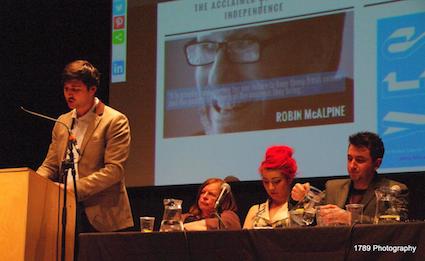
John Lanigan (RCN) attended the book launch of YES: The Radical Case for Independence, written by James Foley and Pete Ramand of the International Socialist Group and the Radical Independence Campaign. The book was launched at the Centre for Contemporary Arts on Sunday March 30th. Bernadette Devlin McAliskey, James Foley and Pete Ramand spoke. Below is John’s report of this event.
Pete Ramand, Bernadette McAliskey, Cat Boyd and James Foley at Glasgow book launch


In the midst of the debate on the Scottish Referendum, nothing could be more important, and timely, in terms of literary contribution and academic thinking, than this work by James Foley and Pete Ramand.
The Centre for Contemporary Arts in Glasgow welcomed an audience of around 150 people who were treated to a wonderful speech from none other than Bernadette Devlin McAliskey who had been invited over from the North of Ireland to speak about the book.
Bernadette who is no stranger to Glasgow or Scottish politics outlined the purpose of the book and the political thinking behind it.
The launch was chaired by Cat Boyd of the International Socialist Group and Radical Independence Campaign.
In her now famous quote Bernadette told the audience that “Another Scotland is possible, but not only is another Scotland possible, another Scotland is probable” Bernadette went on to draw conclusions between the Republican case in Ireland and that of Scotland and warned of the pitfalls and the need to work hard, to make sure that the alternative vision for a radical, independent, Scottish Republic can become a reality.
It looked like everyone in the hall understood that message, that either way, whatever the vote, the work would continue for a radical alternative to the City of London politics and also that of the SNP. The message from Bernadette was firmly one of a socialist alternative that would make Scotland a country that others could look to for leadership.
James Foley of the International Socialist Group and an economist at Edinburgh University spoke on the politics of the book and the arguments raised within. He also spoke at length about the No camp’s efforts to smear pro-independence supporters by equating them with far right nationalists, while at the same time saying patriotism is all right. When it was suggested to them that they were British nationalists they got offended (as they didn’t want to be equated with the likes of the BNP) but who were happy to make the same kind of insinuation about independence supporters.
James outlined very well the reasons why we should be voting YES, and with reference to the risks of Independence, stated that it’s much more risky for Scotland to stay within the UK. James has also written another book on the socialist case for independence Britain Must Break (see the review by Allan Armstrong at:-http://republicancommunist.org/blog/2012/09/16/britain-must-break-to-defend-real-labour-or-the-break-up-of-the-uk-to-advance-republican-socialism/)
Pete Ramand the co-author of  YES: The Radical Case for Scottish Independence and a founding member of the Radical Independence Campaign   looked closely at the benefits to be had from a Scottish Socialist Republic that was able to shape it’s own future, with the people of Scotland at the forefront of the decision making. Pete was very persuasive in showing just how Scotland could afford independence and of the need to get rid of Trident.
 YES: The Radical case for Scottish Independence has had many recommendations from writers and political figures alike, and will no doubt be referred to over the coming months as we approach the Scottish Referendum vote.
For those who are still to be convinced of the case for Scottish Independence this book is undoubtedly essential reading.
( Published by Pluto Press and available to buy online)
Bernadette McAliskey also spoke at the second Radical Independence Campaign Conference in Glasgow on November 23rd, 2013. Her talk can be seen on:- http://republicancommunist.org/blog/2013/11/25/2nd-ric-conference-after-the-uk-the-future-of-4-nations/

6 Responses to “YES: THE RADICAL CASE FOR INDEPENDENCE – GLASGOW BOOK LAUNCH”

  1. ajohnstone says:

    You have no doubt been waiting anxiously and on tenterhooks for the official SPGB position on the referendum
    The Executive Committee of the Socialist Party of Great Britain on the 2nd August adopted the following as a statement on the Scottish Breakaway Referendum on 18 September:-
    “Most of us don’t own a single square inch of Scotland.
    It doesn’t belong to us: we just live here and work for the people who do own it. In or out of the Union, that won’t change.
    In Scotland, society is run in the interests of those who own the wealth. They argue among each other over billions of barrels of oil, GDP rates, profits and exports, because where the borders lie matters to them. Every border is an opportunity to wring cash out of other property owners. Scotland will remain dependent upon their whims and interests whatever the outcome of the referendum.
    They’ll try to sway us one way or another with crumbs (or the promises of crumbs) but we’ll only get what they feel they can spare to protect their privilege and wealth. We will remain dependent upon their investments making a profit for them before we can get our needs and interests seen to.
    The only way to stop this dependency would be for us to take ownership and control of the wealth of the world into our own hands. We could, together, use the wealth of the world to meet our mutual needs and grant the true independence of being able to control our work and our lives in free and voluntary association of equals.
    Though the outcome of this referendum is irrelevant, it is an opportunity for us to tell our fellow workers that this is what we want. We don’t have to suffer in silence, we can go to the ballot stations and write “NEITHER YES NOR NO BUT WORLD SOCIALISM” across the voting paper. Then, join The Socialist Party to fight for an independent world.”
    SPGB Glasgow/Edinburgh branch blog
    SPGB Official Blog
    Raise the Red Flag Not the Saltire !
    Sing the Internationale Not Flower of Scotland !
  2. RCN says:

    Let me start with where I agree with the SPGB Glasgow and Edinburgh branch statement.
    I support the SPGB’s propositions that we “Raise the red flag, Not the Saltire!” (see http://republicancommunist.org/blog/2012/11/12/beyond-the-saltire-and-st-andrew-flying-the-red-flag-on-john-maclean-day/) and “Sing the Internationale, Not Flower of Scotland.”
    However, I would also see Hamish Henderson’s ‘Freedom Come All Ye’ as an excellent anthem for socialists in Scotland, and indeed elsewhere, to sing.
    And, in stating this, perhaps I am getting to the hub of a big difference I have with the SPGB. Every existing nation-state and national movement is class divided. Therefore, there are always (at least) two national traditions and histories – that of the ruling class or the exploiters and oppressors, and that of the popular classes. The popular classes change through history. At present the working class is the main popular class, both at a global level and within the UK and Scotland. This is why it is possible to have particular national popular traditions, producing their own histories and culture.
    If it stopped at that level, however, there would indeed be constant pull back towards the state and nationalism of the ruling class. However, just as the various ruling classes pursue their own ‘internationalism-from above’ links – diplomatically or forcibly if necessarily, so the popular classes, and the working class in particular, has pursued its own ‘internationalism from below’ links, in defiance of the ruling classes and the states they live.
    The SPGB only sees one pole of the capitalist relationship – exploitation. Thus, it quite correctly places its emphasis on the need to abolish wage slavery. This puts it ahead of many other socialist organisations. However, the SPGB does not understand the other pole of the capitalist relationship – oppression by the state.
    Indeed, going to the Edinburgh an Glasgow SPGB branch blog, we can see the following statement. “We have all the constitutional laws available for our use to change our necessary social institutions to work for us, so we can live in a peaceful and prosperous society.”
    I have to say this is almost breathtakingly naïve. There are many states in the world without even the formal trappings of bourgeois or parliamentary democracy. Furthermore, the constitutions of those that do have these trappings, have many mechanisms to exclude meaningful working class participation. At a US, EU and UK level representative institutions are being increasingly gutted of those limited powers they once had. Under the proposed Transatlantic Trade and Investment Partnership (TTIP), the rights of global corporations will be hardwired into the constitutions of these states.
    However, even without TTIP, the UK state itself does not provide us with “all the constitutional laws… to change our necessary social institutions”. The UK’s Crown Powers alone ensure that this can not be the case.
    Furthermore, the SPGB seems to be completely unaware that that the UK extends beyond Great Britain to Northern Ireland (and once, to the whole of Ireland). The relationship between the UK state and Ireland/Northern Ireland has always been fraught. However, the Crown Powers have ensured that the curtailment of even the limited existing democratic rights and the resort to state promoted violence has been very much a feature of its rule.
    And slightly adapting Marx’s maxim, “A nation that oppresses another can not itself be free”, we can see , what the UK state does over the Irish Sea, will have a knock-on effect over here. The Yorkshire miners found out this out in 1984-5. Today, the draconian policing powers once confined to the RUC/PSNI, have become more deeply embedded not only within London’s Met, but elsewhere in the UK – Scotland included (with the backing of the SNP government too).
    In the case of the UK, even invoking the word ‘nation’ is ambiguous. What do we mean by ‘nation’ – ‘Ukania’, Great Britain, England, Scotland, Wales, Ireland/Northern Ireland? Clearly the body doing the oppressing here is the UK state. The resort to ‘Britishness’ as a ‘nation’ acts merely to disguise the interests of the British ruling class and its various hyphenated subordinate components – Scottish-British, Welsh-British and ‘Ulster’-British.
    The SPGB correctly criticises much of the rest of the Left, for not appreciating the real nature of exploitation under capitalism. However, when it come to oppression within the UK, the SPGB lies at the furthest pole of gullibility. It accepts that the ‘British state’ (blind to its Northern Irish component) provides us with “all the constitutional laws” we need – a very paragon of democracy! Here, the SPGB agrees not only with the Labour Party and other social democrats, but with liberals too!
    And, how is the working class to make use of British constitutional laws? The SPGB’s programme of education and propaganda will eventually lead us to a situation where 50%+1 of the electorate will vote for its candidates to Westminster. SPGB MP’s will enact ‘Our Object and Declaration of Principles’ – whilst the British ruling class and the UK’s hard state just stands back and lets it happen!
    The SPGB has been in existence since 1904. It is part of the World Socialist Movement (WSM). After all this time, the WSM only has national sections in Great Britain (not the UK, note), the USA, Australia, Canada and New Zealand. Therefore, the WSM is entirely confined to English speaking countries where illusions in the reality of democracy under their existing constitutions are greatest.
    The SPGB’s ‘Our Object and Declaration of Principles and Aims’ correctly states that “the world is a ‘global village” and that “Socialism is not a cooperative island in the middle of capitalism, but a global system of society that will replace capitalism.” However, when it goes on to how to remedy this, nowhere in this statement is the need for international organisation, either in general, or in particular, i.e. the WSM, ever mentioned. From then on everything focusses on the SPGB itself.
    The SPGB is proud to be at the most revolutionary wing of those who see their socialism as essentially a question of economics. But despite the SPGB’s more advanced declaration of opposition to wage slavery, it remains, like so many others on the British Left, deeply economistic. And when it comes to any appreciation of the oppressive role of the UK/British state, the SPGB is at the most reformist pole of the British Left, sharing a position with the mildest social democrats and liberals. The SPGB holds massive illusions in the existing UK state and its “constitutional laws available for our use”.
    The Republican Communist Network (Scotland) supports neither the British nationalism of the British ruling class and UK state nor the Scottish nationalism of the wannabe Scottish ruling class and the SNP. We are Scottish internationalists advocating ‘internationalism from below’.
    Allan Armstrong (RCN).
  3. ajohnstone says:

    Your reply is appreciated, Allan. i think you have once again accepted the widespread misunderstandings of the SPGB positions, and no wonder we are often misrepresented and we ourselves plead guilty of over-emphasising only parts of our case to counter the opposition of the times and neglecting to highlight the various nuances of our views.
    Firstly, it would indeed be utterly naive to believe that every country in the world has even our limited access to bourgeois democracy. Our advice on the constitution was for those places that do but those many places around the globe unable to use the vote will determine their own means of exercising democracy which as we always say may mean force if required to carry out the will or to defend the will of the people. We are not a pacifist or legalistic organisation.
    The SPGB position is that we would change our tactics if the law on elections is changed to the workers detriment, but until that day, we will show our commitment to democracy and let the capitalist class prove themselves to be un-democratic. We won’t stand idly by if the constitution is changed. It wouldn’t stop socialism being eventually established, one way or another. the SPGB is that faced with an impending socialist election victory the capitalist ruling class would abolish political democracy and, even if they let things go so far as an actual socialist election victory, would not respect it and would carry on ruling regardless yet like those previously in the Eastern European overthrow of the CP dictatorships even if a pro-capitalist minority were to try to prevent a change of political control via the ballot box, the socialist majority will still be able to impose its will by other means, such as street demonstrations and strikes.
    The 2002 coup against Chavez failed because people were prepared to take to the streets to back up their vote and because the bulk of the armed forces remained loyal to the constitution and the constitutionally-elected president. The theory that power obtained by the ballot box to effect radical changes can’t be retained was disproved by actual experience. It confirmed our view that a socialist majority can both win and retain power via the ballot box if that majority is sufficiently organised and determined and if there is no question as to their democratic legitimacy.
    Your caveat about UK democracy and Northern Ireland is somewhat puzzling and i would like elaboration on it since with the participation of Sinn Fein in the assembly government, (and not simply just the assembly), having given up the armed struggle for solely the political process i would think it supports the SPGB case. Sinn Fein engaged in the electoral process quite successfully and were never banned, and even the Bobby Sands seat was held, with an increased vote, by Sinn Fein, who were never legally excluded from participation in elections. Successes convinced republicans that they should contest elections and led to the armalite and ballot box phase of their politics and that led to a resurrection of the old Sinn Fein boycott of the London parliament strategy for elected MPs and eventually lead to their integration fully with parliamentary democracy in Northern Ireland.
    RCN’s anti-parliamentarianism seems at odds with the move to support strengthening and reinforcement of the local state and support participation in a part of the bourgeois democratic process of the referendum adding to peoples illusions. Seems a bit more opportunistic than principled but that may be a bit to ungenerous to say but no doubt has its roots in the Bolshevik roots of many of your supporters.
    Our position on majorities as expressed by yourself if it was held by ourselves would also be naive – but it isn’t our position. We actually demand that there is an *effective political majority* and that may well be a minority of the electorate. The Socialist Party is too much of historical materialists to be sooth-sayers.
    The problem is that it is rather useless for us today to declare what tomorrow exactly is going to happen when socialism in imminent. Will the working class (even a socialist one that is highly politically educated) wait for the declaration of its elected representatives or delegates in Parliament and legislatures? What happens when say 55 per cent of the working class says “Let’s do it now!” What happens if the majority of workers in the UK and Europe start to elect Socialist majorities, but not in the U.S., Japan, etc.? And what if the State (the
    state capitalist State and private capitalist State) do begin to exert their powers to stifle the movement (and they will)? Do we then sit and wait again for our chance? What constitutes a working class majority wanting Socialism. Is it 51%? 60%? 75%? I feel this is a futile exercise to make. We simply cannot foresee the events that take place even when say 30% of the working class becomes socialist. or example, that we reached the stage where 20% of the adult working population was indeed socialist. That would be an incredible achievement and there would be a sudden rise in working class militancy in immediate issues, there would be a new “socialist culture” being built, changes within the entire labour movement, in daily life and how people thought politically. At 40% we would still not be the “overwhelming majority” but this would be such a sizably significant and politically powerful base. And here quantitative changes would mean qualitative changes. The “movement” we have now would not be the same movement under those circumstances. It might move in directions we have never even considered. And it has profound implications. It is too difficult for us to simply say that when the overwhelming majority of people around the world want socialism they will create it because there will indeed rise these very revolutionary situations or critical revolutionary crisis or juncture that have not followed the formal logic of the propositions we put forward. The “movement” will take on a life of its own.
    The World Socialist Movement cannot control whether or not workers become socialists. What we can provide, and what we have continuously provided, is a theory of revolution which, if had been taken up by workers, would have prevented incalculable misery to millions. Over the years, the Party’s theory has led to the formation of a body of knowledge which has been consistently capable of accurate political and economic predictions. For example, in 1917, the Bolsheviks were convinced that they were setting society in Russia on a course of change towards socialism. The Party argued that socialism was not being established in Russia. What followed was the horrendous misery of the Stalinist years. The Party put forward the same view of events in China in 1949. What is happening in Russia and China now? The rulers of these state capitalist regimes introduced free market capitalism. We warned against situations where groups or sections of workers try to stage the revolution or implement socialism when the rest of the working class is not prepared.
    That is why call ourselves majoritarians – not because we support a numerical majority nor commit ourselves unconditionally to Parliament and elections.
    On a minor point we do have an Indian companion party but your point is taken that our influence has been limited to these countries you listed. The World Socialist Movement is indeed an aspiration that we seek to achieve and sadly not a reality at the present time.
    Of course, this internationalism failure exists for all the ex- members off the defunct 3rd International, and the members of the much splintered 4th International. Even the anarchists fail to achieve any worldwide unity in their international organisation.It is regrettable that progress to world socialism has not been accomplished…but the SPGB dares to say that the responsibility for that does not lie with our own political principles but with those who have claimed to be socialist yet adopted non-socialist strategies.
  4. John Lewis says:

    This 1925 SPGB article is relevant to this debate:
    Here’s an extract:
    “The object of the Party, founded by the late John Maclean, is a Workers’ Republic for Scotland.
    The Manifesto sets out the slave position of the working class, and urges that the workers must carry through the Social Revolution.
    The chief fallacy of their position is their insistence upon a Scottish Workers’ Republic. This demand is both reactionary and Utopian. The struggle of the workers of the United Kingdom must be a united one. The workers are under the domination of a class who rule by the use of a political machine which is the chief governing instrument for England, Scotland, Wales, etc. To appeal to the workers of Scotland for a Scottish Workers’ Republic is to arouse and foster the narrow spirit of Nationalism, so well used by our masters. Economically the demand is Utopian, as the development of capitalism has made countries more and more dependent on each other, both through the specialisation of industry or agriculture, and also by the force controlled by the Great Powers to suppress or control the smaller nations.”
  5. ajohnstone says:

    Just a quick correction of a typo to my contribution
    . “…the SPGB is that faced with an impending socialist election victory” should read “One criticism against the SPGB…” which makes the meaning clearer.
    Another swift point… i overlooked the ban on the Republican Clubs of the early 60s when the republican movement disavowed armed struggle and tried the constitutional route but this was partly what sparked off the civil rights movement…mea culpa.

Leave a Reply


Sunday, 24 February 2013

A FEW GOOD WOMEN


Tin-pot African Dictatorship 


British  Occupied Ireland 


Insults Africa !


One of the better reports from the apparent Irish Stalinist, the Pensive Quill.
After her recent harassment by the resurrected heavy gang of the Gardai in the unfree Irish State
Deputy Clare Daly (Ind) asked the Tánaiste and Minister for Foreign Affairs and Trade the steps he has taken in his dealings with the Northern Ireland and British authorities to highlight the wide-spread concern that exists in relation to persons (details supplied) being in prison without knowing the charges against them and without an open trial.

Deputy Eamon Gilmore (Lab): I am very aware of the cases to which the Deputy refers and my officials monitor these and other cases very closely. The first individual referred to has been detained since 13 May 2011, following the revocation of her life licence by the Secretary of State for Northern Ireland. Genuine concerns about several aspects of this case have been raised by Deputies on many occasions, and I have raised them very frankly with the British Government, most recently when I met the Secretary of State for Northern Ireland on Monday, 11 February. I have been advised that the Parole Commissioners for Northern Ireland will determine in March on the issue of her continued detention.

In relation to the second individual referred to, the British authorities have confirmed that he was released under licence in 1992. The Secretary of State for Northern Ireland revoked that licence in April 2010 and the individual, has as a result, been in custody for the past two years and nine months. I understand that an appeal on the case will be heard by the Supreme Court in Belfast shortly. As the case is the subject of an ongoing legal process, it would be inappropriate to comment further at this time.

Deputy Clare Daly: I appreciate that the Tánaiste has raised those matters but all of us need to do more. We were among a cross-party delegation that went to Maghaberry Prison where we visited both Martin Corey and Marian Price in recent weeks. The health of Marian Price in particular is a cause of grave concern. We all have a role in putting pressure, not just on the British authorities but also on the Northern Ireland Administration. Deputy O’Sullivan is correct; the Minister, Mr. Ford, could release the two individuals on compassionate grounds at the stroke of a pen.

The issue is a serious one. I am shocked that the media have not taken it up to a greater extent. The cases involve two people who have been in prison for almost two and three years, respectively. They do not know the charges against them. Their solicitors are not entitled to the evidence against them. In the case of Marian Price’s parole commission hearing, a representative is being appointed on her behalf to represent her. This is a person she cannot meet, who cannot discuss matters with her or talk to her. This person will attend her hearing, which will be held behind closed doors, which she herself is not allowed to attend. If that was taking place in a tin-pot African dictatorship, we would be banging our drums demanding justice. It is happening on this island and it is absolutely unlawful and disgraceful. I echo the point made previously on whether we can get an official from the southern Government to be a public voice at the hearing. Could we demand that the case is held in public and that Marian Price and her solicitor could attend? Could we begin to address the issues in the broader European Union community because it is a serious erosion of human rights?

Deputy Eamon Gilmore: Two cases were referred to in the question. In one case a Supreme Court case is shortly to be held on it so I cannot say anything much further in that regard.

In the second case the individual was sentenced to two life terms of imprisonment – 20 years imprisonment to run concurrently. In March 1975 the individual concerned was transferred from prison in England to Armagh Prison. On 30 April she was released from Armagh on humanitarian grounds. The release was on licence and the licence was then revoked on 15 May 2011 by the then Secretary of State for Northern Ireland. An issue arose about the terms of the revocation. The Secretary of State for Northern Ireland and the Northern Ireland Office inform us that the parole commissioners considered the terms of the royal prerogative of mercy after receiving submissions on behalf of the prisoner, that the Secretary of State ruled that the life sentences were not remitted by the royal prerogative of mercy, and that the individual remained subject to the life sentence.

The prevailing policy within prisons themselves is a devolved matter which is the responsibility of the Department of Justice in Northern Ireland. The Northern Ireland Prison Service is an executive agency of the Department and the Police Service of Northern Ireland. I have received a briefing on the assessment of the parliamentary delegation which visited Maghaberry Prison. My officials are monitoring the situation closely. It is the subject of discussion between the Secretary of State and I and between officials of my Department and corresponding officials in the Northern Ireland Office. That will continue to be the case. I am very much aware of what is going on.

Deputy Clare Daly: If people have done something wrong and have broken the law, they should of course be brought to justice and to trial. This is the opposite case where people are imprisoned for a period of years whose cases have been heard in open court. They have been found to have no case to answer and then secret evidence has been introduced behind closed doors. That is a fundamental attack on human rights and civil rights for everyone in Irish society and beyond.

We do not know that the royal pardon did not cover the sentences because the official excuse is that the pardon has gone missing. Therefore, how do we know what was specified in it?

Why does Martin Corey have to go to the Supreme Court? An open court has already said he has no case to answer. These are serious matters. It is 41 years since Bloody Sunday when people marched against internment. Now there is a new Administration and a new power structure but people are in prison who do not know the reason they are there. The Northern Ireland Minister for Justice could release those two people at the stroke of a pen. I hope that when we have next month’s ministerial Question Time, we do not have to raise the two cases in question because if Marian Price is not released soon on compassionate grounds, given her ill health, it will lead to a seriously destabilising situation in the North for the foreseeable future.

Deputy Eamon Gilmore: In one case, as I said, there will be a Supreme Court hearing and my information is that it is due to be held shortly. A date was set for it earlier in the month but the hearing was not held on that date. I understand a new date will be set for it shortly.

My understanding is that the parole commissioners will hear the Marian Price case in early March. Three dates have been indicated to me as to when the case will be held and it has been indicated to us that there will be a decision shortly after that. Clearly, we cannot prejudge what that decision is likely to be and I will certainly be keeping a very close watch on what is happening and my officials will be doing that on my behalf.


9. Deputy Gerry Adams (SF) asked the Tánaiste and Minister for Foreign Affairs and Trade asked a cryptic question, whether his attention was drawn to the various legal proceedings currently being taken by persons (details supplied) to set aside the indeterminate sentence being imposed on them by the British Secretary of State, Ms Theresa Villiers, without access to judicial proceedings in which they can see, hear and challenge the evidence against them; and if he has expressed his abhorrence of the denial of fair judicial procedure to these two Irish citizens

29. Deputy Mick Wallace (Ind) asked the Tánaiste and Minister for Foreign Affairs and Trade in view of the fact that Marian Price has been interned without trial for a period of nearly two years, if he will consider raising the matter at a European level; and if he will make a statement on the matter.

30. Deputy Frank Feighan (FG) asked the Tánaiste and Minister for Foreign Affairs and Trade if he will provide an update on the Marian Price case; and the action he is taking to advance the case

33. Deputy Aengus Ó Snodaigh (SF) asked the Tánaiste and Minister for Foreign Affairs and Trade if his attention has been drawn to the deterioration of the physical and mental health of a person (details supplied); his views on their prison conditions; and if he has discussed them with British Secretary of State, Theresa Villiers.

63. Deputy Luke 'Ming' Flanagan (Ind) asked the Tánaiste and Minister for Foreign Affairs and Trade the discussions he has had with the Northern Ireland Office and the Secretary of State with regard to Marian Price; and if he will make a statement on the matter.

66. Deputy Damien English (FG) asked the Tánaiste and Minister for Foreign Affairs and Trade if his attention has been drawn to the fact that the Stormont Assembly Minister, David Ford, denied until the last minute compassionate parole to persons (details supplied); if he will raise with Minister Ford at their next meeting the need to address compassionately requests from both in view of the limbo position in which they have been placed, having being neither charged with an offence, nor given a release date, granted bail or seeing the evidence against them; and his views on a royal pardon issued to one of the persons in the 1970s being conveniently misplaced.

67. Deputy Martin Ferris (SF) asked the Tánaiste and Minister for Foreign Affairs and Trade if he has raised with the British authorities the continued detention-internment without trial of two Irish citizens (details supplied) in prison; and if he has demanded their immediate release.

Deputy Eamon Gilmore: I propose to take Questions Nos. 9, 29, 30, 33, 63, 66 and 67together.

I am very aware of the cases to which the Deputy refers and my officials monitor these and other cases very closely. The first individual referred to has been detained since 13 May 2011 following the revocation of her life licence by the Secretary of State for Northern Ireland. Genuine concerns about several aspects of this case have been raised by Members on many occasions, and I have raised them very frankly with the British Government, most recently when I met the Secretary of State for Northern Ireland last Monday, 11 February. I have been advised that the parole commissioners will determine in March on the issue of her continued detention.

In relation to the second individual referred to, the British authorities have confirmed that he was released under licence in 1992. The Secretary of State for Northern Ireland revoked that licence in April 2010 and the individual has as a result been in custody for the past two years and nine months. I understand an appeal in relation to the case will be heard by the Supreme Court in Belfast shortly. As the case is the subject of an ongoing legal process, it would be inappropriate to comment further at this time.

Deputy Seán Crowe: There has been some discussion of this but I want to add a few points. The nature of these cases involves unseen and unknown evidence, so it is difficult for people to defend themselves when they do not know what evidence has been presented against them. The common denominator is the involvement of shadowy figures in the background from MI5 and MI6 who are not friends of the Irish peace process. The Minister said he would get the report of the delegation that visited Marian Price. That delegation has stated that her health is getting worse and we know she is only allowed to exercise in a corridor late at night, with no access to the fresh air or the environment. She is also concerned that there is talk of closing the wing she is on and returning her to what she described as the dungeon. She said that part of the problem with the dungeon was that she was refused access to medication. The Red Cross has been refused access to Hydebank where she is being held. Will the Minister raise that with the British Government?

Deputy Eamon Gilmore: I have already brought to the attention of the Secretary of State the previous visit that was undertaken by a group of Oireachtas Members whom I subsequently met and whose report and assessment I was given. On a continuing basis, we have raised with the Minister for Justice in the Northern Ireland Executive the conditions in which Ms Price is being held. The immediate focus is on the hearing by the parole commissioners that is due in early March.

Bernadette Devlin McAliskey's Bloody Sunday March for Justice 2013 address as delivered at Free Doire Corner on Sunday the 27th of January. 


Bernadette McAliskey addressing the rally at this year's Bloody Sunday March For Justice which had the theme 'End Impunity'. Despite a wet, windy, wintery day around 3500 people braved the elements to march in solidarity with the victims of Bloody Sunday and other injustices. This years events gave specific focus to the miner's strike and the Hillsborough disaster as well as the scandal that has been playing out with impunity in Rossport where the local community are under occupation by Shell and the Garda has the common wealth of the Irish people is not just given away to Shell for the taking but at the cost of the health and safety of the local people.