Showing posts with label Scottish. Show all posts

Thursday, 11 September 2014

SCOTTISH INDEPENDENCE Among Proddy Dogs And Papes


Alistair first got involved in folk music way back in the mid-sixties, following what seems to be a surprisingly common entry route - "Yeah, I was Glasgow's pimpliest Bob Dylan clone !" - but he went along to folk clubs and was exposed to traditional Scottish music. Having been "accustomed" to the likes of Andy Stewart and Kenneth McKellar, the real sounds of his homeland came as a surprise, hearing traditional Scottish ballads, the strange cadence, and the modality of the tunes he was "gob-smacked". By the age of fifteen he was visiting The Attic Folk Club in Paisley and taking a strong interest in the music, but just a year later he was to become a reluctant emigrant to New Zealand travelling with his parents on an assisted passage. However despite not being eager to go, he was able to break straight into the folk circuit - it was very welcoming to what it regarded as the genuine article, and here was a Scottish kid singing traditional Scottish ballads.

After two years in New Zealand he was a seasoned performer, and when ex-Glaswegian Gordon MacIntyre came from Australia to tour, Alistair was a support act. At the end of the week Gordon said that there was a thriving folk scene in Australia and that Alistair should go over there, so he did! Gordon introduced him to the right people and soon Alistair was established, and played around the folk circuit for a few years before drifting into other forms of music. It was the time of peace, love, and flower power, and he went on the hippy trail for about ten years, before coming back to traditional music via punk!

Alastair had already started writing his own stuff in the seventies, travelling around with a guitar, playing round campfires, jamming with other musicians, and needing to expand a limited repertoire of songs, but it wasn't until he was playing with Roaring Jack that he began to write seriously. The Jacks were an electric folk punk band, "We screamed our way through traditional folk ballads with great gusto, whilst the audience had a scrum at the front of the stage, but that got me back into folk music again." He neglects to mention the stage-diving from the top of the speaker stacks, but the band was popular, even getting invited to folk festivals. They were usually put in a tent a long way off from everybody else and their audience was mostly punks - but they wouldn't have been there otherwise, so the festival organisers were happy to have the Jacks because they brought along an audience.

The band did two albums and an EP, plus an awful lot of touring, but Alistair was quietly(-ish) gaining a reputation as a songwriter of some note. "People more from the mainstream of folk began to do my songs - in a less frenetic style than the Jacks, and a few people recorded them." Alistair also started doing more solo work, playing acoustic, rather than electric guitar, and eventually recorded his first solo album "Dance of the Underclass" in 1991. This album included twelve of his own songs, including "He Fades Away" and "The Swaggies Have All Waltzed Matilda Away", plus a rousing version of the "Internationale"! Roaring Jack eventually split up after some six years together, but by this time Hulett was well on his way and had a second solo album, recorded with temporary band The Hooligans, issued in 1994 and titled "In the Back Streets of Paradise".

The strength of his songwriting is obvious on hearing the material, but besides the very accurate and precise observation which underpins the lyrics from this fine wordsmith, there is also a common thread of a deeply felt political and social awareness. It was June Tabor's recording of "He Fades Away", on "Against The Stream" in 1994, that first made me aware of Alistair's writing. "I love the way June sings it! It was weird really, but when I wrote it, especially when that middle eight section was coming to me, I was thinking of her music as I was writing that chord progression. I didn't know her or anything but after I recorded it I asked my record label to send her a copy, but it didn't ever reach her". Happily, by the strange forces of serendipity, June was given a tape to play in the car whilst travelling between gigs in the US, and there it was. The song tells of a man dying from asbestosis, contracted whilst working in the Wittenoom blue asbestos mine in Western Australia, and is one of two songs written by Alistair about the horrors of the mines, the other being "Blue Murder".

"A lot of the people that worked in the asbestos mines came from fairly remote parts of Europe, coming over on government assisted passages. They had to sign up to stay and work for two years in the mines, and they weren't aware of what they were getting themselves into. It was a hell-hole, and highly toxic too, but if they left before the two years were up, they were tracked down by the Western Australia police and forcibly returned to the mines. It was almost like indentured labour." Both songs contain extremely moving and powerful imagery, demonstrating the skill, and the passion of the writer. They were originally written as part of a project to produce a play based on "Blue Murder" - a book about the mines by Ben Hills. The project never reached completion due to circumstances surrounding the Free Tim Anderson campaign where Alistair was actively involved in clearing the name of left-wing activist Tim Anderson. "He was accused of a particularly horrendous crime - planting explosives outside the Hilton Hotel, where a summit meeting of the Commonwealth heads of state was taking place. Two bin-men and a policeman had been killed and Tim was being framed as the culprit. He was completely innocent, as was later proved, but Ben Hills wrote an article for the Sydney Morning Herald defaming Tim, and I felt I couldn't continue to work with Ben after that".

It isn't possible to talk about Alistair without being aware of his social and political stance, and his standpoint is made quite clear by his singing, his writing, and the introductions to his songs. "I see myself as a Socialist in the Marxist tradition - I believe that the way forward in society is for the producers to take control of the means of production - for the Working Class to take political and economic power". These beliefs lend a great deal to both his own songs and his choice of other material. His version of "The Weaver and the Factory Maid" is quite a revelation, putting it into the context of hand-loom weavers (who had been at the pinnacle of their society) being driven into abject poverty by the advent of the steam shuttle, which mechanised the weaving process and almost at a stroke totally devalued the skill, the craft of the hand-loom weavers. "Their response was to band together in the night and go and smash the looms, out of sheer desperation". The Luddites, as they were known, failed, and progress inevitably overtook them, but between the skilled weavers and the relatively unskilled factory hands there was a major conflict, and a marriage between the two was almost unthinkable. "At the end of the song the weaver is saying to his father that if a young man is going to find a partner it will be in the factory, that is where everyone is going, it's inevitable. When you understand the social context, it's really a formidable song."

However, don't get the impression that a Hulett gig is all politics, far from it, he doesn't only sing about his political beliefs, he presents an interesting and well balanced set, but like several folk luminaries before him, he is politicised. "I'm not alone in this; a lot of singers on the folk scene in the sixties were card carrying Communist Party members - Bert Lloyd was; so was Hamish Henderson, and Ewan MacColl." And MacColl was an early influence on his music, with one of his current repertoire being "Chylde Owlett", using the Lydian mode, and learned from the singing of MacColl. "He was a huge influence. A lot of people have influenced me, but he would be at the top of the list."

Twenty-odd years in Australia fostered in Hulett a taste for the "old" Australia, and its politics - and in his song "The Siege Of Union Street" there is a case of direct action from the times of the depression. "Somebody gave me a pamphlet and said that I might like to read it 'cos it was about the street I was living in at the time! I read it and it amazed me. There had been a struggle to prevent the eviction of a war widow and her children, and over a thousand people had fought in the streets for three days against the police and the landlords, and managed in the process to ultimately get the law changed." Alastair was given a copy of a taped conversation with a man by the name of Jim Monroe who had been a founder member of the Unemployed Workers Union, the organisation which had waged the Union Street campaign. "One of the things he said was about the solidarity amongst the people fighting to prevent this unjust eviction - they were grand old days on the barricade! - and I knew that that was the angle I wanted to write from. After that, the song just wrote itself."
Another aspect of Australia's past was the violent and bloody oppression which characterised the last two hundred years history of the continent: "The Swaggies Have All Waltzed Matilda Away" tells of the brutality shown to the original settlers, the transportees, and also to the indigenous Aboriginal people:

"You caused the poor blacks to suffer the same
Imprisoned on missions or hunted for game
Blood stained the soil of Australia."

This song was the catalyst which brought together Alistair Hulett and Dave Swarbrick. "Dave had moved to live in Australia, in the Blue Mountains, and whilst on tour he was staying with a fella called Rob Bartlett, a fine English singer and guitarist living in Adelaide, who played him 'The Swaggies' on my CD 'Dance of the Underclass' and he liked it." Alistair was already working on a new album, which he had intended to ask Swarb to play on, but then he got a 'phone call saying Dave had heard the CD and would like to work with Alistair. "So we call that our song!" After hearing the demos for the new album Dave said that rather than play on it for a session fee, he would prefer it to be a collaboration. "We recorded 'Saturday Johnny and Jimmy the Rat' and we had such a good time playing together that we toured Australia with it. Personal circumstances then meant that both of us were returning to the UK at the same time, and so the collaboration continued." That was in 1996 and Alistair, on his return, went to live in Herefordshire where a strange coincidence led to him meeting June Tabor, due to them both using the same health food shop. "The shop owner mentioned to June, another customer, that a folk singer had arrived from Australia and told her my name. She didn't know that I was living there, only about twelve miles from her place, but I got a 'phone call and went over for dinner one night. She's lovely!"

"Saturday Johnny..." was released in the UK and Swarb and Alistair toured extensively, doing clubs and festivals to wide acclaim. Several reviewers admitted not knowing Alistair's name, and going to the gigs purely on the strength of Swarb, but all came away raving about the duo, and Hulett's songwriting. The comparisons with the Swarbrick/Carthy pairing were bound to be made, and not without validity. "If he (Swarbrick) was to play with any guitar player, especially one who plays finger style as I do, then it's an obvious comparison to make. I have to say that I'm quite in awe of Martin's guitar playing - not only his playing, his whole artistry. He is definitely the business as far as I'm concerned."

But whilst Alistair readily admits to being influenced by Carthy, there is something more to it; that distinctive percussive style so difficult to define but immediately recognisable. "We use the same tuning, he (Carthy) passed that on to me. With it you can play in lots of different keys, with an obviously modal tuning. I like that modal sound. I was previously using DADGAD, C modal, and G modal, and it meant either re-tuning 6 or 7 times during a set, or carting 3 or 4 guitars around. But Martin's actually devised a way of tuning that is as versatile as standard tuning, but where you can still get that modal sound. It's a tricky one - you've got to commit to it! You can't really go back into normal tuning again without so altering the tension of the neck that the entire guitar goes out of tune! The tuning means that strings are tuned down from standard and a fairly heavy gauge of string is required. It's really 'sloppy', but I like that. Some of the strings are so slack that you get a lot of vibrato, and they also become quite 'rattley', but I like the sound of the string hitting off the fret - I like to yank at the strings a bit!" His playing is deceptive - understated, camouflaging his skill, but allowing him when paired with Swarbrick to produce a sound which is much fuller than would be expected from just the two instruments.

After their successful tour they both returned to other work with Alistair taking up solo work and Swarb working with other people, but they also continued to develop material together and their second CD, "The Cold Grey Light of Dawn" was released in 1998, again to great critical acclaim. "The Siege of Union Street", the bleak "Chylde Owlett", and "The Swaggies..." are to be found here, plus some other very powerful pieces of writing. The album also has a song written in Australia, but recalling the Glasgow he'd left behind him; "Among Proddy Dogs and Papes" is no nostalgia trip, instead it concerns itself with the sectarian violence which was endemic in the city at that time. "It has been a real joy to return and find the sectarian animosity and the violence so greatly reduced." Other changes in the city have also been welcomed by Alistair. "I'd always thought that the buildings were made out of black stone, but they've been cleaned, and everywhere now is this beautiful blonde and red sandstone - I didn't even know it was there!"

The second CD led to another tour together in 1998, but by this time Alistair's reputation in the UK had grown, and people had picked up on the first tour and the solo work as well. Additionally, 1998 saw Hulett at the Isle of Bute, "Bute Experience!" with the debut performance of "Red Clydeside" a presentation in word and song of a chapter of his home city's history. "Around the time of the start of the First World War, Glasgow was the home of the dispossessed - the Irish and the Clansmen." This led to a very politically aware, and politically active, population, which resulted in a rent strike in 1915 led by a Govan housewife, and which forced the British government to legislate against wartime rent increases. "The Rent Strike was the first upheaval in a working class revolt that came to be known as Red Clydeside. Its leader was a man called John MacLean who would address meetings of workers outside the factory gates and exhort them to be true to their class not their country, and not go to war." This was obviously unpopular with the government of the day and twice MacLean was imprisoned, but twice he was released due to the level of public pressure. "When he was released the second time he was very weak and unwell, he had suffered terribly during his imprisonment, but on his release he was taken to speak at what was possibly the largest political meeting ever assembled in this country."

Alistair had been working on this project with Swarbrick with the intention of bringing out a CD. "All the songs are written , we've even got the track order for the CD, and we were due to go into the studio to record it before Dave's illness." Ah yes, the period spent in hospital which resulted in a glowing, albeit thankfully premature, obituary in the Telegraph, to which Swarbrick responded with a statement that he'd "died in Coventry before!" But how is he now? "He was very ill, but although he's lost quite a lot of muscle tone, he's getting stronger day by day and he's playing again now." Besides the delay on the recording of the new CD there were other rather more pressing implications. "We had a thirty date tour booked, and then Dave fell ill. I'd just taken out a mortgage and I wasn't looking forward to seeing the bank manager. So, I went to Roy Bailey and said that I needed a big favour!" Roy, who had recorded "He Fades Away" in 1994, obliged, and eventually went out on half the dates, with the two of them essentially doing a song-swap. "Roy would do a song, then I'd follow with one which was somehow related to it, and so on - but we both kept the option of changing the subject without notice!" For the rest of the gigs Alistair was partnered by ace squeezer John Kirkpatrick. "I spoke to Martin (Carthy) about the other gigs, and he suggested John." Despite the two pairings being quite different both came up with a successful and interesting format, helping Alistair expand his audience base - and pay the mortgage!

Alistair Hulett is a singer of intensity, integrity, and conviction, but although much of his writing is hard edged social and political commentary which challenges any hint of passivity in his audience, he doesn't let the ideology overpower the imaginative lyricism of his writing. He combines rich vocal tonality, deceptively understated guitar style, and articulate, incisive introductions in a relaxed presentation. He is a singer and writer of stature, and Australia's loss is most definitely our gain.

by Mel Howley, From The Living Tradition magazine

Wednesday, 10 September 2014

SCOTLAND'S Working Class Heroes


Can ye no hush your weepin'
all the wee lambs are sleepin'
Birdies are nestlin' nestlin' together 
Dream Angus is hirplin' oer the heather
Dreams to sell, fine dreams to sell 
Angus is here wi' dreams to sell
Hush ye my baby and sleep without fear
Dream Angus has brought you a dream my dear.
List' to the curlew cryin'
Faintly the echos dyin' 
Even the birdies and the beasties are sleepin'
But my bonny bairn is weepin' weepin' 
Dreams to sell, fine dreams to sell 
Angus is here wi' dreams to sell
Hush ye my baby and sleep without fear
Dream Angus has brought you a dream my dear


(Stephan Coyle)
James ConnollyJames Connolly was born in the Cowgate area of Edinburgh of Irish parents in 1868. He was pioneer of the socialist and labour movement in Scotland before leaving for Ireland in 1896 where he took up a full time post with the Irish Socialist Republican Party, whose 100th anniversary is this year. This party sought to unite the twin strands of Irish Republicanism and Socialism into a single revolutionary force. Connolly later formed the Irish Citizen's Army during the Dublin lockout of 1913 to defend the dockworkers from the police and scabs. Connolly played a prominent part in the Rising and held the post of Commander in Chief of the Republican forces. He was badly wounded in the Rising and was executed by the British at Kilmainham Jail on May 12 whilst strapped to a chair.


Labour MP'S stood up and cheered in the House at the news of his death. The British left of the day condemned him for going to Ireland at all, including the Imperialist Social democrat leader Hyndman who believed in Socialism within the British Empire.

 Charles Carrigan


Charles Carrigan was born of Irish parents in the (then) industrial town of Denny, Stirlingshire in 1882. Modest by nature he possessed a keen intellect and worked as a tailor. From an early age he developed a love of all things Irish and was an enthusiastic Gaelic Leaguer.When Sinn Fein was founded in 1905, members of the IRB formed a branch in Glasgow soon afterwords, named the Eire Og Craobh. Charles Carrigan was it's first chairman. The branch was very active and organised Gaelic classes as well as holding lectures on Irish history and the contemporary political situation. Carrigan's wide reading knowledge of their hardships endured by the working classes of Clydeside, many of whom were Irish immigrants, developed in him a strong social conscience. In 1906 the future Minister of Housing in the First Labour Government, John Weatley, founded the small but influential Catholic Socialist Society. It aimed to reconcile practising Roman Catholics with the tents of socialism. Carrigan and fellow IRB member, Thomas O'Baun enrolled. As well as serving on the organising committee and presiding at meetings, Carrigan was much in demand as a lecturer. It was hardly surprising then, that when Arthur Griffith sided with the management during the Dublin Lock Out, the Glasgow Sinn Feiners felt compelled to denounce his actions.


Carrigan and other prominent IRB members left for Ireland in order to evade conscription which was introduced in January 1916. When there they made preparations for the impending Rising. During the fighting Carrigan was positioned at the GPO with other members of the Scottish Division. Despite putting up a brave fight, the constant British bombardment was taking it's toll. Incendiary shells set the Republican Headquarters on fire and their evacuation became necessary. It was during the second evacuation on the 28th that Charles Carrigan was cut down by a hail of bullets with the O'Rahilly by his side. They were killed in Moore Street near the burning GPO. Bya sad coincidence it was Carrigan's 34th birthday. Charles Carrigan's name takes pride of place on a monument in St. Paul's Cemetery, Glasnevin, beneath which he is buried along with 15 other heroes of Easter Week.


Iain MacKenzie KennedyIain MacKenzie Kennedy was a Scottish Republican who is believed to have hailed from the Lochaber district on Inverness-shire. In 1916 he went to Ireland in a quest for the Irish language and later the West Cork Brigade of the IRA. He was killed by Free State forces at Passage West on August 8 1922. He and two Republican comrades put up an unequal fight against 64 Free Staters, killing 12, and wounding 15. The following is an extract from his obituary which appeared in the 'Fenian'.


"We well remember Iain MacKenzie Kennedy in Killarney during the 'trouble', but before it had reached its Black and Tan zenith. A fine strapping handsome boy, he was attired always in a kilt and the tartan of his clan. He was fiercely anti-English. He had thrown away much in Scotland and came to Ireland accompanied by his very charming mother rather than fight for the English. He went about quite openly although the town was full of British military. One day two swaggering officers armed fully, passed him in the street and made some sneering remark about his cowardice in not "joining up". He reached out and grabbed one in either hand, banged their two heads together, and threw the dazed up the street. He was intensely Gaelic and clan proud". Iain MacKenzie Kennedy is buried in the Republican plot in Cork City and his name takes prided of place on the Republican Monument in Macroom.


The Irish in Scotland It is right and proper that we the faithful Republicans of Glasgow recall the significant contribution that was made by the contingent of Glasgow Republicans who travelled to Dublin to play a full part in that epoch making event. The highest ranks of the Irish Republican Brotherhood were informed on January 1916 that the Rising was planned. This resulted in an upsurge in explosive gathering raids and smuggling operations on the part of that organisation. The Finna also transported large amounts of explosives, detonators fuse wire and other materials useful in bombmaking. After being stored in safe houses in Scotland the material would be taken by young Finna boys to Ireland. The route most commonly used was that between Ardrossan and Belfast. Some of the smuggled explosives which mainly came from Lanarkshire coalfields, would be distributed amongst sympathisers in Belfast, but the bulk would be transported to Dublin.


Not alone did Scotland provide some of the arms used in the Easter Rising, but some of the participants. Immediately the discussion to stage a Rising was known to the IRB in Scotland, those who possessed specialist knowledge of explosives left for Ireland. They joined up with some of their comrades, who were stationed in a camp at the Kimmage home of Count Plunkett and were known as the Scottish Division of the Kimmage Garrison. Their task along with Republican contingents from London and Liverpool, was to prepare the armoury for the Rising. The majority of Irish Volunteers in Scotland were only informed of the plans for the Rising about a week in advance. About 50 Irish Volunteers from Glasgow took part in the event and were joined by an enthusiastic band of women from Cumann nam Bann. The latter did sterling work in nursing the Republican casualties during the subsequent fighting. Many of them were schoolteachers who had learned how to shoot in a Glasgow rifle range. The first military action of the overseas contigents occurred before the Rising itself when they successfully fought off a would be police raiding party, killing a squad detective. Most of the Scotish Division were deployed in garrisons on the perimeter of the GPO and elsewhere.


Six of the men who had come from 'a land beyond the sea' never returned. Glasgow Cumann nam Bann and Citizen Army member Margaret Skinneder, was badly wounded on the Wednesday, whilst taking part in a house situated behind the Russell Hotel on the Green. It was thougt to be occupied, by the British, who had to dislodged before more aggressive action could be taken, but a sniper in the house opposite opened fire killing 17 year old Fred Ryan and hitting Margaret Skinneder three times.Fortunately she made a full recovery and wrote her book, 'Doing my bit for Ireland', which was published the following year. Following the military failure of the Rising the one hundred or so members of the British contingents, together with two thousand other internees and deportees, many of whom had been totally uninvolved in the Rising, were conveyed in cattle boats to Britain. Members of the Scottish Division, including it's leader Joesph Robinson, were dispersed in such prisons as Reading jail, Balinnie and Perth, before being interned together in Frongoch Camp in North Wales. This place was to become in effect the 'University of Irish Republicanism'.With the release of the Republican prisoners in December, 1916 the IRB in Glasgow was able to regroup and resume its previous activities of raiding for arms and transporting the material to Ireland.


A scottish Brigade of Oglaigh Nah Eireann was established in early 1919 out of the Irish Volunteers and by the High Water mark of the Anglo-Irish War in 1921, it could boast a membership of 2,500 with 33 affiliated companies across Scotland. Everywher there was a significant Irish presence, a branch of the Sinn Fein existed. The largest one was in Greenock with a membership of 1000, with 600 each for Paisley and Dumbarton. Clearly the Irish in Scotland were very staunch and according to one Prominent Republican. source, the support from Scotland in terms of munitions and financial aid during the Tan War outstripped that of any other country including the USA.
- See more at: http://www.scottishrepublicansocialistmovement.org/Pages/SRSMArticlesRepublicanRollofHonourforScotland.aspx#sthash.6caI4HDi.dpuf

Tuesday, 9 September 2014

SCOTLAND WALKS IN THE FOOTSTEPS OF JAMES CONNOLLY


Speaking with many people from across the political divide in Ireland currently , the general consensus privately, is that Irish Peace Process, is currently dying a slow death. One of its principal architects Gerry Adams in a statement recently stated, “The political process is in trouble. I believe that the political process faces its greatest challenge since the Good Friday Agreement negotiations in 1998. The anti-Good Friday Agreement axis within unionism; the pro-unionist stance of the British secretary of state Theresa Villiers; the refusal of Downing Street to honour its own obligations, are combining to create the most serious threat to the political institutions in the North in recent years.

“The result of all this is directly undermining power-sharing and partnership government. The unionist leaderships have been encouraged in their posture by a British government that has not been fully engaged with the political process for four years.” He added, that traditional pro-British Unionist were unwilling to participate positively in any of the Agreement's institutions, stating that “Instead it has adopted a tactical approach aimed at serving the political agenda of a fundamentalist rump in their party rather than the needs of the whole community,”

Again yesterday, Adams made a veiled attack, on the current Fine Gael regime in Government in the South of Ireland, which has traditionally protected the Unionists in the North, stating, "An anti-agreement axis has now emerged. There needs to be a pro-agreement axis and the two Governments need to be very, very focused on delivering on the agreement.” 

The Irish Government has been too passive in my view and the Taoiseach(Irish Prime minister) could well emulate the example of Albert Reynolds (Another Peace Process architect who died last week)  to get involved and press ahead but particularly to keep the British Government to its obligations.”

The traditional Unionist Leader in the north Peter Robinson statement in reply, "Once more we see the self-serving attempt by Sinn Fein to distract public attention from real problems by blaming everyone, except itself, for what it asserts is a crisis that impacts on the political institutions."

Last week Hilary Clinton's aide Nancy Soderberg said, “Today, too many in Ireland take two decades of a ceasefire for granted. They still focus on their own sense of victimhood of the past and fail to forge a new united community that can not only solidify the peace, but even build shared prosperity. A look back at the hard-fought ceasefire may encourage some broader thinking about the responsibility of leadership to build a better shared future for the people of Ireland.”

The British Conservative Government and their Vice Royal in Ireland, since coming to power, other than enforcing a heavy censorship of international media coverage of the ongoing low intensity war In Occupied Ireland, have irresponsibly taken a hands off approach with the Peace Process and essentially have failed to understand the critical small print of the dying Good Friday agreement.

In a recent statement the leader of Republican Sinn Fein, the traditional  Irish Republican voice, leader Des Dalton stated, "We are being asked to abandon the high ideals, that inspired that revolutionary generation of a century ago and instead embrace the mythology of empire. It is evident that in the decade of centenaries, the political establishments of Leinster House, Stormont and Westminster, are determined to draw a line under Irish history. By demonising and isolating Irish Republicanism and refusing it access to public debate, they hope, that it will simply fade from the public consciousness, robbed of historical or political legitimacy. Quoting from a Ronan Fanning article in the Irish Times, he added,  “…the propagation of a bland, bloodless, bowdlerised and inaccurate hybrid of history, which if carried to extremes, is more likely to provoke political outrage than to command intellectual respect, let alone consensus.”

The Freemasonry of the Orange Order are now front and centre in Unionist, Fine Gael and British politics. Its Chaplain, Rev Mervyn Gibson, the most influential person in all-party talks on flags, parading and the past, is even more influential after the DUP and UUP scuttled the talks by the recent US Government to try move the dying process on, with its envoys Richard Haas and Meghan Sullivan sent packing by the Orange Order, exercising its trump card, the Orange veto.This is one of many critical factors, that was not dealt with by The Peace process. Another was the issue of large numbers of political prisoners still languishing in British Gaols, in both parts of Ireland. This threatens to explode again at any moment, in the same way that, the Hunger Strike of Bobby Sands and the 11 other Irish Republicans, who starved to death on Hunger Strike, changing the face of Irish politics and giving the platform to the Adams voice, to be serious player he now is in Irish politics.


Now however, as the Orange Order have demonstrated themselves to be the real voice of traditional Unionism, while Adams clearly does not speak for traditional Irish Republicans. What Nancy Soderberg and the British Conservative Party in London have failed to grasp, is that the Good Friday Agreement will not stick, without a proper foundation, in the context of both the Orange and Green traditions of Ireland. These traditions are deep in the psyche of the majority of Irish people's consciousness. One of the principal lessons of the last 800 years of Irish History, which Ms Soderberg in the context of Ireland and many American citizens in the context of their own short history, fail to understand is "Old Europe."


In light of all of this, one does not have to be particularly bright to observe, that the Peace Process is past its sell by date on the ground in Ireland. It clearly needs to evolve into something more comprehensive and inclusive, with respect to the matter of Orange/Green traditions and their real voices. Clearly again for a more permanent solution, the "Peace Process needs to evolve from a superficially contrived short term solution into a bedded down Comprehensive Settlement Process.


Settlement Process


The English Oxford dictionary  defines "settlement"as "An official agreement intended to resolve a dispute or conflict." Obviously in any permanent settlement, compromise is critical and nobody is going to achieve their ideals.This needs to be first accepted by everyone at the negotiating table, however painful.The alternative is a war for total victory, the consequence of which, no sane mind can countenance. Most fair minded traditional Irish republicans will acknowledge, that the Orange tradition has made considerable sacrifices, with respect to their identity, particularly in the context of both World Wars and the recent ongoing war in Ireland, with tens of thousands losing their lives in all of this. This is a considerable factor in their tradition and identity. Any agreement that ignores this reality is doomed.


Likewise within the "green tradition," millions of Irish have died, as a result of British colonialism. This reality cannot simply be airbrushed out of Irish history by revisionism, because it is deeply embedded, consciously or unconsciously, within the Irish psyche, on the same scale as the Jewish Holocaust is with Israelites. It also must be addressed within any credible settlement.There are  many other pressing, critical social issues within Ireland, such as a Bill of Civil Rights, People before Profit, transparent genuine Immediate Democracy, with modern technology, such as internet democracy, with checks and balances, that ensure ordinary people have real voting power, against unregulated corporate monopolies hijacking the constitutional process, with political bribery and the current endemic corruption of the present system, in all parts of Ireland.


To any objective political view, of the small island of Ireland, with its current political realities, it is crystal clear, that a Federal solution, similar to many other European countries, is really the only feasible solution to the current reality, with an arrangement where Unionists in Ulster keep their identity and traditions, within a British Commonwealth arrangement, customized specifically to facilitate their specific traditions and arrangements to protect them, along with their British brethren, from the creeping, fascist monopoly of Europe. This of course will be anathema to many traditional Irish republicans, but it will take compromise, fair mindedness and sacrifice, in any credible settlement, that is based on reality, as opposed to the horrific alternative.

Of course many will argue, that the changing demographics on the ground will change this, but in a spirit of true reconciliation, all minorities, including immigrant aspirations, must be respected in any genuine modern democracy. Traditional Irish Republicans like Ruarai O'Bradaigh, recognized this and presented drafts for a comprehensive agreement, that factored in much of this compromise, in a Spirit of Genorosity, which has traditionally been a much acclaimed Irish characteristic, at least until recently. It is time for everyone to get real, put their ego's and personalities to one side and make this comprehensive, inclusive, settlement a reality, based on civilized principles of human progress.

The author formally does not belong to any political organization and offers this proposal in a spirit of unity not division. Because of fascist censorship in Ireland presently, I also ask  those readers who agree with the outlines of this proposal, to share it wherever you can. If you belong to a political party, trade union or political forum or platform, please take up this proposal and make it as inclusive as possible. If you are overseas or non Irish, we still need your help for a comprehensive, inclusive settlement.

Monday, 30 June 2014

BIGOTED BROADCASTING CORPORATION BBC ANTI IRISH SCOTTISH


IN A RECENT CULTURE DEBATE A BBC SPOKESPERSON ASSERTED "In a recent debate on culture, a well known BBC spokesperson, with a perfectly straight face and stiff upper lip, asserted - "Jews are instinctively miserly, Arabs are inherently deceitful, the Irish born thick, the Scottish neanderthal and the Germans lack a sense of humour. All of this is rubbish of course, however it is not rubbish to introverted English racists, who work under the cover of being British or use their indoctrinated BBCspeak.

Scottish independence: Hundreds protest over 'BBC bias'

Protest at Pacific QuayHundreds of people gathered to protest against "BBC bias" outside the corporation's Pacific Quay headquarters


Hundreds of people gathered at BBC Scotland's headquarters in Glasgow to protest over the corporation's coverage of the referendum.

The protestors claimed an "unhealthy bias" existed in favour of the pro-Union Better Together campaign.

Organiser Moira Williams said there was "increasing discontent" about the way the independence campaign was being represented by the BBC.

However, the BBC said its referendum coverage was "fair and accurate".

Police said there was a maximum of 350 protesters, who carried flags and banners outside Pacific Quay, the BBC's Glasgow base.

Speaking to the BBC, Ms Williams said: "We organised this event because we are witnessing increasing discontent over BBC referendum coverage and we felt we needed to stand against this unhealthy bias.

"Whether Scotland votes 'Yes' or 'No', let it be based on facts provided in a fair and accurate way, not because people have been misguided."

She added: "The BBC should be doing what it says in its job description - being unbiased and impartial."

A spokeswoman for BBC Scotland said: "Our coverage of the referendum story is fair and impartial in line with the editorial guidelines."

The Scottish independence referendum takes place on 18 September 2014.

Voters will answer the Yes/No question: "Should Scotland be an independent country?"


Dec 28, 2012 at 10:52am

Post by lbak on Dec 28, 2012 at 10:52am


Last Edit: Jan 21, 2013 at 10:27am by lbak

vnnforum.com/showthread.php?t=137587&page=6

I

n 1977, Israel’s Prime Minister Menachem Begin had a meeting with Egyptian president Anwar Sadat.


This led to 'peace' between the two countries.


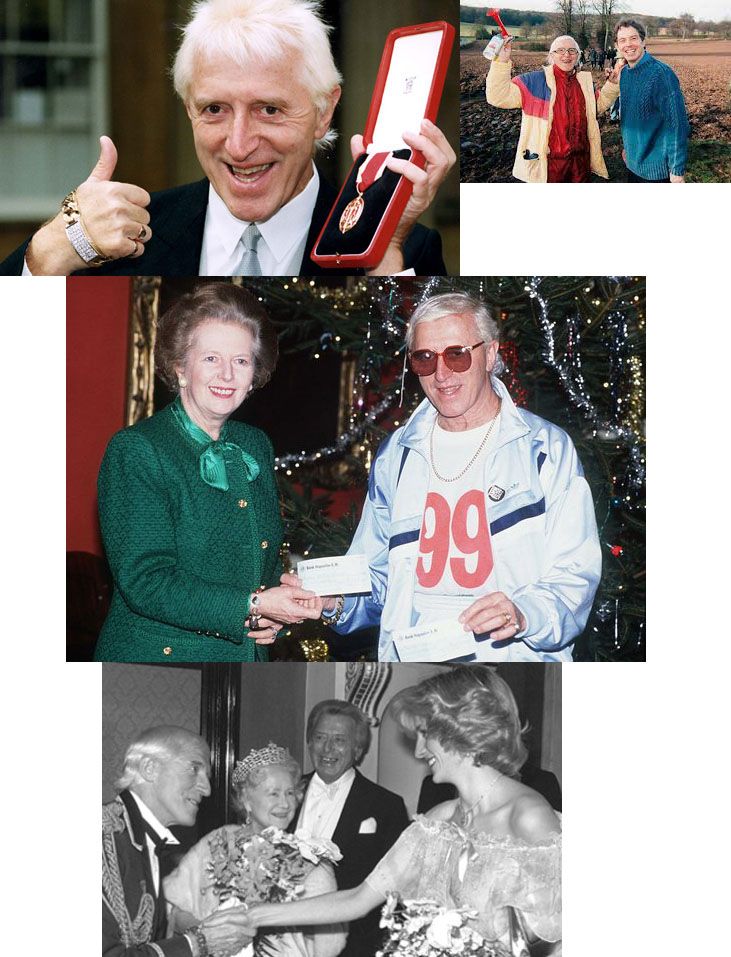
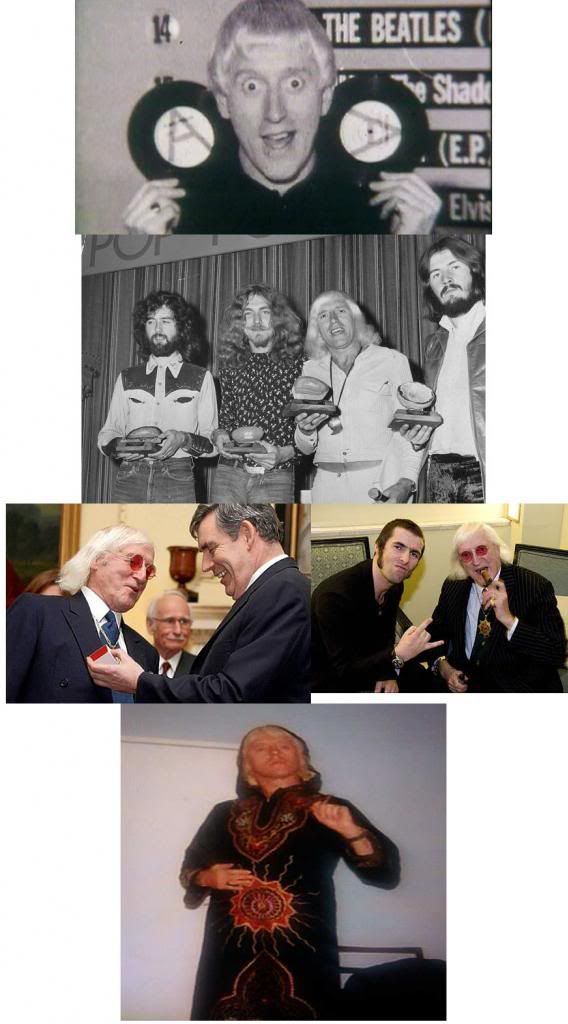
Sir Jimmy Savile received a medal from Israel in 1979, for services rendered.


Reportedly, Savile visited Israel in 1975 to advise Israel's President Ephraim Katzir on a matter of security.


Reportedly, Savile told the Israeli cabinet that he "was very disappointed: the Israelis had won the Six Day War but they had given back all the land, including the only oil well in the region, and were now paying the Egyptians more for oil than if they had bought it from Saudi Arabia."


Reportedly, Savile visited Israel a number of times to offer his advice.


A Manchester businessman, Benny Sternberg, revealed that "Savile had been approached to explore the possibility of a meeting between Sadat and Begin because of his friendship with the family of the Egyptian president's wife Jehan."


"Savile claimed during an interview with The Guardian newspaper’s Simon Hattenstone that he told Professor Katzir: 'I’m very disappointed because you’ve all forgotten how to be Jewish and that’s why everyone is taking you to the cleaners … You won the Six Day War, you took all that land, you gave it all back, including the only oil well in the area, and now you’re paying the Egyptians for the oil you already had.'


"Savile also maintained that the president invited him to repeat his words at a Cabinet meeting. 'They asked my opinion about a couple of things, to which I said, ‘Nothing’s impossible’. They did exactly what I suggested and it worked out 100 per cent successful.’”


"The occasion was confirmed partly by Roger Ordish, producer of Jim'll Fix It, who said: 'I know he met the President when we were in Israel in 1975.'


"Sir Jimmy always said he had berated the Israeli Cabinet in 1975 for being too soft after the Six Day War."


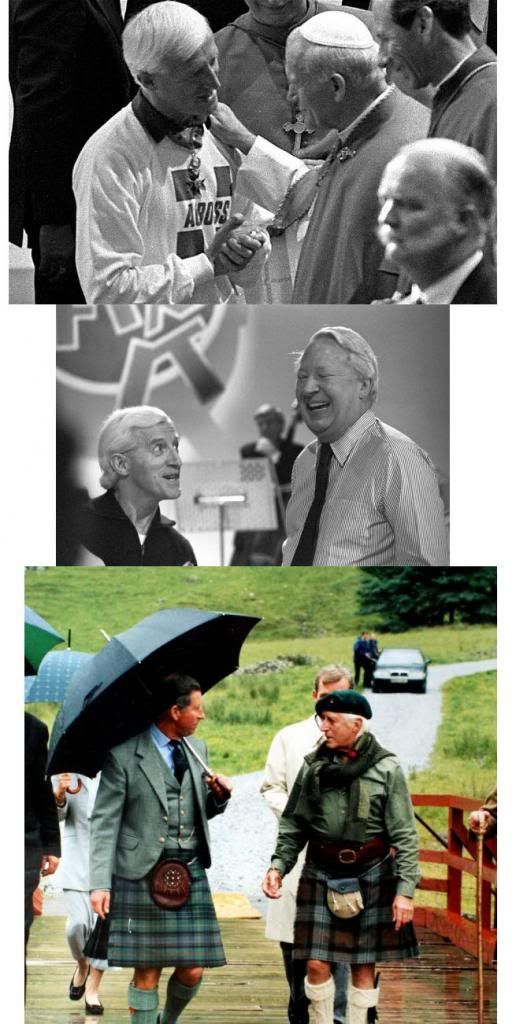
Jimmy Savile had both a Royal and Papal knighthood (Order of St. Gregory the Great)

He was a Knights Hospitaller (also known as the Sovereign Military Hospitaller Order of St. John of Jerusalem of Rhodes and of Malta, Order of St. John, Knights of Malta, and Chevaliers of Malta)


Dec 29, 2012 at 2:06pm

Post by lbak on Dec 29, 2012 at 2:06pm

aSome background on Jimmy Savile....


thesumpplug.blogspot.com/2012_11_01_archive.html

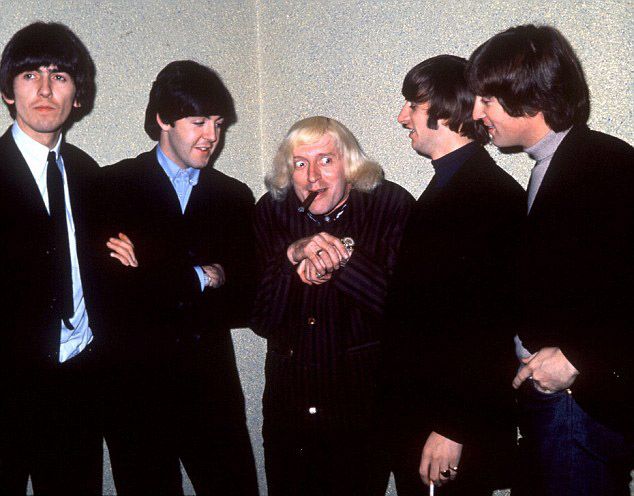
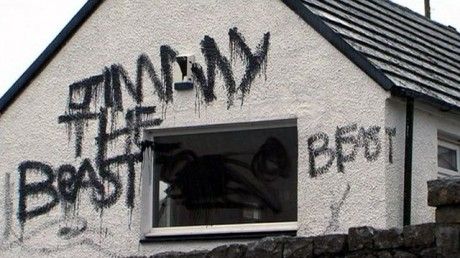
Jimmy Savile's cottage in Glencoe Scotland.


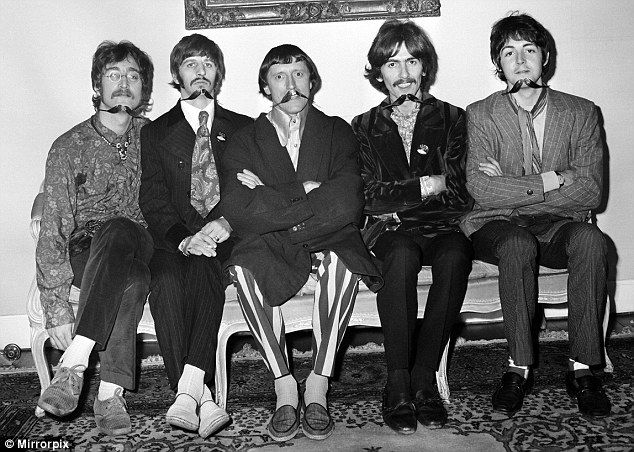
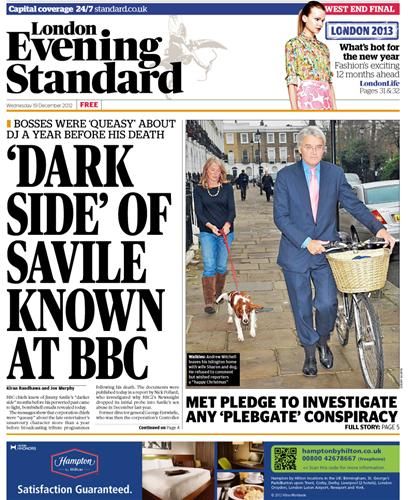
"Jimmy Savile groomed an entire generation, two generations. I don't think anybody in the UK was immune."
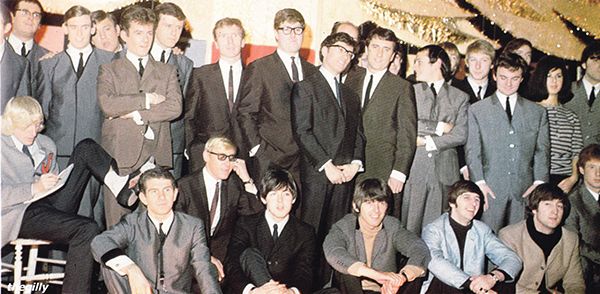
Selling the Beatles, 1962

As a regional businessman and a fledgling band manager, Brian Epstein presumed that the Beatle's record company (EMI's Parlophone) and Lennon and McCartney's publisher (Ardmore and Beechwood) would support the record. This presumption would prove false, however, and Epstein would need to draw on all of the resources he could spare if he were to make the disc a success. He began with what he knew from the retail end of the industry and commenced rallying Liverpudlians to write letters to both Radio Luxembourg and the BBC asking them to play Love Me Do.

Just as the stations XERF (in Ciudad Acua, Mexico) and CKLW (in Windsor, Ontario, Canada) were able to broadcast deep into the United States with transmitters many times more powerful than FCC-regulated American stations, a station in the Grand Duchy of Luxembourg carpeted most of Western Europe. Perhaps surprisingly, Radio Luxembourg (broadcast in the Medium Wave band) was British-owned and its English-language service became a primary outlet for UK businesses whose advertising the BBC declined. (The BBC refused to broadcast anything that suggested product promotion.) Radio Luxembourg suffered its sometimes-scratchy signal; but British listeners tuned in every night to embrace the pop music that Aunty Beeb would not play.

British corporations like EMI and London music publishers like Essex Music directly controlled much of the station's airtime by buying broadcast blocks during which they played pre-recorded programs. Indeed, on Monday 8 October 1962, the Beatles taped an interview at EMI's headquarters in London, which Radio Luxembourg broadcast along with their recording of Love Me Do on Friday 12 October. (George Harrison later recalled the thrill of first hearing himself on that radio broadcast.) The Liverpool letters solicited by Epstein that arrived in Luxembourg eventually arrived at EMI in London where the manager hoped they would catch corporate attention and result in better domestic support for the Beatles and their releases.


"Jimmy Savile joined Radio Luxembourg in 1958. Within two years, he was overwhelmingly the most popular disc jockey in Britain, hosting shows such as "Teen and Twenty." Savile regularly won best DJ of the year polls in kid's magazines. By 1964, when the BBC began broadcasting "Top of the Pops," Savile was the Godfather of the UK pop scene with the power to make or break any artist."

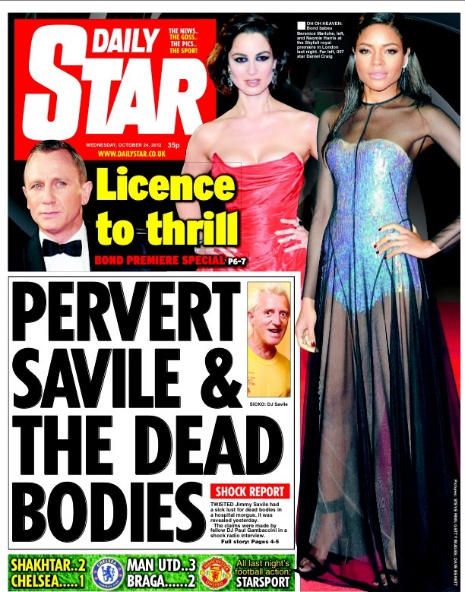
JIMMY SAVILE boasted he knew members of the IRA who could have his enemies hospitalised.

Investigators probing the sex predator DJ believe he used threats of violence to keep his victims quiet during his 50 years of systematic child abuse.

Savile once bragged to a journalist that he could fix anyone who double-crossed him with just one phone call – with startling claims that he had friends in the Irish terrorist group.

He said: “I know the IRA, men from the IRA and you don’t need to ask these guys twice. All I have to do is call my friends in the IRA. They’ll have someone waking up in hospital the next morning eating their breakfast through a f***ing straw.

“I’m serious, don’t f***ing think I’m not serious. I can get them done – just with a phone call, that’s all it takes, young man.”


"In the 1960′s ,The former Radio 1 DJ Alan ‘Fluff’ Freeman owned a large corner shop on the Lea Bridge Rd in London.

"This shop has recently been reported as a place where ‘Fluff’ held kinky parties ,attended by the likes of confirmed bachelor Sir Jimmy Saville , Jonathen King, the once jailed paedophile broadcaster & former pop star and Brian Epstein, who was at the time the Homosexual manager of the Beatles.

At these parties , young boys , specially brought over from several childrens homes would be plied with drugs and alcohol."

Sunday, 8 June 2014

BALKINIZATION OF BRITAIN WITH SCOTTISH INDEPENDENCE


The Swedish Foreign Minister Carl Bilt, says Scottish independence will lead to the "Balkanisation" of the UK. Balkanization, is a geopolitical term used to describe the process of fragmentation or division of a state into smaller regions or states that are often hostile or non-cooperative with one another with the former Yugoslavia being a prime example. Scotland and England entered a political union in 1707, with both parliaments ceasing to exist to be replaced by a new 'united' parliament located in London. Despite the Treaty being a legally binding international treaty, the English parliament and those who regard themselves as particularly crafty Englishmen has ridden rough-shod over Scotland in the Union.


Both nations will be in exactly the same position in the EU, after Scottish Independence and the UK will ceases to exist as a legal entity! London has no veto, and thus the BritScumState in Ireland will also cease to exist, without any further pretensions of being any sort of a defunct British legal entity. Besides all of this, 90% of the UK's oil fields in Scottish waters will be under the jurisdiction of Scots Law. Thus with International maritime law, Britain will become bankrupt. The pound is also Scotland's currency and they will continue using it, which will leave Belfast and the English without a legal currency and their savers bankrupt.

.
The Corporate British media, particularly the BBC, all London-based, are of course supporting the Union and dedicating their resources, to rubbishing everything Scottish, to undermine the nation's confidence as they do in Ireland with the BBC and Irish Times. It is for the people of Scotland alone, inclusive of of all religions and origins, to decide. This is  the democratic right of self-determination of all peoples. Obviously intelligent Scottish voters know, that the best people to govern Scotland and grow its economy are those who live there, and not a distant foreign-dominated parliament in London. They will of course remain close friends with all their neighbours, including what is called the Republic of Ireland, as regards what happens to what is commonly known as the BritScumState and the Orangemen in Ireland remains to be seen.


Friday, 9 November 2012

BHOY WONDERS CELTIC


What a way to celebrate the 125th birthday of Rod Stewart! 


Paul Doyle guardian.co.uk, Thursday 8 November 2012 11.24 EST It happened. It really happened. 

Photograph: Jeff J Mitchell/Getty Images

 BHOY WONDERS What a setting, what a scoreline, and what a way to celebrate the 125th birthday of Rod Stewart! More than a club? The Queen's Celtic are that, thanks partially to triumphs such as the one masterminded by Neil Lennon last night and executed by a band of players who will probably never grace the cover of a market-leading console game but showed Barcelona that if you can't do the basics then you've no business calling yourself the best team in history. The Catalan Art Project conceded one goal from a corner, another from a mighty punt upfield, could have had two players sent off for fundamental incompetence and failed to find any flaw in Lennon's ploy of allowing them to have the ball in wide areas as often as they liked. Therefore Tito Vilanova's glitterati deservedly lost to a side glued together for a cumulative cost of £3.50 and a crate of Tizer. It was a Queen's Celtic display that prompted an intoxicating mass outpouring of emotion from their fans, an intoxicating mass intake of lager by their fans and numerous intriguing questions, such as: aren't Celtic's scouts canny? Why did Newcastle let Fraser Forster go? How long before Barcelona try to sucker them into swapping Alex Song for Victor Wanyama? Did Kenny Dalglish think he was signing Georgios Samaras when he forked out £35m for Andy Carroll? And are you watching, the Pope's O'Rangers? "Good defensive tactics, an amazing performance by Fraser Forster in goal, a partisan crowd and a pinch of good luck," summed up Angel LD Maza in Marca after a match that proved that even 99.9% possession is only nine-tenths of the law. "With these ingredients, [the Queen's] Celtic cooked up a night on which Barcelona were unable to offer their best," continued the scribe before praising the atmosphere conjured by the locals. "There is perhaps no greater home pitch advantage in all of football than a match at Parkhead." "It was an enthralling fight between two different schools of football, similar to what has happened in the last few Clasicos ," added AS's Alfredo Matilla, continuing: "Neither team's style of football is necessarily more dignified than the other's: one is direct, the other more elaborate, but both can lead you to victory." Vilanova and his players were similarly fair-minded in defeat, diluting their disappointment with tributes to the Queen's Celtic's valour and their fans' fervour.