Showing posts with label Long Kesh. Show all posts

Monday, 4 May 2015

ONLY A WORKING CLASS BOY - SANDS - BOBBY SANDS


Bobby Sands 


Biography by Bio

Activist (1954–1981)


Bobby Sands was an Irish nationalist who led a hunger strike in prison in 1981. He was elected Member of Parliament during the strike and died May 5, 1981. 

Synopsis

Born in 1954, Bobby Sands grew up in Belfast under the cloud of nationalist and loyalist divisions. He joined the Republican Movement when he was 18 and was soon arrested and imprisoned for possessing a firearm. A second arrest in 1976 led to a 14-year-sentence. In prison, Sands embarked on a long hunger strike that led to his death. During the strike he was elected a Member of Parliament.
Early Years


A hero among Irish nationalists, Robert Gerard "Bobby" Sands was born in Belfast, Ireland on March 9, 1954. Bobby Sands was the oldest of four children born to John and Rosaleen Sands, and the couple's first son. At an early age, Sands's life was affected by the sharp divisions that shaped the north of Ireland. At the age of 10, he was forced to move with his family out of their neighborhood due to repeated intimidation by loyalists.


"I was only a working-class boy from a Nationalist ghetto," Sands later wrote about his childhood. "But it is repression that creates the revolutionary spirit of freedom."


Loyalist intimidation proved to be a theme in Sands' life. At the age of 18, he was forced out of his job as an apprentice car builder. (He had joined the National Union of Vehicle Builders just two years before.) Not long after, he and his family had to move again, as a result of political trouble.

Activism


The steady number of conflicts pushed Sands to join the Republican Movement in 1972. His ties to the movement soon captured the attention of the authorities, and later that year, he was arrested and charged with possessing firearms in his house. He spent the next three years of his life in prison. Upon his release, Sands immediately returned to the Republican Movement. He signed on as a community activist in Belfast's rough Twinbrook area, quickly becoming a popular go-to person for a range of issues affecting the neighborhood.


In late 1976, authorities arrested Sands again, this time in connection with a bombing that had taken place at a large furniture company and an ensuing gun battle. After weathering a brutal interrogation and then a court proceeding that offered up questionable evidence connecting Sands and three others to the attack, a judge sentenced Sands to 14 years in prison at Her Majesty's Prison's Maze, Long Kesh, a facility used to house Republican prisoners from 1971 until 2000, located just outside of Belfast.


As a prisoner, Sands's stature only grew. He pushed hard for prison reforms, confronting authorities, and for his outspoken ways he was frequently given solitary confinement sentences. Sands's contention was that he and others like him, who were serving prison sentences, were actually prisoners of war, not criminals as the British government insisted.
Hunger Strike


Beginning on March 1, 1981, Sands led nine other Republican prisoners into the H Block section of the Maze, Long Kesh, on a hunger strike that would last until death. Their demands ranged from allowing prisoners to wear their own clothes to permitting visits and mail, all of which were central in improving the inmates' way of life.


Unable to move authorities to give in to his requests, and unwilling himself to end his hunger strike, Sands's health began to deteriorate. During the first 17 days of the strike alone, he lost 16 pounds.


A hero among his fellow nationalists, Sands was elected as a Member of Parliament for Fermanagh and South Tyrone. To the shock of Unionists, he won more than 52 percent of the vote in the north Ireland. While cheered by the victory, Sands seem to know that he was destined to be a martyr.
Death and Legacy


Only days after slipping into a coma, on the morning of May 5, 1981, Sands died from malnutrition due to starvation. He was 27 years old, and had refused to eat for 66 days. He'd become so fragile over his final weeks, he spent his final days on a water bed to protect his deteriorating and fragile body. At time of his death, Sands was married to Geraldine Noade, with whom he had one son, Gerard.


While loyalists dismissed Sands's death, others were quick to recognize its significance. Over the next seven months, nine other IRA supporters died on a hunger strike. Eventually, the British government gave proper political recognition to the prisoners, many of them earning their release under the 1998 Bad Friday agreement.


Thursday, 12 March 2015

HAPPY PADDYS DAY COUNTS


On the 2 March 1972, United Kingdom, Paedophile, Prime Minister, Edward Heath stated in the House of Commons:


"The Government, having reviewed the whole matter with great care and with reference to any future operations, have decided that the techniques ... will not be used in future as an aid to interrogation... The statement that I have made covers all future circumstances." Since that time, the UK have outsourced their torture and taught it to torturers worldwide. Now, the the British Government have declared, that they are leaving the European Court, because they can no longer comply with European Law, neither can the comply with International Law, and have refused to join the International Criminal Court. They are currently torturing, politically interned Irish POWs in Maghaberry, by unecessary strip searching and sticking everything up the arse, as in Kenya in the articles below, which is typical paedophile torture. There is modern equipment as used in airports and prisons all over the world, to carry out this work, without torture and degradation.

As far as Irish Blog is concerned, there is no need to write anymore about UK standards of injustice, the above actions, confirm in themaelves, their uncivilized status.They have just sent the SAS back into Ireland and without European Law, can torture at will in Occupied Ireland again in despite a PSEUDO PEACE PROCESS. They also plan to use Occupied Ireland again, as a test laboratory, to develop further drone technology.

In Irish Blog's Court, they are proven C(O)UNTS!

CASE DISMISSED !


Paper trail: from Northern Ireland’s hooded men to CIA’s global torture


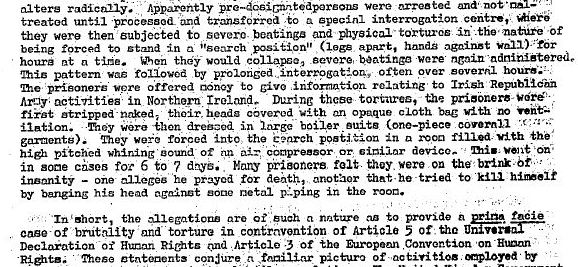
In August 1971 the UK authorities arrested and interned hundreds of men in Northern Ireland. Fourteen of them were selected for "special treatment" - torture in a specially-built interrogation centre at a British Army camp. The men were subjected to the soon-to-be infamous "five techniques" of hooding, stress positions, white noise, sleep deprivation and deprivation of food and water - combined with brutal beatings & death threats.

Allegations soon emerged of abuse. Amnesty International sent its first ever research mission to the UK to investigate, interviewing the men and finding some of them to still be black and blue with bruises.

In it's October 30 1971 report, Amnesty found a "prima facie case of brutality and torture".


Responding to public outrage in Ireland, the Irish government made history by taking the first ever inter-state case under the European Convention of Human Rights, alleging the UK had tortured the men.

While the UK denied torture, Prime Minister Ted Heath soon announced a prohibition by UK forces of any future use of the techniques.

In 1976, the European Commission on Human Rights found that the UK had tortured the men, but the UK appealed the decision claiming that the techniques used had no long-term impact.

The appeal succeeded and in 1978 the European Court of Human Rights found that the interrogation amounted to "inhuman and degrading treatment" but not torture.

The difference was subsequently seized upon by those who wanted to use similar interrogation techniques.

In 2002, Jay Bybee in the US Attorney General's office prepared legal advice on what could and could not be done to interrogation subjects. He quoted liberally from the Ireland v UK 1978 decision in the infamous 'torture memos':


Within months, the CIA was using the "five techniques" in Iraq, Afghanistan and around the world.

Here's an excerpt from a CIA report on what they did when interrogating a "high value detainee" (HVD). The similarity of the torture techniques to those applied in Northern Ireland is striking.


With the publication today of the US Senate report into CIA torture, more of the horror of US abuses has now been laid bare.

Meanwhile, happy with the downgraded European Court decision and the "special stigma of torture" removed, the UK quietly forgot about Ted Heath's supposed probihition. In Iraq, the techniques were put to use again.

They cost Baha Mousa his life. The inquiry into his death found that the Iraqi's 2003 demise was caused by "factors including lack of food and water, heat, exhaustion, fear, previous injuries and the hooding and stress positions used by British troops - and a final struggle with his guards".
Letter from Home Secretary Merlyn Rees to Prime Minister Jim Callaghan in 1977, when the UK was arguing (successfully, as it turned out) in Strasbourg that the techniques used were not torture

Meanwhile, through work by the Pat Finucane Centre, NUI Galway and RTÉ, files were discovered in the UK state archives in Kew suggesting that Britain misled the Court in 1978, withholding key evidence demonstrating they knew the techniques had long-term health impacts on the victims, and that the torture had been authorised at UK Cabinet level.

Following calls from Amnesty International and others, the Irish government has now decided to appeal the European Court decision in light of the new evidence. Perhaps the 'hooded men' will finally have their day in a Strasbourg Court with the full truth before it.

Shockingly, to date, no proper, independent investigation of the torture of the 'hooded men' has ever been carried out by the UK authorities and no-one has ever been held to account.

With total impunity in the UK for torture conducted in Northern Ireland in the 1970s, it is perhaps no wonder that the US followed the example of their closest ally when it came to fighting their 21st century "war on terror".
New evidence of British colonial atrocities has not changed our national ability to disregard it
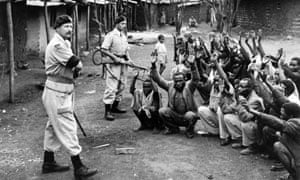
Members of the Devon Regiment round up local people in a search for Mau Mau fighters in Kenya in 1954. Photograph: Popperfoto/Popperfoto/Getty Images

@GeorgeMonbiot


There is one thing you can say for the Holocaust deniers: at least they know what they are denying. In order to sustain the lies they tell, they must engage in strenuous falsification. To dismiss Britain's colonial atrocities, no such effort is required. Most people appear to be unaware that anything needs to be denied.

The story of benign imperialism, whose overriding purpose was not to seize land, labour and commodities but to teach the natives English, table manners and double-entry book-keeping, is a myth that has been carefully propagated by the rightwing press. But it draws its power from a remarkable national ability to airbrush and disregard our past.

Last week's revelations, that the British government systematically destroyed the documents detailing mistreatment of its colonial subjects, and that the Foreign Office then lied about a secret cache of files containing lesser revelations, is by any standards a big story. But it was either ignored or consigned to a footnote by most of the British press. I was unable to find any mention of the secret archive on the Telegraph's website. The Mail's only coverage, as far as I can determine, was an opinion piece by a historian called Lawrence James, who used the occasion to insist that any deficiencies in the management of the colonies were the work of "a sprinkling of misfits, incompetents and bullies", while everyone else was "dedicated, loyal and disciplined".

The British government's suppression of evidence was scarcely necessary. Even when the documentation of great crimes is abundant, it is not denied but simply ignored. In an article for the Daily Mail in 2010, for example, the historian Dominic Sandbrook announced that "Britain's empire stands out as a beacon of tolerance, decency and the rule of law … Nor did Britain countenance anything like the dreadful tortures committed in French Algeria." Could he really have been unaware of the history he is disavowing?

Caroline Elkins, a professor at Harvard, spent nearly 10 years compiling the evidence contained in her book Britain's Gulag: the Brutal End of Empire in Kenya. She started her research with the belief that the British account of the suppression of the Kikuyu's Mau Mau revolt in the 1950s was largely accurate. Then she discovered that most of the documentation had been destroyed. She worked through the remaining archives, and conducted 600 hours of interviews with Kikuyu survivors – rebels and loyalists – and British guards, settlers and officials. Her book is fully and thoroughly documented. It won the Pulitzer prize. But as far as Sandbrook, James and other imperial apologists are concerned, it might as well never have been written.

Elkins reveals that the British detained not 80,000 Kikuyu, as the official histories maintain, but almost the entire population of one and a half million people, in camps and fortified villages. There, thousands were beaten to death or died from malnutrition, typhoid, tuberculosis and dysentery. In some camps almost all the children died.

The inmates were used as slave labour. Above the gates were edifying slogans, such as "Labour and freedom" and "He who helps himself will also be helped". Loudspeakers broadcast the national anthem and patriotic exhortations. People deemed to have disobeyed the rules were killed in front of the others. The survivors were forced to dig mass graves, which were quickly filled. Unless you have a strong stomach I advise you to skip the next paragraph.

Interrogation under torture was widespread. Many of the men were anally raped, using knives, broken bottles, rifle barrels, snakes and scorpions. A favourite technique was to hold a man upside down, his head in a bucket of water, while sand was rammed into his rectum with a stick. Women were gang-raped by the guards. People were mauled by dogs and electrocuted. The British devised a special tool which they used for first crushing and then ripping off testicles. They used pliers to mutilate women's breasts. They cut off inmates' ears and fingers and gouged out their eyes. They dragged people behind Land Rovers until their bodies disintegrated. Men were rolled up in barbed wire and kicked around the compound.

Elkins provides a wealth of evidence to show that the horrors of the camps were endorsed at the highest levels. The governor of Kenya, Sir Evelyn Baring, regularly intervened to prevent the perpetrators from being brought to justice. The colonial secretary, Alan Lennox-Boyd, repeatedly lied to the House of Commons. This is a vast, systematic crime for which there has been no reckoning.

No matter. Even those who acknowledge that something happened write as if Elkins and her work did not exist. In the Telegraph, Daniel Hannan maintains that just eleven people were beaten to death. Apart from that, "1,090 terrorists were hanged and as many as 71,000 detained without due process".

The British did not do body counts, and most victims were buried in unmarked graves. But it is clear that tens of thousands, possibly hundreds of thousands, of Kikuyu died in the camps and during the round-ups. Hannan's is one of the most blatant examples of revisionism I have ever encountered.

Without explaining what this means, Lawrence James concedes that "harsh measures" were sometimes used, but he maintains that "while the Mau Mau were terrorising the Kikuyu, veterinary surgeons in the Colonial Service were teaching tribesmen how to deal with cattle plagues." The theft of the Kikuyu's land and livestock, the starvation and killings, the widespread support among the Kikuyu for the Mau Mau's attempt to reclaim their land and freedom: all vanish into thin air. Both men maintain that the British government acted to stop any abuses as soon as they were revealed.

What I find remarkable is not that they write such things, but that these distortions go almost unchallenged. The myths of empire are so well-established that we appear to blot out countervailing stories even as they are told. As evidence from the manufactured Indian famines of the 1870s and from the treatment of other colonies accumulates, British imperialism emerges as no better and in some cases even worse than the imperialism practised by other nations. Yet the myth of the civilising mission remains untroubled by the evidence.

• A fully referenced version of this article can be found at www.monbiot.com

Sunday, 18 August 2013

INTERNMENT DENIAL SPEECH OF X REPUBLICAN McGUINNESS


Here is the speech delivered by McGuinness in full:

When people mention the town of Balinamore, they inevitably mention John Joe McGirl.
John Joe epitomised everything that is good about our struggle.
Be it his involvement in the IRA in the 1930s, to his leadership role in the Border Campaign, or his election to Leinster House, or his key part in reorganising Republicanism in the early 1970s, or his decisive contribution in 1986, John Joe always led from the front.
He was, and he remains for Republicans, not just here in Leitrim, or the border, but across our country, an inspirational leader.
25 years on from the time we laid John Joe to rest he continues to inspire.
Why is this?
It is because John Joe knew about struggle.
He knew about strategy.
He knew what it meant to carry the burden and the responsibility leadership and he knew that at all time the struggle needed to move forward.
He also knew about our past – but he was never a hostage to it.
He was a County Councillor from 1960 up until the time of his death, during years when for some Republicans electoralism was a bad word.
Not for John Joe. He knew that popularising our struggle and making it relevant to people was the way we would bring about Irish reunification and freedom.
He didn’t fear carrying the Republican message of freedom and justice and peace into political institutions – indeed it was John Joe and people like him who led the way for the people like me coming behind him.
Partition was an injustice and it was an injustice that John Joe committed his entire adult life to ending.
And it is an injustice that we remain committed to ending today.
The past few weeks have not been good weeks for the political process in the north.
The peace process needs political leaders with the skills and craft of John Joe McGirl at this time.
Political unionism needs to realise that nothing can be gained by continually feeding the insatiable appetite of those who see life through a red, white and blue prism. They are violently opposed to this process because at the heart of it they are opposed to Equality.
History is littered with unionist leaders who made this mistake.
I have never been selective in condemning and challenging violent attacks on the peace process from whatever quarter. I do not look over my shoulder, my face and the face of this party is firmly focused on the future.
And I believe that the future will be better than the past.
The history of our Peace Process tells any observer one thing.
When Republicans make agreements – we implement them.
This week’s decision by the DUP to abandon the agreement reached on the future development of the Maze/Long Kesh site is a mistake.
It is a mistake not just because it jeopardises much needed investment and jobs, but also for the message it sends to the vast majority of people –nationalist and unionist – who are rock solid behind the peace process.
Some in the extremes of political unionism believe that they can unpick Good Friday Agreement. Moves like this give them succour.
However it ignores the political reality and ignores the fact that the vast majority of unionists want to see this process succeed. They are not interested in re-fighting battles that are long over, or harking back to a time that has long gone.
They want to see their political leaders get on with the job of reconciliation and delivering in the government.
They are embarrassed by the antics of the thugs who attacked the police in recent weeks in Belfast while wrapped in the Union flag.
The Orange State that I grew up in is gone – and most sensible unionists realise that is a good thing - it is time that political unionism woke up to this reality.
So the choice for unionism is very clear – come a share power on the basis of equality and real partnership – and when you do that you will find genuine nationalist and republican partners – or pander to rejectionists who abhor equality, fairness and parity of esteem.
Richard Haas will come to Ireland next month to chair all-party discussions. We will approach these talks with the objective of advancing the peace process and further underpinning the political institutions.
We want to see agreement on parades, on flags and emblems and on dealing with the legacy of the past. The Haas talks are not about replacing the Parades Commission to satisfy the demands of the Orange Order.
I am entirely comfortable with unionists seeking to express a British identity in a sensible and non-confrontational fashion.
Likewise I expect them to acknowledge and recognise my Irishness in the same spirit. I do not believe that is too much to ask or expect.
The Haas talks can succeed if everyone approaches them in this spirit.
Confidence in the political process can be built. Progress on difficult issues can be made. But we cannot do this on our own. There needs to be unionists who are willing to be partners in peace.
John Joe McGirl would have understood well the events of the past month. He would not have been surprised.
He would also have understood well the plight of many young people across this island, especially in this region, once again facing the prospect of emigration.
Partition has distorted the economy of this and other areas.
The best way for the people of Leitrim to honour the memory of John Joe McGirl is to work harder to deliver on what he worked for – a real Republic, a united Ireland based on the principles of equality and social justice for all. For counties like Leitrim and towns like Ballinmore, all-Ireland cooperation is key to economic development and job creation.
For the republicans of Leitrim, I would say that if you wish to ensure John Joe McGirl’s legacy is maintained and built upon you need to build and organise Sinn Féin throughout this county and increase the party’s representation at all levels.
That is the path John Joe set us on 60 years ago. It is a path which offers a peaceful and democratic way to a United Ireland.
There are Local and European elections next year. This provides a real opportunity to increase the Sinn Fein representation on Leitrim County council and to elect a Sinn Féin MEP in the north west constituency.
I would call on the people of Ballinamore and of Leitrim to get behind the Sinn Féin EU candidate Matt Carthy. It’s time to put a voice into Europe that will stand up for the ordinary people of this region.
In 1957 at the gravesides of those killed at Edentubber, John Joe McGirl said “The tragedy which brought to a sudden end the lives of five great Irishmen is a tragedy of the Irish nation, the tragedy of an Ireland that is unfree and divided. These men came from the North and the South to join together to end the tragedy of our nation and her people.’
This generation of Irish Republicans have ended the conflict, we have put in place a political process and strategy which can end partition, division and inequality.
We need to always move ahead along that road. I believe that we are up to the task. We have an opportunity to realise the objective for which John Joe dedicated his life.
A united, independent Irish Republic is not rhetoric for us, it is a real and live political project which, if we are prepared to work hard and win even more people to our objective, will be achieved. That is a responsibility we all share.


Tuesday, 30 July 2013

BEFORE ABU GHRAIB LONG & KESH MARTIN COREY


Negotiations are currently being carried out between the British government and legal representatives of Mau Mau insurgents who were tortured by colonial law enforcement officers during the Mau Mau rising.  

Britain established British East Africa, as a protectorate on 1 July 1895.  Under an arrangement similar to the plantation of Ulster in Ireland in the 16th and 17th centuries, white settlers were encouraged to emigrate to Kenya.  The British seized over 7 million acres of land including an area that became known as the White Highlands, which was set aside for the exclusive use of white European settlers.

Kenyans rebelled against British rule and colonialism, climaxing with the Mau Mau Revolt of 1952.  A state of emergency was declared on 20 October 1952, during which Operation Jock Scott was launched.  Although KAU President Jomo Kenyatta and 180 other Mau leaders were interned without trial, as happened later with Operation Demetrius in British Occupied Ireland, many of the movement’s most instrumental members were able to evade capture, as news of the impending sweep had been leaked. 

 By 1953, the British had screening centres in their detention camps, and began mass deportations of Kikuyu from Nairobi, which was the center of the Mau Mau insurgency. Forced labor was imposed, and internment camps were established.  Within these internment camps and screening centers torture took place.  A 2011 editorial in The British Guardian compared them to Nazi concentration camps:

'There is something peculiarly chilling about the way colonial officials behaved, most notoriously but not only in Kenya, within a decade of the liberation of the concentration camps and the return of thousands of emaciated British prisoners of war from the Pacific. One courageous judge in Nairobi explicitly drew the parallel:  Kenya’s Belsen, he called one camp.'

The Kenya Human Rights Commission reported that 90,000 Kenyans were tortured or executed by British security forces during the Mau Mau Rebellion, as techniques including electric shock, cigarette burns, sodomy and rape were used to gather intelligence about insurgent operations.   Some were burned alive, while others were castrated or had other body parts cut off.  In many cases, detainees died due to such brutal treatment.

'With the tacit consent of ministers at Westminster, a British administration in colonial Kenya chose to behave as if Africans had no human rights. Rattled by a handful of murderous attacks on planters, they tried to face down the rebels using the empire's default setting of brutality. Castration, sodomy, rape and beatings were everyday weapons in its unremitting defence of the rights of the white settlers.'

In 2009, British lawyers Leigh, Day & Company filed a compensation claim on behalf of five Kenyans who suffered abuse and torture at the hands of the British authorities.  In addition to detailing acts of torture against each of the claimants, the papers alleged “widespread interference by British authorities in criminal investigations into allegations of abuse and torture of Kenyans” and that “London ignored detailed reports of widespread and systematic violence by security forces.”  According to the suit, “Far from being the acts of a few rogue soldiers, the torture and inhuman and degrading treatment of Kenyans during this period was systemic and resulted from policies which were sanctioned at the highest levels of the British government by the then-colonial secretary.”

Other colonial situations in which Britain used torture include Swaziland, Aden and British Guiana.  These stories are detailed in a book calld, Cruel Britannia. These same techniques were used in British Occupied Ireland during the Troubles, the ones that were inflicted on the Hooded Men.  In fact, both the Compton Committee and the Parker Committee found that the techniques used in British occupied Ireland in 1971 were the same as thosee approved for use in previous operations that included Kenya.

Forty two years ago internment without trial was again introduced in British Occupied Ireland after which the irish Government were forced to take the British to the European Court of Human Rights where the British were found guilty of torture. AAfter the verdict the British Government gace an undertaking to the world they would use these techniques again. What they failed to mention was that they passed the techniques on by training Americans to use them in Abu Graib. They also fulfilled their undertaking by using Americans and extraordinary rendition to do their dirty work for them.

A spokesperson for Britain’s Foreign Office said, “It is an enduring feature of our democracy that we are willing to learn from our history.”  Given Britain’s sustained use of torture against its own people, one must question the veracity of that statement indeed any statement beaing in mind the treatment of one Martin Corey. Martin Corey was incarcerated by the British in Long Kesh Concentration Camp over 40 years ago and is still interned without trial now in Maghaberry.

We are just coming up on the 42nd anniversary of internment without trial, in the latest phase ob Britain's unrelenting war on the plain people of Ireland when internment without trial was introduced on the 9 th of August 1971. The Plain people of Ireland took to the streets to protest internment without trial, unarmed peacefully in Derry. They were gunned down in a cold blooded massacre on Bloody Sunday in Derry. Martin Corey currently interned more than 3 years without trial, simply for his political belief in a United Ireland. He is a prisoner of political conscience interned by the dictat of an unelected English Viceroyal in Ireland

Wednesday, 3 July 2013

LONG KESH CONCENTRATION CAMP | Martin Corey | British Occupied Ireland


During the seventies, former bishop of Derry Edward Daly experienced Bloody Sunday close up, where the British shot dead 14 unarmed protesters on Bloody Sunday protesting internment, he gave them their last rites. He visited both loyalist and republican prisoners in the infamous Long Kesh Concentration Camp – later renamed by the disgraced British as the Maze.
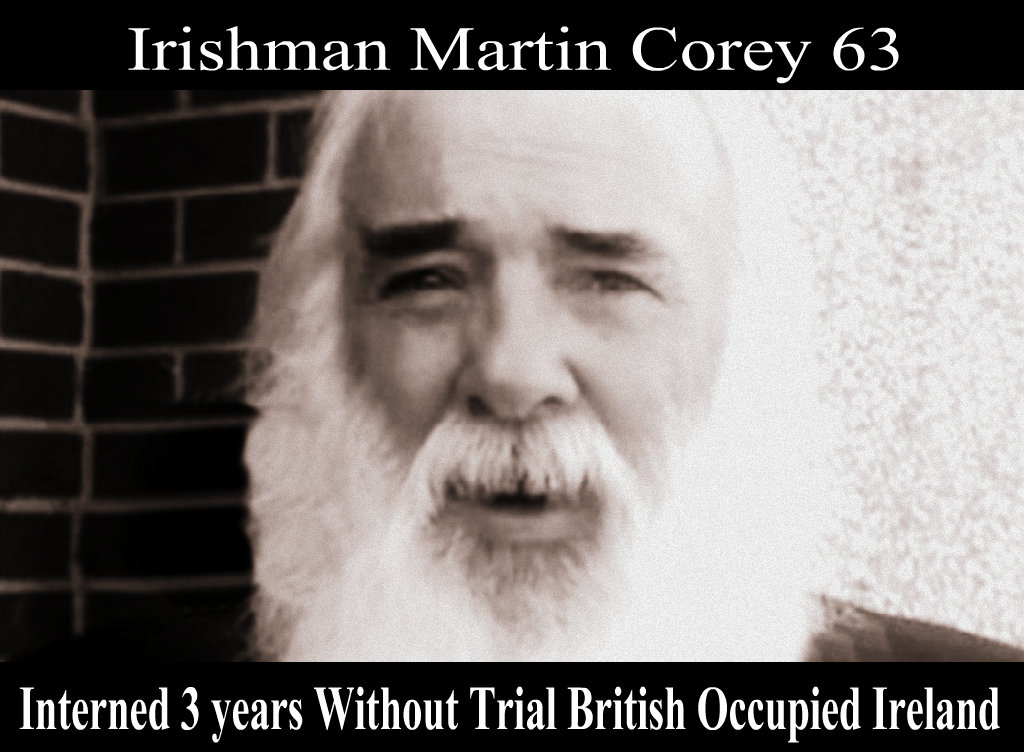
In 1976, paramilitary prisoners had their ‘political’ status removed and were treated as criminals which sparked the blanket protests and political prisoners refused to wear jail uniforms, which  later escalated into hunger strikes. Below is an an extract from Bishop Daly's book, describing the foul conditions at Long Kesh Concentration Camp, where current political internee Martin Corey, has spent most of his adult life.  He is 63 now, having spent 22 years as a political prisoner of conscience in British hellholes, 19 years in Long Kesh, seperate from the  most recent, being 3 years in Maghaberry without trial. He is still interned more than 40 years later, in British Occupied Ireland despite a Peace Process without due process.
IN MARCH 1978, the prisoners ‘on the blanket’ escalated their protest by refusing to clean out their cells, wash or go to the toilet. They smeared the walls and ceilings of their cells with their own excrement and the floors streamed with urine. The lasting memory of visits to Long Kesh during that protest was the horrendous stench. The cells were industrially cleaned by the prison authorities with power hoses from time to time and prisoners were moved to other cells. I have no idea how people lived or worked in those conditions. During my visits there to the wings, I was violently ill on several occasions. The revolting and foul smell seemed to permeate everything I wore, even days after the visit. Items of outer clothing, even after dry cleaning, were virtually unusable subsequently.
In 1980, after four years of unsuccessful protests appealing for special status, a status that would recognise them as political prisoners, prisoners of war rather than criminals, rumours began to circulate that a hunger strike was imminent.
Individually and jointly, Cardinal Tomás Ó Fiaich and I made several lengthy visits to the H-Blocks in Long Kesh Prison in the spring and summer months of 1980, meeting virtually all the protesting prisoners individually in their cells. These visits usually lasted from early morning until late in the evening. We also met with the prison authorities and visited some Loyalist prisoners, including some of their better-known leaders.

‘It was a parallel universe’

Those lengthy visits to Long Kesh are etched forever in my memory. Spending seven or eight hours at a time going around cells visiting young men in those conditions was unforgettable. It was a parallel universe. There were usually two men in each cell. Their hair was matted and they had long unkempt beards. They were thin and haggard and their eyes were sunken. They wore long blankets. There was no furniture in the cells. The stench was intense and allpervasive. I simply do not know how people retained their sanity after spending such a long time in that environment. Yet I always found the prisoners in high spirits and imbued with a steely determination. Only a few of them talked about a hunger strike.
However, Cardinal Ó Fiaich and I were both convinced that if they embarked upon that course, they would see it through. We also believed that if these men were to embark on their threatened hunger strike, it could have disastrous consequences for the community as a whole. We decided to approach the British Government jointly on behalf of the prisoners. We believed that they had a legitimate and arguable case and that both the Government and prisoners and society generally in the North would benefit from a less stringent and degrading prison regime. We reached this conclusion on the basis that were it not for the political circumstances that these young people found themselves in, most of them would never
have seen the inside of a prison. Most of them came from stable family backgrounds.
We also believed that these protests were undertaken on the prisoners’ own initiative, rather than on bidding or orders from any group outside the prison. Equally, we believed that the protest in the prison was perceived by the prisoners as their continuing contribution to the struggle going on outside the prison.
The issue was further complicated by the fact that a sustained paramilitary campaign was going on contemporaneously throughout the North. In the course of that campaign, many prison officers were murdered. Those who perpetrated these murders claimed that they were acting in support of the prisoners on protest. There was intense anger and hatred between the prisoners and prison staff. There were many allegations of assault. Intimate body searches were frequently carried out, often in a brutal and demeaning manner. There are few dignified methods where intimate strip searches are concerned. The searcher and the searched are dehumanised. Long Kesh was a loathsome, hateful place as well as a powder keg as the 1970s moved to the 1980s.
Edward Daly and Cardinal Ó Fiaich would later meet with the British government in an attempt to negotiate an end to the 1981 hunger strikes, in which ten prisoners died. He writes that the strikes worsened community divisions, and intensified violence, concluding: “I hope there will never again be a hunger strike in Ireland.”
See Link for details and Retweet or Reshare if you Support the  ReleaseMartinCorey  Campaign.

Tuesday, 2 July 2013

MARTIN COREY BRITISH OCCUPIED IRELAND CONCENTRATION CAMP SURVIVOR INTERNED AGAIN


Martin Corey who served almost twenty years in Long Kesh Concentration Camp, British Occupied Ireland as a Political Prisoner, has been interned again without trial for the last three years. Martin was released in 199i but despite serving such a lengthy period as a Political Hostage, Martin remained dedicated to his beliefs as an Irish Republican and to his community.

More than three years ago the Lurgan Republican was wrongfully interned in Maghaberry Gaol again on the word of the British Secret Services, MI5. Martin Corey is not guilty of any crime. He simply believes in the re-unification of his country and has not been involved in any militant activity,since his release in 1992. It is not a crime to be Irish or peacefully demonstrate support for Eire Nua, unless you live in the scum state of British Occupied Ireland

The British are simply making an example of Martin, to strike fear in all those who would dare stand up for their human rights, particularly the thousands of ex-Political Prisoners after the peace process in Ireland who would support peaceful alternatives to provisional Sinn Fein. The British and their agents in the supposed free state are censoring peaceful working class alternatives to a united island of Ireland.


Those within the Nationalist and Republican community who have taken up seats in the British parliament of Stormont or on British paramilitary police boards, must ask themselves will they continue to be silent partners in these tactics of British repression. Last time internment was introduced, it started 40 years od war in Ireland and the Nationalist party of that time the SDLP walked out of the British parliament. 
Jim McIlmurray a totally non political friend wrote the following;"Martin Corey has spent three years in Maghaberry Prison without any charges ever being placed against him. During that time, police have never questioned or interviewed Martin regarding any incident, occurrence or event relating to his imprisonment.

So who is Martin Corey ?

Martin Corey is a 63 year old man who served more than 19 years of his life in Long Kesh Concentration Camp as a republican prisoner. He was released by the prison authorities in 1992 and began to rebuild his life. He is a popular figure from a well respected, hard-working family in the town.

It was a proud day for Martin when he was granted a loan to purchase his own mechanical digger. After a time, he gained the contract as the parish grave digger, covering several cemeteries in the greater Lurgan area. Many people, myself included, will recall his compassionate approach and professionalism during the time of families' bereavement.

In all the time I have known Martin, I have only known his interests to be his family, his friends and his love of coarse fishing.

On Friday, April 16th, 2010, the police arrived at his O’Neill’s Terrace home and told him they had a warrant for his arrest. Martin was brought to Lurgan PSNI station and later that day transferred to Maghaberry prison. It was stated he broke the terms of his Life Licence release. When his solicitor requested to know what Martin was alleged to have done, he was told it a matter of National Security and the subject of closed file information.

For the past three years, his solicitor and lawyers have challenged his unlawful detention on numerous occasions in the High Court. On Monday, the 9th of July, 2012, a High Court judge, Justice Seamus Tracy, who has a background in the European Human Rights Courts, ordered Martin’s immediate release, stating that his Human Rights had been breached under sections 4 and 5 of the European Human Rights act and that there were no charges for which he should answer. I waited for 4 hours outside Maghaberry with Martin’s family that day, only to be told at 4:15pm that the then current Secretary of State, Owen Patterson, had overruled the High Court judge and blocked Martin's release. I was 25 yards away from Martin when I received that call. I watched him step out of the prison van at the reception centre and watched him walk back to the van to be returned to his cell. As he got into the van, he paused and stared at me and that will always be one of the hardest and cruelest moments I have ever witnessed in my life.


Martin has a legal entitlement to an annual Parole Board review every twelve calendar months to reevaluate the reasons for his continued detention. I have been accepted to speak on Martin’s behalf; however, every date set for a hearing for Martin last year was followed by a cancellation by the Parole Board, citing numerous excuses. Martin hasn’t received a parole review in 18 months, an action deemed illegal by the Court of Human Rights in Strasburg. We are currently awaiting a date to take this case to the High Court for a judicial review.


Martin has been subjected to a number of incidents during his time in Maghaberry Prison. These incidents include waiting over three weeks for an emergency dental appointment; of note, a veterinarian would have a legal obligation to report a pet owner for cruelty if he found an animal to be suffering for that period. Also, Martin's request for compassionate leave to attend the funeral of his brother was denied by both the Prison Service and the Courts without any reasons given. He was only granted leave to attend 1 hour before the service started after a request was made to the Justice Minister on humanitarian grounds. I had to make three requests to the Prison Ombudsman to intervene in cases concerning material submitted by myself for Martin for use in his cell crafts. The prison staff either confiscated the printed image materials or refused to provide them to Martin. The Prison Ombudsman upheld all three decisions in Martin’s favour, ruling against the Northern Ireland Prison Service and determining that the material must be provided to Martin.

Martin’s case has been in the High Court in Belfast several times over the past three years, without any finding of criminal offence with which to charge him. Had Martin been charged with possession of an illegal firearm during his arrest three years previously, he would have been released six months ago. There is no other name for his illegal detention other than internment without trail.

As a close friend of Martin's, I am in a better position than most to know if he was ever involved in any activity that could be deemed illegal or “a threat to National Security”, a phrase often utilized by faceless, nameless individuals in the courts. I can say without fear of contradiction that Martin is an innocent man. Everyone should make their voice be heard and call upon the Secretary of State to either bring charges against him or release him immediately.

I speak to Martin by telephone on a daily basis and visit him regularly in Maghaberry Prison, and can assure everyone that his spirits remain high despite his total lack of confidence in the judicial system in the North of Ireland. He thanks everyone for their continued messages of support .

We are currently awaiting a date to attend the Court of Appeal in London to challenge his illegal detention. If unsuccessful there, we will take his case to the European Courts of Justice. We will continue our presence at the Belfast High Court to request the Parole Board to give an explanation as to why Martin has been denied his legal right to an annual Parole Review."


Retweet to Release Martin Corey


Political Prisoner of Conscience 

British Occupied Ireland.


Saturday, 22 June 2013

LONG KESH H-BLOCKS HAVEN''T GONE AWAY YOU KNOW !


Long Kesh Lyrics and guitar chords, The Wolfe Tones. Author unknown, as is with many rebel songs, the chords may not be as The Wolfe Tones sing it, always change the key to suit your own voice.


There's[G] a place just[C] outside[G] Lisburn

It's a place that's[D] known to[G] few

Where a[C] group of[D] Irish re[G]bels

Are[C] held by[D] Faulkner's[G] crew

They are forced to[D] live in[G] cages

Like the inmates[D] of Belle[G]vue

But the sperit of[D] 19[G]16

Will always[D] see them[G] through
The men in this vile place
They come from far and near
Some from the Derry Bogside
And Omagh town so near
And some of them from Belfast
From the markets and the Falls
From the narrow streets of Ardoyne
And all around Tyrone
On that black day in August
When Faulkner showed his hand
He thought that by internment
He could break our gallant band
But the boys from Ballymurphy
How they showed the way that night
How they thaught those English soldiers
How Irish men could fight
Long Kesh it's known to everyone
The system must be broke
Ardoyne the New Lodge and the Falls
Will see the system choke
No more the special powers act
The means will envoke
And Long Kesh will be the U stone
Of which the system's broke
A word now Irish people
No matter where you are
Remember our brave rebels
In Long Kesh this year
And by civil disobeience
Or any other way
We'll make a stand until the day
Each one of them are free

Stop the Internment Torture of 63 Year Old Martin Corey 

category international | rights and freedoms | opinion/analysis author Saturday June 15, 2013 17:03author by brionOcleirigh - AllVoices Report this post to the editors
Release Martin Corey
Imagine if you will, being taken from your home, without a reason or charge, by paramilitary police, who regularly collude in the murder of lawyers and journalists. You are then imprisoned for three years, without being told, how long you will remain kidnapped, by these scum state thugs.
Martin Corey
Martin Corey
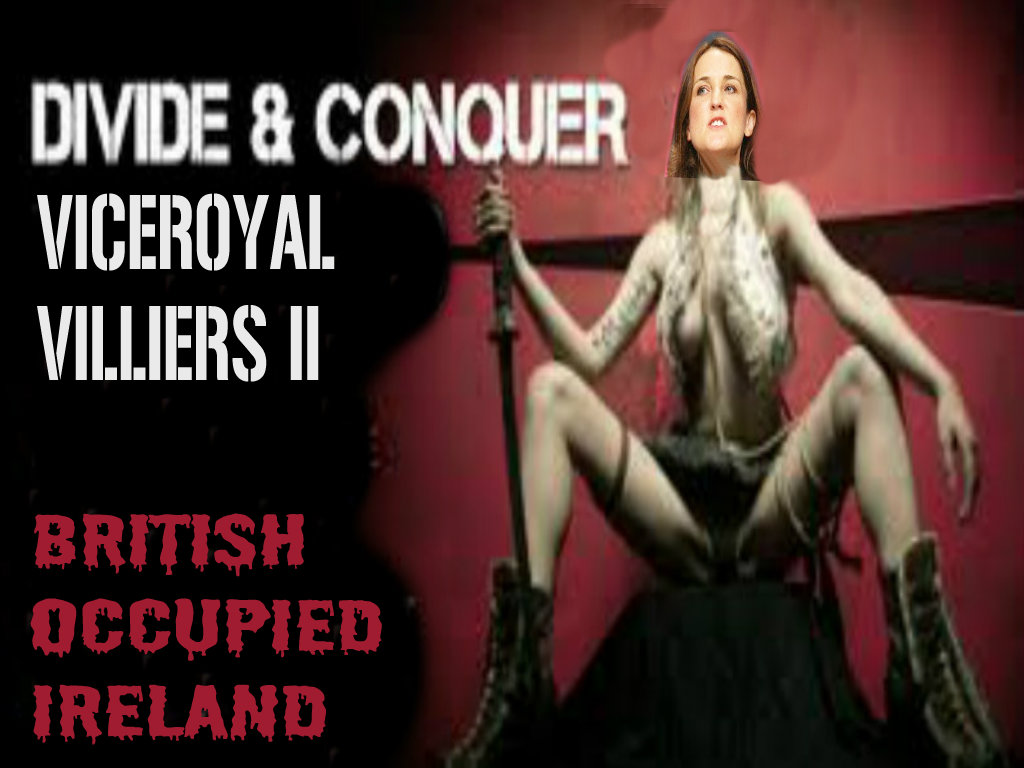
When a judge is informed about the details of your kidnap, he orders your immediate release. You are taken to the front gate to be released, where you are about to embrace your loved ones, when another dictatorial order, from an unelected English Viceroyal, who inherited her appointed position, from her great, great grandfather, who disappeared millions of your people in a holocaust, orders your kidnap perhaps for the rest of your life, again.

Is this mental torture ? Is this a breach of your human rights. In the instance of Martin Corey, bearing in mind the trauma and his elderly 63 years, it may well be in fact a death sentence, with the history of considerable torture, suffered previously by Martin, at the hands, boots and batons of sectarian state kidnappers who imprison you. The last time Britain introduced internment without trial in the early 1970's, Britain was found guilty by the European Court of Human Rights of torture, when Martin Corey was also battered and tortured, at that time.

Now 40 years later, they are torturing him again, refusing dental treatment for weeks on end of agony, while his handicraft wooden work, is smashed by sectarian prison guards. How then can there be peace, with such injustice in British Occupied Ireland? How can the Peace Process work, with the British Tories systematically undermining and breaching it?

With British internment without trial last time, the Nationalist Constitutional Party of the SDLP, was forced to withdraw from a parliament, dubbed by their arrogant scum state establishment, as a Protestant Parliament for Protestant people. How then can a supposed Irish Republican Party, now stay in the very same Parliament, even when their own peace loving members, the latest being John Downey, are also being imprisoned for activity, part of the settlement, long before the Agreement.

The internment of Marian Price, like the internment of Martin Corey, demonstrated further divisions in the criminal justice system in British Occupied Ireland, following the devolution of policing and the criminal justice framework agreed, after the Hillsborough Agreement of 2010, which was all part of the Peace Process.

Marian's case demonstrated the ongoing, all embracing, dictatorial power, of the English Viceroyal for British Occupied Ireland, in matters of social control and in controversial internment cases, such as Martin Corey. The reliance by the British on closed material procedures, in alleged terrorist cases, is simply internment without trial and of particular concern to human rights groups, in that the Parole Commissioners, are not members of an independent judiciary in British Occupied Ireland, but are in fact British appointed officers, who were the internment agents, determining the conditions in the first instance.

The role of the Parole Commissioners in Marian and Martin's case and their lack of accountability and authority, should have been put to the scrutiny of the Political Stormont Assembly Justice Committee of the Peace Process a long time ago. The Parole Commissioners in effect gave authority to the decision of judges made years ago, that Marian Price and Martin Corey should be released on bail pending investigations of the PSNI.

It was these decision that the the Viceroyal for British Occupied Ireland ignored, in evoking dictatorial powers, in relation to categories of individuals released or interned under cover of licence, thereby directly interfering with the independence of the judiciary of British Occupied Ireland, who ruled years ago, that both Marian and Martin Corey should be released.

The powers that could have released Marian Price on compassionate grounds, were not exercised or supported by the supposed Minister of Justice, who misled the Stormont Assembly and the public, after being bullied by MI5 and sectarian power brokers in the Assembly.

David Ford therefore exacerbated the medical and psychological conditions of both Marion Price and the elderly Martin Corey, as their internment was illegally prolonged,without charge or a time frame, which after three years in Martin Corey's instance, is mental torture and a blatant breach of his human rights, even by the tinpot dictatorial standards of Viceroyal kidnap, in British Occupied Ireland.

Martin Corey is a fragile old man, who did his bit for his country years ago, like our recently deceased Ruairí Ó Brádaigh. He is a patriot in every sense of the word, of war that had a peace Agreement which the British signed. Only someone acquainted with the extreme sectarianism around Portadown and Lurgan, would understand Martin's heroic, selfless defence of his community, threatened with extinction like the destruction of Bombay Street 40 years ago.

Martin in his old age, deserves respect, along with the peace and justice he craves for his community threatened with extinction, by the very same discredited forces of the disbanded RUC, that he guarded with his life, so zealously and paid so dearly, with 22 long years of imprisonment, torture and abuse by the British regime, found guilty at the European Court. of Human Rights in Strasbourg.

Enough is enough, the supremacist British Tories and their sectarian, fascist Orange Order prison regime, have had their pound of flesh, many times over with Martin already. Before the funeral of Ruairí Ó Brádaigh last week, Martin spent 19 years, before being interned for the last three years, lovingly, hand carving a Celtic cross, as a mark of the esteem, which he held Ruairi, during those long years of hardship.

The photo of this presentation to Ruairí, is the only possible flimsy evidence of Martin engaged in anything remotely political. I am asking all people with compassion, across the sectarian divide, who have respect for their elders, a sense of fairplay and international standards of justice, to campaign on twitter and facebook internationally for Martin Corey. Campaign to Release Martin Corey. Do it for a lasting Peace with Justice in ireland.
Related Link: http://www.releasemartincorey.com
Athenrye - Men Behind the Wire & Free the People


Comments (6 of 6)

Jump To Comment: 1 2 3 4 5 6
author by Brian Clarke - AllVoicespublication date Mon Jun 17, 2013 13:58Report this post to the editors
Nobody is safe in a scum state, where there is no rule of law, where a person can be locked up, without an open and transparent trial, on the expensive, paid, secret, evidence of the spooky, unaccountable, intelligence of a foreign, SS Secret Service such as MI5.

Bearing in mind we are constantly being told, that we are in a Peace Process, not wartime Ireland, those supremacist bigoted Tories in London or sectarian Orange Order Loyalists in Belfast, who dismiss Martin Corey’s political internment, as relevant only to traditional Irish Republicans’ or just to the scum state of British Occupied Ireland, would do well to remember the words of their great Tory leader Winston Churchill who wrote;
Habeas corpus and trial by jury are the supreme protection of ordinary people from the state. The power of the state casting a man into prison without formulating charge or deny him judgment by his peers is the odious foundation of totalitarian governments.

To be precise Winston Churchill wrote: “The power of the Executive to cast a man into prison without formulating any charge known to the law and particularly to deny him the judgement of his peers is in the highest degree odious and is the foundation of all totalitarian government whether Nazi or Communist.”

To be further precise, Winston who defeated the Nazi's, I am sure would also agree, that whatever else, neither the Tories or the Orange order can be accused of being communists, so by the very own standards, of their greatest leader, they are most definitively NAZI.

Her Majesty's working class 'commoners' would do well also, to remember the words of the German anti-Nazi theologian Martin Niemöller: "First they came for the communists, and I didn't speak out because I wasn't a communist. Then they came for the trade unionists, and I didn't speak out because I wasn't a trade unionist. Then they came for the Jews,
and I didn't speak out because I wasn't a Jew.
“Then they came for me and there was no one left to speak out for me”

The action of the unelected British Viceroyal and the Government’s Office in overturning a decision of the Belfast High Court, to release veteran Republican Martin Corey, confirms the default position of the British, Peace Process or not, when dealing with Irish working class, as unadulterated, naked, bloody repression.

All the lofty talk of the rule of British law, upon which the British Monarchial state is supposedly based, counts for nothing, when it comes to dealing with those in British Occupied Ireland or elsewhere, whose only "crime’ is to seek self determination for their respective communities or nations.

In Martin Corey's case, the British state has dumped their 800 year old Magna Carta, their Habeas Corpus from the time of their own King John, and courts of a fair and transparent trial, in order to block the release of a traditional Irish Republican, without a shred of credible evidence for "the judgement of his peers" to quote Churchill again.

The political internment of Martin Corey has lifted the veil of secrecy, on the rotten nature, of the scum state of British Occupied Ireland by the standards of any objective, civilized, international observer.

The British repression and brutality visited on Martin Corey, constitutes not only an attack on Martin’s human rights, not only an attack on the human and civil rights of people in British Occupied Ireland but an attack on all ordinary people, referred to as commoners, by their medieval Monarchy, not modern day citizens.

The apologists for sectarian Stormont and the political power sharing arrangements, propagating the illusion, that everything is normal, speak of a new ‘human rights’ regime, with new policing and justice standards. On the day of the recent release, of the interned Marian Price, the President of Provisional Sinn Fein, a principal partner in the power sharing British regime, Gerry Adams himself said, “The logic of today’s release is that Martin Corey should also be freed.”

Now Mr Adams, with all due respect to the part your party played, in the release of Marian Price, after three long years of internment without public charge, reason or time frame, in the instance of 63 year old Martin Corey, there comes a time to walk the talk, to take responsibility as in even the most pretentious democracy.

You sold the Peace Process on a power sharing basis to your movement. I and others like me were willing to give you the benefit of considerable doubt, for the sake of peace. Your Nationalist predecessor the non republican SDLP, walked out of the Stormont parliament, with the introduction of internment without trial 40 years ago, while you own peace loving comrades are still being jailed, while the British are consistently breaking the terms of the peace process.

Enough is enough. You do have the power, mandated to you originally, by the hard work, hardship and commitment of FORMER political activists, like Martin Corey. You are obliged by principles of the 'Irish Republican Movement' from which you originate and derive your power originally, to use that power to dismantle what even the English Tory Churchill referred to as: “The power of the Executive to cast a man into prison without formulating any charge known to the law and particularly to deny him the judgement of his peers is in the highest degree odious and is the foundation of all totalitarian government whether Nazi or Communist.”

Mr Adam's, strip away the spin and dross of the current Tory dismantled and discredited 'peace process', the reality of what remains, is the same discredited, sectarian, undemocratic, colonial scum state, with its speclal courts of repression, special laws of repression and a still colonial police force of the RUC/PSNI, to politically police the dictat of a Monarchial tin-pot dictator. Nothing has changed in terms of the repression of the British Crown towards the native Irish people of British Occupied Ireland ask Martin's neighbours.

With a heavy and reluctant heart, I have to report nothing has changed within the British Sectarian Stormont parliament, in the cozy relationship of Britain and it's well oiled middle class career politicians, despite the odd outburst of electioneering bluster, chasing the Queen's shilling, at the expense the of the people of no property, such as the politically interned Martin Corey.

As a former chairperson of Newry Sinn Fein, I'm calling you out Comrade Adams. Be a man, take responsibility, instruct you party to exercise their political mandate, like the SDLP did all those years ago, and inform the Tories of your party's intention, to withdraw from the British parliament of Stormont, until their odious internment without trial, of ordinary Irish people is finished once and for all.
Peace with Justice
Peace with Justice
Related Link: http://bit.ly/13TVzXF
author by Wolfie Smith - Workers Revolutionary Party publication date Wed Jun 19, 2013 19:59Report this post to the editors
Comrade Clarke , Revolution , nice to see your carrying on the good work now in the guise of Republicanism.
Related Link: http://wrp.org.uk/
author by Brian Clarke - AllVoicespublication date Wed Jun 19, 2013 21:00Report this post to the editors
An T-idurnaisunta Eirigi, a lucht ocrais, as bhur gcodladh! Eirigi, a dhaoraithe na gainne! Mar anois ta an reabhloid ag tonnadh, is ta deire le re na cainte! Amach le bhur bpisreoga uile, A sciabhaite, Eirigi! Eirige! Athrom anois na sean-droch-idi, 'S teanam i mbaol ar thoir na buaidhe! Anois a chairde, tagaigi uile Ta an cogadh deiridh ar suil! Aontaionn an tidirnaisiunta An cine daonna go leir!

Anois a chairde, tagaigi uile Ta an cogadh deiridh ar suil! Aontaionn an tidirnaisiunta An cine daonna go leir! Nil trust ar bith againn i dtaoisigh Na suil le slanaitheoir o neamh 's muid ag braith ar ar lamha feinig Chun saol nua a bhaint amach! Os muid a chruthaios gach saibhreas, Os muid a throideas gach cath Aontaithe le chiele gan aon aighneas Is againn a bheas an rath Anois a chairde, tagaigi uile Ta an cogadh deiridh ar suil! Aontaionn an tidirnaisiunta An cine daonna go leir 
The Cause of Ireland is the Cause of Labour - James Connolly
Internationale irish


Related Link: http://irishblog-irishblog.blogspot.com/
author by Ivor Bigun - Dinosaurs and no votes publication date Wed Jun 19, 2013 21:56Report this post to the editors
If our subject persuades himself to believe contrary to the evidence in order to evade, somehow, the unpleasant truth to which he has already seen that the evidence points, then and only then is he clearly a self-deceiver .
author by Brian Clarke - AllVoicespublication date Thu Jun 20, 2013 02:31Report this post to the editors
Dear Ivor Bigun,
If I simply wanted votes, i would be still in Provisional Sinn Fein but you see i am not a careerist politician. I am not sure you noticed but this thread is not about me, it's about Martin Corey who doesn't have a life right now, because imperialists, or to be more accurate, uncivilized pirates, who learned their trade from the Roman Empire, invaded his community and he was unselish enough 40 years ago, to defend that community.

Martin was neither charged or given reason or trial as in a civilized country and his life of freedom has been being taken away from him. His local lawyer Rosemary Nelson, who would normally defend him, was murdered by the same state imperialist British forces, but then he wasn't even given a trial. He therefore has to go to the European Court of Human Rights, where Britain was already found guilty o f torture of Martin's comrades, interned 4o years ago, to try get justice.

The lawyer Pat Finucan, who was an expert on European Law in Belfast, was also murdered by British state forces. Now that doesn't leave Martin with many options, other than to plead his case with the public despite considerable British censorship but then Martin's local journalist was also murdered by British state forces, that's why I am here ,trying to do the best I can, as a citizen(not commoner) journalist.

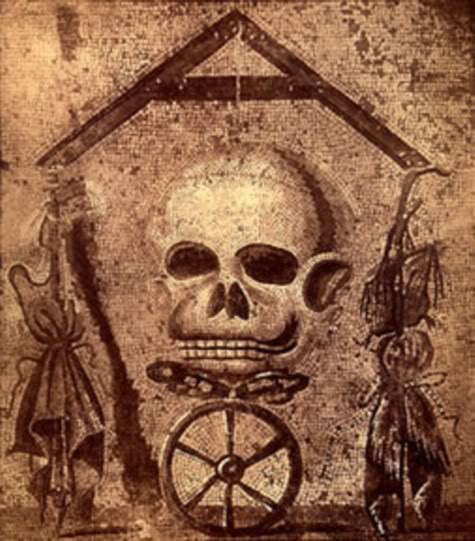
Seeing as you learned your craft from Imperial Rome and bearing in mind your good name, Mr. Ivor Bigun, I have a friend who is wondering if you knew this fellow dinosaur in the video below? With regard to getting a life , I already got one, a very good one, thank you, you see I am a freeman. Life is short Ivor and we pass this way but once, everything after that for me at this stage, is a bonus but community like life, is bigger than the self, as you will no doubt learn one day, when life puts manners on you as it does with us all, ask Maggie Thatcher, who said their is no such thing as community.
pompeii_mosaic
pompeii_mosaic
Biggus Dickus


Related Link: http://irishblog-brianclarkenuj.blogspot.com/
author by brionOcleirigh - AllVoicespublication date Fri Jun 21, 2013 02:25Report this post to the editors
The British Government mentored loyalist paramilitary groups like the UDA, along with its widespread infiltration of a locally recruited regiment of the British Army, as part of its counterinsurgency policy of using loyalist paramilitaries, as allies in the war against the native Irish population. In the process they murdered hundreds of innocent people, like lawyers, Pat Finucane, Rosemary Nelson and journalist Martin O'Hagan, at the behest of the British State's SS, the RUC Special Branch, MI5 and the FRU. The relationship between loyalist paramilitaries and the British state, was and still is similar, to the relationship between the Contras and the US administration of Ronald Reagan and Oliver North. The many innocent civilians murdered as part of these counter insurgency policies, is still regarded by the British Government particularly the Tories in London, as mere collateral damage as are their own cannon fodder.

The town of Lurgan and the associated towns of Portadown and Craigavon, make up part of what has been known as the "murder triangle"; an area known for a significant number of state sponsored sectarian murders and reactionary defensive fatalities, during 'The Troubles.' Lurgan still is one of the areas in British Occupied Ireland, where traditional republicans have considerable levels of support. The legacy of the latest 'Troubles' is an extension of the ongoing British mentored Loyalist sectarianism, against the native Irish population, which sometimes erupts into violence at 'interface areas.'

At the early part of the 70's, the British were sponsoring, over a hundred heavily armed local British soldiers, along with scores of British paramilitary police, in an area known as 'The Murder Triangle', to regularly murder local nationalists, many of them totally innocent of any political activity, in a campaign of repressive fear oppression and ethnic cleansing. One of the first inquiries to shed light on this form of intelligence-led policing and fear based ethnic cleansing, was the Stalker Inquiry.

John Stalker an honest English policeman, was asked in May 1984 to investigate six deaths at the hands of the RUC in three separate incidents in 1982. Before he had completed his investigation this honest policeman from Manchester, was removed from the inquiry and suspended from his post in the Greater Manchester Police (GMP) on suspicion of associating with known criminals in Manchester. He was later cleared and reinstated but retired within a few months, the damage to the investigation was done.

In his book on the affair, John Stalker, gives his impression of RUC Special Branch after investigating two of the incidents. The Special Branch targeted the suspected terrorist, they briefed the officers, and after the shootings, they removed the men, cars and guns for a private de-briefing before CID officers were allowed any access to these crucial matters. They provided the cover stories, and they decided at what point the CID were to be allowed, to commence the official investigation of what had occurred. The Special Branch interpreted the information and decided what was, or was not, evidence. "I had never experienced, nor had any of my team, such an influence, over an entire police force by one small section".

He described at length the way the Special Branch and MI5 gave him the run-around and refused to give him vital information. He had discovered that in one of the incidents, in which two people had been shot in a hayshed, the building had been bugged by MI5. He had requested access to the tape and the file of the informant who had been involved in this and one of the other incidents.

Some six months after first requesting the tape, he was told that it no longer existed, but he could have the transcript provided he signed a secrecy form. He refused so Special Branch and MI5 did not allow an independent police investigator access to crucial information. The protection of their informer took precedence over accountability and transparency. Stalker’s persistence had dire personal consequences. He was subsequently removed from the inquiry on carefully circulated lies.These are the same people to this day who decide who is interned without trial on the unreliable paid evidence of self serving informers. This is the secret SS scum state that interns Martin Corey today. To understand the 22 years spent behind bars by Martin Corey, we must understand this war on ordinary Irish people in their own land by British Imperialists.

In 1973 before Martin Corey served 22 years with regard to a shooting in defence of his community, a book entitled THE BLACK PAPER, Northern Ireland — The Story of the Police was published by the Central Citizens’ Defence Committee, Belfast. It sadly traces the attempt and breakdown of the reform of the police from the 1968 period onward. It concludes:

"All the wishing in the world will not achieve the impossible. There is no way out of this torturous dilemma but the more difficult way that must be faced up to sooner or later. Law and order will not return to British Occupied Ireland on any basis but one. It will have to be seen to apply equally and fairly, to everyone in the land, whatever their position, even if they wear a uniform or hold a seat in Parliament. Only when that is seen to be happening, will the laws gain the respect from the community upon which its validity rests. This respect had been lost in British Occupied Ireland. It must be regained and strengthened. When those who make the law, break the law, in the name of the law, there is no law."

The current use of internment without trial, secret evidence, secret trials, the primacy of secrecy around paid, informer's evidence and political policing, is certainly not the way to a lasting peace. Justice must not be just done, but must clearly seen to be done by all sections of the community. Anyone who ignore this reality, is a superficial careerist who is not genuinely interested in peace. It is the consistent position of traditional Irish republicans, that this is not possible within a scum state, within the small island of Ireland, created originally, strictly on the basis of a sectarian head count by the British to create division as in all of their colonies to justify their presence and maintain their self interests with exploitative supremacy.
Viceroyal Villiers II
Shoot To Kill - Part 1


Shoot To Kill - Part 2


Related Link: http://bit.ly/14N6i8J

Long Kesh Video

Long Kesh Tin Whistle
A A A G G G F F
A D' D' C B B A
F# G G A B A F#
F# G G F# E D
A A D' D' F'# E' D' B A
F# G A B A G F#
A A D' D' F'# E' D' B A
F# G A E G F# D

That's the notes for one verse, so just repeat it for the five verses since there is no chorus
MARTIN COREY UPDATES LINK

Release Martin Corey