As an Irishman, I find the result of the Scottish Referendum difficult to accept but accept it I do, firstly out of respect for the Scottish people's voice. Secondly from my Irish experience, there has already been too much bloodshed by principled people from all sides. However I do believe, that the Labour party has betrayed the people it purports to represent, but that is a matter for the Scottish people to decide for themselves. I hope working class people stay United, in the face of certain forces, that will try to divide them. In the interest of that unity, I call on my class to 'Keep their Powder dry' and keep their eyes on in the long term vision, as was so clearly articulated by that man from Edinburgh, James Connolly.
Labour MP'S stood up and cheered in the House of Commoners at the news of James Connolly's execution by being shot in a wheelchair, by a firing squad of the British Army.The British left of the day condemned him for going to Ireland at all, including the Imperialist Social democrat leader Hyndman who believed in Socialism within the British Empire.
From Wikipedia, the free encyclopedia
This article is about the political concept. For theological federalism, see
Covenant Theology.
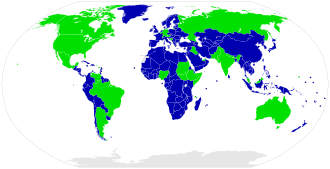 Unitary states
Federations
Part of
a series on
Politics

Primary topics
[show]
Political systems[show]
Academic disciplines
[show]
Public administration[show]
Policy[show]
Organs of government
[show]
Related topics
[show]
Subseries
[show]
Politics portal
v
t
e
Federalism is a
political concept in which agroup of members is bound together by covenant (Latin: foedus,
covenant) with a governing
representative head. The term "federalism" is also used to describe a system of
government in which
sovereignty is
constitutionally divided between a central governing authority and constituent political units (such as states or provinces). Federalism is a system based upon
democratic rules and institutions in which the power to govern is shared between national and provincial/state governments, creating what is often called a
federation.
Contents [
hide]
1 European vs. American Federalism
2 Examples of federalism
2.1 Australia
2.2 Brazil
2.3 Canada
2.4 Colombia
2.5 India
2.5.1 Asymmetric federalism
2.5.2 Coalition politics
2.6 South Africa
2.7 Federalism in Europe
2.7.1 French Revolution
2.7.2 European Union
2.8 Russian Federation
2.9 United States
2.10 Venezuela
2.11 Federalism with two components
2.11.1 Belgium
2.11.2 Other examples
2.12 Proposed federalism
2.12.1 China
2.12.2 Libya
2.12.3 Philippines
2.12.4 Spain
2.12.5 United Kingdom
3 Federalism as the anarchist and libertarian socialist mode of political organization
4 Christian Church
5 Constitutional structure
5.1 Division of powers
5.2 Organs of government
5.3 Other technical terms
6 Federalism as a political philosophy
7 Federalism as a concept: history
8 See also
9 Notes and references
10 In Literature
11 External links
European vs. American Federalism[
edit]
Main articles:
Federal Europe and
Federalism in the United States
In
Europe, "Federalist" is sometimes used to describe those who favor a common federal government, with distributed power at regional, national and supranational levels. Most European federalists want this development to continue within the
European Union. European federalism originated in post-war Europe; one of the more important initiatives was
Winston Churchill's speech in
Zurich in 1946.
[1]
In the
United States, federalism originally referred to belief in a stronger central government. When the U.S. Constitution was being drafted, the
Federalist Party supported a stronger central government, while "
Anti-Federalists" wanted a weaker central government. This is very different from the modern usage of "federalism" in Europe and the United States. The distinction stems from the fact that "federalism" is situated in the middle of the political spectrum between a
confederacy and a
unitary state. The U.S. Constitution was written as a reaction to the
Articles of Confederation, under which the United States was a loose confederation with a weak central government. Further, during the
American Civil War, members of the
Confederate States of America, which seceded in favor of a weaker central government, referred to pro-
Union soldiers of the United States government as "
Federals."
[2] Thus in the United States "federalism" argued for a stronger central government, relative to a confederacy.
In contrast, Europe has a greater history of unitary states than North America, thus European "federalism" argues for a weaker central government, relative to a unitary state. The modern American usage of the word is much closer to the European sense. As the power of the
Federal government has increased, some people have perceived a much more unitary state than they believe the
Founding Fathers intended. Most people politically advocating "federalism" in the United States argue in favor of limiting the powers of the federal government, especially the
judiciary (see
Federalist Society,
New Federalism).
In
Canada, federalism typically implies opposition to
sovereigntist movements (most commonly
Quebec separatism).
The governments of
Argentina,
Australia,
Brazil,
India, and
Mexico, among others, are also organized along federalist principles.
Federalism may encompass as few as two or three internal divisions, as is the case in
Belgium or
Bosnia and Herzegovina. In general, two extremes of federalism can be distinguished: at one extreme, the strong federal state is almost completely unitary, with few powers reserved for local governments; while at the other extreme, the national government may be a federal state in name only, being a
confederation in actuality.
In 1999, the
Government of Canada established the
Forum of Federations as an international network for exchange of best practices among federal and federalizing countries. Headquartered in
Ottawa, the Forum of Federations partner governments include Australia, Brazil, Canada,
Ethiopia,
Germany, India,
Mexico,
Nigeria, and
Switzerland.
Some
Christian denominations are organized on federalist principles; in these churches this is known as ecclesiastic or theological federalism.
Examples of federalism[
edit]
Australia[
edit]
Main articles:
Federalism in Australia and
Federation of Australia

The States and Territories of Australia, consisting of The Australian Capital Territory (red), New South Wales (pink), Northern Territory (yellow, top), Queensland (blue), South Australia (purple), Tasmania (yellow, bottom), Victoria (green), and Western Australia (orange).
On January 1, 1901 the
Australian nation emerged as a federation. The
Australian continent was colonized by the
United Kingdom in 1788, which subsequently established six self-governing colonies there. In the 1890s the governments of these colonies all held
referendums on becoming a unified, independent nation. When all the colonies voted in favour of federation, the
Federation of Australia commenced, resulting in the establishment of the
Commonwealth of Australia in 1901. Whilst the Federation of Australia emerged in 1901, the States of Australia remained colonies of Britain until 1986 when the UK and Australia passed the Australia Acts. The model of Australian federalism adheres closely to the original model of the United States of America, though through a
Westminster system.
Brazil[
edit]

Brazil is a union of 26
statesand one
federal district, which is the site of the federal capital,
Brasília.
See also:
States of Brazil
In
Brazil, the fall of the
monarchy in 1889 by a military
coup d'état led to the rise of the
presidential system, headed by
Deodoro da Fonseca. Aided by well-known jurist
Ruy Barbosa, Fonseca established federalism in Brazil by decree, but this system of government would be confirmed by every
Brazilian constitution since 1891, although some of them would distort some of the federalist principles. The 1937 Constitution, for example, granted the
federal government the authority to appoint State Governors (called
interventors) at will, thus centralizing power in the hands of President
Getúlio Vargas. Brazil also uses the Fonseca system to regulate interstate trade.
The
Brazilian Constitution of 1988 introduced a new component to the ideas of federalism, including
municipalities as federal entities. Brazilian municipalities are now invested with some of the traditional powers usually granted to states in federalism, and although they are not allowed to have a Constitution, they are structured by an
organic law.
Canada[
edit]
Main article:
Canadian federalism

In
Canada, the provincial governments derive all their powers directly from the
constitution. In contrast, the
territories are subordinate to the federal government and are delegated powers by it.
In Canada, the system of federalism is described by the division of powers between the
federal parliament and the country's
provincial governments. Under the
Constitution Act (previously known as the
British North America Act) of 1867, specific powers of legislation are allotted. Section 91 of the constitution gives rise to federal authority for legislation, whereas section 92 gives rise to provincial powers.
For matters not directly dealt with in the constitution, the federal government retains residual powers; however, conflict between the two levels of government, relating to which level has legislative jurisdiction over various matters, has been a longstanding and evolving issue. Areas of contest include legislation with respect to regulation of the economy, taxation, and natural resources.
Colombia[
edit]
In 1858 the unitary government of
Colombia, then known as the
Republic of New Granada, was dissolved and replaced by the
Granadine Confederation, a decentralized federal state. While the
Colombian Civil War (1860–1862) resulted in the dismantling of the fledgling confederation, the
United States of Colombia that replaced it operated on similarly federal theories, though their actual policies generally differed. Today, however, the
Republic of Colombia is a unitary constitutional republic.
India[
edit]
Main article:
Federalism in India

Indian state governments led by various political parties
The
Government of India (referred to as the Union Government) was established by the
Constitution of India, and is the governing authority of a federal union of
29 states and 7 union territories.
The government of India is based on a tiered system, in which the
Constitution of India delineates the subjects on which each tier of government has executive powers. The Constitution originally provided for a two-tier system of government, the Union Government (also known as the Central Government), representing the Union of India, and the State governments. Later, a third tier was added in the form of
Panchayats and Municipalities. In the current arrangement, The
Seventh Schedule of the Indian Constitution delimits the subjects of each level of governmental jurisdiction, dividing them into three lists:
Union List includes subjects of national importance such as defence of the country, foreign affairs, banking, communications and currency. The Union Government alone can make laws relating to the subjects mentioned in the Union List.
State List contains subjects of State and local importance such as police, trade, commerce, agriculture and irrigation. The State Governments alone can make laws relating to the subjects mentioned in the State List.
Concurrent List includes subjects of common interest to both the Union Government as well as the State Governments, such as education, forest, trade unions, marriage, adoption and succession. Both the Union as well as the State Governments can make laws on the subjects mentioned in this list. If their laws conflict with each other, the law made by the Union Government will prevail.
Asymmetric federalism[
edit]
A distinguishing aspect of Indian federalism is that unlike many other forms of federalism, it is asymmetric.
[3] Article 370 makes special provisions for the state of
Jammu and Kashmiras per its
Instrument of Accession. Article 371 makes special provisions for the states of
Andhra Pradesh,
Arunachal Pradesh,
Assam,
Goa,
Mizoram,
Manipur,
Nagaland and
Sikkim as per their accession or state-hood deals. Also one more aspect of Indian federalism is system of
President's Rule in which the central government (through its appointed Governor) takes control of state's administration for certain months when no party can form a government in the state or there is violent disturbance in the state.
Coalition politics[
edit]
Although the Constitution does not say so, India is now a multilingual federation.
[3] India has a multi-party system,with political allegiances frequently based on linguistic, regional and caste identities,
[4] necessitating coalition politics, especially at the
Union level.
South Africa[
edit]
By the definition of most political scientists, South Africa counts as a federal state in practice.
Federalism in Europe[
edit]
Several federal systems exist in
Europe, such as in
Switzerland,
Austria,
Germany,
Belgium,
Bosnia and Herzegovina and the
European Union. Germany and the EU offer the only examples in the world where members of the federal "upper houses" (the
Bundesratand the
Council) are neither elected nor appointed but comprise delegates of the governments of their constituents.
Modern Germany abandoned federalism only during
Nazism (1933–1945) and in
East Germany during from 1952 to 1990.
Adolf Hitler viewed federalism as an obstacle to his goals. As he wrote in
Mein Kampf, "
National Socialism must claim the right to impose its principles on the whole German nation, without regard to what were hitherto the confines of federal states."[
page needed] Accordingly, the idea of a strong, centralized government has negative associations in German politics, although prior to
1919 or
1933, many social democrats and liberals favored
centralization in principle.[
citation needed]
In Britain, an
Imperial Federation was once seen as (inter alia) a method of solving the
Home Rule problem in Ireland; federalism has long been proposed[
by whom?] as a solution to the "
Irish Problem", and more lately, to the "
West Lothian question".
[5]
French Revolution[
edit]
During the
French Revolution, especially in 1793, "federalism" had an entirely different meaning. It was a political movement to weaken the central government in Paris by devolving power to the provinces.
[6][7]
European Union[
edit]
Following the end of
World War II, several movements began advocating a European federation, such as the
Union of European Federalists or the
European Movement, founded in 1948. Those organizations exercised influence in the European unification process, but never in a decisive way.[
citation needed] In 2011 also a European political party calling for the creation of a federal Europe was established, the
European Federalist Party.
Although the drafts of both the
Maastricht treaty and the
Treaty establishing a Constitution for Europe mentioned federalism, the representatives of the member countries (all of whom would have to agree to the term) never adopted it. The strongest advocates of European federalism have been
Germany,
Italy,
Belgium and
Luxembourg while those historically most strongly opposed have been the
United Kingdom and
France; while other countries that have never campaigned specifically for a particular means of governance in Europe are considered as federalists.[
citation needed] Some[
who?] would consider this the case with states such as
Spain,
Portugal,
Greece, and
Hungary. In recent times[
when?] the French government has become increasingly pro-European Union, while countries like the
Czech Republic have taken on the roles of primary opponents to a stronger EU.[
citation needed]
Those uncomfortable using the “F” word in the EU context should feel free to refer to it as a quasi-federal or federal-like system. Nevertheless, for the purposes of the analysis here, the EU has the necessary attributes of a federal system. It is striking that while many scholars of the EU continue to resist analyzing it as a federation, most contemporary students of federalism view the EU as a federal system (See for instance, Bednar, Filippov et al., McKay, Kelemen, Defigueido and Weingast). (R. Daniel Kelemen)
[8]
Russian Federation[
edit]
Main article:
Russian federalism
The post-Imperial nature of Russian subdivision of government changed towards a generally autonomous model which began with the establishment of the USSR (of which Russia was governed as part). It was liberalized in the aftermath of the Soviet Union, with the reforms under
Boris Yeltsin preserving much of the Soviet structure while applying increasingly liberal reforms to the governance of the constituent republics and subjects (while also coming into conflict with Chechen secessionist rebels during the
Chechen War). Some of the reforms under Yeltsin were scaled back by
Vladimir Putin.
All of Russia's subdivisional entities are known as subjects, with some smaller entities, such as the republics enjoying more autonomy than other subjects on account of having an extant presence of a culturally non-Russian ethnic minority or, in some cases, majority.
United States[
edit]
Main article:
Federalism in the United States
Federalism in the United States is the evolving relationship between
state governments and the
federal government of the United States. American government has evolved from a system of dual federalism to one of associative federalism. In "Federalist No. 46," James Madison asserted that the states and national government "are in fact but different agents and trustees of the people, constituted with different powers." Alexander Hamilton, writing in "Federalist No. 28," suggested that both levels of government would exercise authority to the citizens' benefit: "If their [the peoples'] rights are invaded by either, they can make use of the other as the instrument of redress." (
1)

The United States is composed of fifty self-governing states and several territories.
Because the states were preexisting political entities, the U.S. Constitution did not need to define or explain federalism in any one section but it often mentions the rights and responsibilities of state governments and state officials in relation to the federal government. The federal government has certain express powers (also called
enumerated powers) which are powers spelled out in the Constitution, including the right to levy taxes, declare war, and regulate interstate and foreign commerce. In addition, the
Necessary and Proper Clausegives the federal government the implied power to pass any law "necessary and proper" for the execution of its express powers. Other powers—the
reserved powers—are reserved to the people or the states.
[9] The power delegated to the federal government was significantly expanded by the Supreme Court decision in
McCulloch v. Maryland (1819), amendments to the Constitution following the
Civil War, and by some later amendments—as well as the overall claim of the Civil War, that the states were legally subject to the final dictates of the federal government.
The
Federalist party of the United States were opposed by the
Democratic-Republicans, including powerful figures such as
Thomas Jefferson. The Democratic-Republicans mainly believed that: the Legislature had too much power (mainly because of the
Necessary and Proper Clause) and that they were unchecked; the Executive had too much power, and that there was no check on the executive; a dictator would arise; and that a bill of rights should be coupled with the constitution to prevent a dictator (then believed to eventually be the president) from exploiting and/or tyrannizing citizens. The federalists, on the other hand, argued that it was impossible to list all the rights, and those that were not listed could be easily overlooked because they were not in the official bill of rights. Rather, rights in specific cases were to be decided by the judicial system of courts.
After the
American Civil War, the federal government increased greatly in influence on everyday life and in size relative to the state governments. Reasons included the need to regulate businesses and industries that span state borders, attempts to secure civil rights, and the provision of social services. The federal government acquired no substantial new powers until the acceptance by the Supreme Court of the
Sherman Anti-Trust Act.
From 1938 until 1995, the
U.S. Supreme Court did not invalidate any federal statute as exceeding Congress' power under the
Commerce Clause. Most actions by the federal government can find some legal support among the express powers, such as the
Commerce Clause, whose applicability has been narrowed by the Supreme Court in recent years. In 1995 the Supreme Court rejected the
Gun-Free School Zones Act in the Lopez decision, and also rejected the civil remedy portion of the
Violence Against Women Act of 1994 in the
United States v. Morrison decision. Recently, the Commerce Clause was interpreted to include marijuana laws in the
Gonzales v. Raich decision.
Dual federalism holds that the federal government and the state governments are co-equals, each sovereign.
However, since the Civil War Era, the national courts often interpret the federal government as the final judge of its own powers under dual federalism. The establishment of
Native American governments (which are
separate and distinct from state and federal government) exercising limited powers of
sovereignty, has given rise to the concept of "bi-federalism."
Venezuela[
edit]
The
Federal War ended in 1863 with the signing of the Treaty of Coche by both the centralist government of the time and the Federal Forces. The
United States of Venezuelawere subsequently incorporated under a "Federation of Sovereign States" upon principles borrowed from the
Articles of Confederation of the United States of America. In this Federation, each State had a "President" of its own that controlled almost every issue, even the creation of "State Armies," while the Federal Army was required to obtain presidential permission to enter any given state.
However, more than 140 years later, the original system has gradually evolved into a quasi-centralist form of government. While the
1999 Constitution still defines Venezuela as a Federal Republic, it abolished the Senate, transferred competences of the States to the Federal Government and granted the President of the Republic vast powers to intervene in the States and Municipalities.
Federalism with two components[
edit]
Belgium[
edit]

This section contains information of unclear or questionable
importance or
relevance to the article's subject matter. Please help
improve this article by clarifying or removing
superfluous information. (September 2009)
Main articles:
Belgian federal government,
Belgian federal parliament and
Communities, regions and language areas of Belgium
Federalism in the
Kingdom of Belgium is an evolving system. Belgian federalism reflects both the
linguistic communities (
French and
Dutch, and to a lesser extent
German) and the economic regions (
Brussels,
Flanders and
Wallonia). These correspond to
the language areas in Belgium. Although officially there are three language areas, for all practical purposes only two languages are relevant on the federal level, Dutch and French:
Brussels is officially a bilingual area, but it has a
French-speaking majority.
[10]
Flanders is the region associated with the Belgium's
Dutch-speaking majority, i.e. the
Flemish Community.
Due to its relatively small size (approximately one percent) the German-speaking Community of Belgium does not have much influence on national politics.
Wallonia is a French-speaking area, except for the
East Cantons. French is the second most spoken first language in Belgium, following Dutch. Within the French-speaking Community of Belgium, there is a geographical and political distinction between Wallonia and Brussels for historical and sociological reasons.
[11]
On one hand, this means that the
Belgian political landscape, generally speaking, consists of only two components: the Dutch-speaking population represented by Dutch-language
political parties, and the majority populations of Wallonia and Brussels, represented by their French-speaking parties. The Brussels region emerges as a third component.
[12] This specific dual form of federalism, with the special position of Brussels, consequently has a number of political issues—even minor ones—that are being fought out over the Dutch/French-language political division. With such issues, a final decision is possible only in the form of a compromise. This tendency gives this dual federalism model a number of traits that generally are ascribed to
confederalism, and makes the future of Belgian federalism contentious.
[13][14]
On the other hand, Belgian federalism is federated with three components. An affirmative resolution concerning Brussels' place in the federal system passed in the parliaments of
Wallonia and Brussels.
[15][16] These resolutions passed against the desires of Dutch-speaking parties, who are generally in favour of a federal system with two components (i.e. the Dutch and French Communities of Belgium). However, the Flemish representatives in the
Parliament of the Brussels Capital-Region voted in favour of the Brussels resolution, with the exception of
one party. The chairman of the
Walloon Parliament stated on July 17, 2008 that, "Brussels would take an attitude".
[17] Brussels' parliament passed the resolution on July 18, 2008:The Parliament of the
Brussels-Capital Region approves with great majority a resolution claiming the presence of Brussels itself at the negotiations of the reformation of the Belgian State.
[16] July 18, 2008
This aspect of Belgian federalism helps to explain the difficulties of
partition; Brussels, with its importance, is linked to both Wallonia and Flanders and
vice-versa. This situation, however, does not erase the traits of a confederation in the Belgian system.
Other examples[
edit]


Official flag of
Iraqi Kurdistan Ratio: 2:3
Current examples of two-sided federalism:
Bosnia and Herzegovina is a federation of two entities:
Republika Srpska and
Federation of Bosnia and Herzegovina.
Historical examples of two-sided federalism include:
Czechoslovakia, until the
Czech Republic and
Slovakiaseparated in 1993.
The
Federal Republic of Yugoslavia, from 1992 to 2003 when it became a confederation titled the State Union of
Serbia and Montenegro. This confederation expired 2006 as
Montenegro declared its independence.
The 1960
Constitution of Cyprus was based on the same ideas, but the union of
Greeksand
Turks failed.
United Republic of Tanzania (formerly
United Republic of Tanganyika and Zanzibar), which was the union of
Tanganyika and
Zanzibar.
Iraq adapted a federal system in 15 October 2005, and formally recognized the
Kurdistan Region as the county's first and currently only federal region. See
Constitution of Iraq for more information regarding Iraq's method of creating federal entities.
The Federal Republic of
Cameroun operated between 1961 and 1972
Proposed federalism[
edit]
It has been proposed in several
unitary states to establish a federal system, for various reasons.
China[
edit]
Main article:
Federalism in China
China is the largest unitary state in the world by both population and land area. Although China has had long periods of central rule for centuries, it is often argued that the unitary structure of the Chinese government is far too unwieldy to effectively and equitably manage the country's affairs. On the other hand,
Chinese nationalists are suspicious of decentralization as a form of secessionism and a backdoor for national disunity; still others argue that the degree of autonomy given to
provincial-level officials in the People's Republic of China amounts to a de facto federalism.
Libya[
edit]
Shortly after the
2011 Libyan civil war, some in the eastern region of the country (
Cyrenaica) began to call for the new regime to be federal, with the traditional three regions of
Libya (Cyrenaica,
Tripolitania, and
Fezzan) being the constituent units. A group calling itself the Cyrenaican Transitional Council issued a declaration of autonomy on 6 March 2012; this move was rejected by the
National Transitional Council in
Tripoli.
[18][19][20][21]
Philippines[
edit]
The
Philippines is a unitary state with some powers devolved to
Local Government Units(LGUs) under the terms of the
Local Government Code. There is also one autonomous region, the
Autonomous Region of Muslim Mindanao. Over the years
various modificationshave been proposed to the
Constitution of the Philippines, including possible transition to a federal system as part of a shift to a
parliamentary system. In 2004,
Philippine PresidentGloria Macapagal Arroyo established the Consultative Commission which suggested such a Charter Change but no action was taken by the
Philippine Congress to amend the 1987 Constitution.
Spain[
edit]
Spain is a unitary state with a relatively 'high' level of decentralisation (i.e., a
regional state). Federalism is accepted by parties, such as
Podemos,
United Left and, more recently,
Spanish Socialist Workers' Party . The Spanish Socialist party -traditionally a guaranty of centralism in recent Spanish democratic era, as confirmed in the years of centralism developed during
Felipe González's government- has recently considered the idea of building a Federal Spain, in part, due to the increase of the Spanish peripheral nationalisms and the Catalan proposal of
self-determination referenda for creating a
Catalan State in
Catalonia, either independent or within Spain.
[22][23][24]
United Kingdom[
edit]
Since the 1997 referendums on in
Scotland and
Wales, and after the
Good Friday Agreement in
Northern Ireland, three of the four countries of the
UK have some level of autonomy outside of
Westminster's rule. To counter the increasing popularity of
Scottish nationalism and
Welsh nationalism, both of which threaten the unity of the United Kingdom (see
Unionism in the United Kingdom) there have been some calls for the UK to adopt a federal system, with each of the four
home nations having its own, equal devolved legislatures and law-making powers. This is supported by various
Liberal Democrats and the
Green Party of England and Wales, and would provide a solution to the
West Lothian Question.
Federalism as the anarchist and libertarian socialist mode of political organization[
edit]
Main article:
Decentralization § Libertarian_socialist_decentralization
Anarchists are against the State but are not against political organization or "governance"—so long as it is self-governance utilizing
direct democracy. The mode of political organization preferred by anarchists, in general, is federalism or
confederalism.[
citation needed] However, the anarchist definition of federalism tends to differ from the definition of federalism assumed by pro-state political scientists. The following is a brief description of federalism from section I.5 of
An Anarchist FAQ:"The social and political structure of anarchy is similar to that of the economic structure, i.e., it is based on a voluntary federation of decentralised, directly democratic policy-making bodies. These are the neighbourhood and community assemblies and their confederations. In these grassroots political units, the concept of "self-management" becomes that of "self-government", a form of municipal organisation in which people take back control of their living places from the bureaucratic state and the capitalist class whose interests it serves.[...]The key to that change, from the anarchist standpoint, is the creation of a network of participatory communities based on self-government through direct, face-to-face democracy in grassroots neighbourhood and community assemblies [meetings for discussion, debate, and decision making].[...]Since not all issues are local, the neighbourhood and community assemblies will also elect mandated and recallable delegates to the larger-scale units of self-government in order to address issues affecting larger areas, such as urban districts, the city or town as a whole, the county, the bio-region, and ultimately the entire planet. Thus the assemblies will confederate at several levels in order to develop and co-ordinate common policies to deal with common problems.[...]This need for co-operation does not imply a centralised body. To exercise your autonomy by joining self-managing organisations and, therefore, agreeing to abide by the decisions you help make is not a denial of that autonomy (unlike joining a hierarchical structure, where you forsake autonomy within the organisation). In a centralised system, we must stress, power rests at the top and the role of those below is simply to obey (it matters not if those with the power are elected or not, the principle is the same). In a federal system, power is not delegated into the hands of a few (obviously a "federal" government or state is a centralised system). Decisions in a federal system are made at the base of the organisation and flow upwards so ensuring that power remains decentralised in the hands of all. Working together to solve common problems and organise common efforts to reach common goals is not centralisation and those who confuse the two make a serious error -- they fail to understand the different relations of authority each generates and confuse obedience with co-operation."
[25]
Christian Church[
edit]
See also:
Subsidiarity
Federalism also finds expression in
ecclesiology (the
doctrine of the
church). For example,
presbyterian church governance resembles
parliamentary republicanism (a form of political federalism) to a large extent. In
Presbyterian denominations, the local church is ruled by elected
elders, some of which are
ministerial. Each church then sends representatives or commissioners to
presbyteries and further to a
general assembly. Each greater level of assembly has ruling authority over its constituent members. In this governmental structure, each component has some level of sovereignty over itself. As in political federalism, in presbyterian ecclesiology there is shared sovereignty.
Other ecclesiologies also have significant representational and federalistic components, including the more anarchic
congregational ecclesiology, and even in more hierarchical
episcopal ecclesiology.
Some Christians argue that the earliest source of political federalism (or federalism in human institutions; in contrast to
theological federalism) is the
ecclesiastical federalism found in the
Bible. They point to the structure of the early
Christian Church as described (and to many, prescribed) in the
New Testament. This is particularly demonstrated in the
Council of Jerusalem, described in
Acts chapter 15, where the
Apostles and
eldersgathered together to govern the Church; the Apostles being representatives of the universal Church, and elders being such for the local church. To this day, elements of federalism can be found in almost every Christian denomination, some more than others.
Constitutional structure[
edit]
Division of powers[
edit]
Not to be confused with
Separation of powers.
In a federation, the division of power between federal and regional governments is usually outlined in the
constitution. It is in this way that the right to self-government of the component states is usually constitutionally entrenched. Component states often also possess their own constitutions which they may amend as they see fit, although in the event of conflict the federal constitution usually takes precedence.
In almost all federations the central government enjoys the powers of foreign policy and national defense. Were this not the case a federation would not be a single sovereign state, per the UN definition. Notably, the
states of Germany retain the right to act on their own behalf at an international level, a condition originally granted in exchange for the
Kingdom of Bavaria's agreement to join the
German Empire in 1871. Beyond this the precise division of power varies from one nation to another. The constitutions of
Germanyand the
United States provide that all powers not specifically granted to the federal government are retained by the states. The Constitution of some countries like
Canada and
India, on the other hand, state that powers not explicitly granted to the provincial governments are retained by the federal government. Much like the US system, the Australian Constitution allocates to the Federal government (the Commonwealth of Australia) the power to make laws about certain specified matters which were considered too difficult for the States to manage, so that the States retain all other areas of responsibility. Under the division of powers of the European Union in the Lisbon Treaty, powers which are not either exclusively of European competence or shared between EU and state are retained by the constituent states.

Satiric depiction of late 19th century political tensions in Spain
Where every component state of a federation possesses the same powers, we are said to find 'symmetric federalism'.
Asymmetric federalism exists where states are granted different powers, or some possess greater autonomy than others do. This is often done in recognition of the existence of a distinct culture in a particular region or regions. In Spain, the
Basques and
Catalans, as well as the Galicians, spearheaded a historic movement to have their national specificity recognized, crystallizing in the "historical communities" such as
Navarre,
Galicia,
Catalonia, and the
Basque Country. They have more powers than the later expanded arrangement for other Spanish regions, or
the Spain of the autonomous communities(called also the "coffee for everyone" arrangement), partly to deal with their separate identity and to appease peripheral nationalist leanings, partly out of respect to
specific rights they had held earlier in history. However, strictly speaking Spain is not a federalism, but a decentralized administrative organization of the state.
It is common that during the historical evolution of a federation there is a gradual movement of power from the component states to the centre, as the federal government acquires additional powers, sometimes to deal with unforeseen circumstances. The acquisition of new powers by a federal government may occur through formal constitutional amendment or simply through a broadening of the interpretation of a government's existing constitutional powers given by the courts.
Usually, a federation is formed at two levels: the central government and the regions (states, provinces, territories), and little to nothing is said about second or third level administrative political entities.
Brazil is an exception, because the 1988 Constitution included the municipalities as autonomous political entities making the federation tripartite, encompassing the Union, the States, and the municipalities. Each state is divided into municipalities (municípios) with their own legislative council (câmara de vereadores) and a mayor (prefeito), which are partly autonomous from both Federal and State Government. Each municipality has a "little constitution", called "organic law" (lei orgânica).
Mexico is an intermediate case, in that municipalities are granted full-autonomy by the federal constitution and their existence as autonomous entities (municipio libre, "free municipality") is established by the federal government and cannot be revoked by the states' constitutions. Moreover, the federal constitution determines which powers and competencies belong exclusively to the municipalities and not to the
constituent states. However, municipalities do not have an elected legislative assembly.
Federations often employ the
paradox of being a union of states, while still being states (or having aspects of
statehood) in themselves. For example, James Madison (author of the
US Constitution) wrote in
Federalist Paper No. 39 that the US Constitution "is in strictness neither a national nor a federal constitution; but a composition of both. In its foundation, it is federal, not national; in the sources from which the ordinary powers of the Government are drawn, it is partly federal, and partly national..." This stems from the fact that states in the US maintain all
sovereignty that they do not yield to the federation by their own consent. This was reaffirmed by the
Tenth Amendment to the United States Constitution, which reserves all powers and rights that are not delegated to the Federal Government as left to the States and to the people.
Organs of government[
edit]
The structures of most federal governments incorporate mechanisms to protect the rights of component states. One method, known as '
intrastate federalism', is to directly represent the governments of component states in federal political institutions. Where a federation has a
bicameral legislature the
upper house is often used to represent the component states while the
lower house represents the people of the nation as a whole. A federal upper house may be based on a special scheme of
apportionment, as is the case in the
senatesof the United States and Australia, where each state is represented by an equal number of senators irrespective of the size of its population.
Alternatively, or in addition to this practice, the members of an upper house may be indirectly elected by the government or legislature of the component states, as occurred in the United States prior to 1913, or be actual members or delegates of the state governments, as, for example, is the case in the
German Bundesrat and in the
Council of the European Union. The lower house of a federal legislature is usually directly elected, with apportionment in proportion to population, although states may sometimes still be guaranteed a certain minimum number of seats.
In Canada, the provincial governments represent regional interests and negotiate directly with the central government. A
First Ministers conference of the prime minister and the provincial premiers is the
de facto highest political forum in the land, although it is not mentioned in the constitution.
Federations often have special procedures for amendment of the federal constitution. As well as reflecting the federal structure of the state this may guarantee that the self-governing status of the component states cannot be abolished without their consent. An amendment to the constitution of the United States must be ratified by three-quarters of either the state legislatures, or of constitutional conventions specially elected in each of the states, before it can come into effect. In referendums to amend the constitutions of Australia and Switzerland it is required that a proposal be endorsed not just by an overall majority of the electorate in the nation as a whole, but also by separate majorities in each of a majority of the states or cantons. In Australia, this latter requirement is known as a double majority.
Some federal constitutions also provide that certain constitutional amendments cannot occur without the unanimous consent of all states or of a particular state. The US constitution provides that no state may be deprived of equal representation in the senate without its consent. In Australia, if a proposed amendment will specifically impact one or more states, then it must be endorsed in the referendum held in each of those states. Any amendment to the Canadian constitution that would modify the role of the
monarchy would require unanimous consent of the provinces. The
German Basic Law provides that no amendment is admissible at all that would abolish the federal system.
Other technical terms[
edit]
Fiscal federalism – federalism involving the transfer of funds between different levels of government.
Formal federalism (or '
constitutional federalism') – the delineation of powers is specified in a written constitution.
Executive federalism (also known as 'administrative federalism').
Federalism as a political philosophy[
edit]
Main articles: Federalism and
Federalist
The meaning of federalism, as a political movement, and of what constitutes a 'federalist', varies with country and historical context.[
citation needed] Movements associated with the establishment or development of federations can exhibit either centralising or decentralising trends.[
citation needed] For example, at the time those nations were being established, factions known as "federalists" in the United States and Australia advocated the formation of strong central government. Similarly, in European Union politics, federalists mostly seek greater EU integration. In contrast, in Spain and in post-war Germany, federal movements have sought decentralisation: the transfer of power from central authorities to local units. In Canada, where Quebec separatism has been a political force for several decades, the "federalist" impulse aims to keep Quebec inside Canada.
Federalism as a concept: history[
edit]
The
Oxford English Dictionary first records the English word federalism as occurring in print in 1793 with reference to French politics,
[26] though anti-federalism appears as early as 1788.
[27]
See also[
edit]
Federal republic
Asymmetric federalism
Federacy
Forum of Federations
Anti-Federalism
Federal Union
Confederation
Consociationalism
Federalist
Federalist Society
Federation
Pillarisation
Subsidiarity principle
Layer cake federalism
States' rights
Cooperative Federalism
Union of Utrecht
Democratic World Federalists
World Federalist Movement
Devolution (in contrast)
Notes and references[
edit]
Jump up^ Winston Churchill's speech in Zurich in 1946
Jump up^ Free Dictionary: Federal soldier
^
Jump up to:a b Indian Constitution at Work.
NCERT. pp. 232, 233.
Jump up^ Johnson, A "Federalism: The Indian Experience ", HSRC Press,1996, Pg 3, ISBN
Jump up^ "UK Politics: Talking Politics The West Lothian Question". BBC News. 1 June 1998.
Jump up^ Bill Edmonds, "'Federalism' and Urban Revolt in France in 1793," Journal of Modern History (1983) 55#1 pp 22-53
in JSTOR
Jump up^ François Furet and Mona Ozouf, eds. A Critical Dictionary of the French Revolution(1989), pp. 54-64
Jump up^ Kelemen, R. Daniel (September 2005).
"Built to Last? The durability of EU federalism" (PDF).
Princeton University. Retrieved 2011-11-28.
Jump up^ "THE CONSTITUTION OF THE UNITED STATES OF AMERICA With Explanatory Notes". U.S. Department of State's Bureau of International Information Programs.
Jump up^ (Dutch)
”Taalgebruik in Brussel en de plaats van het Nederlands. Enkele recente bevindingen”, Rudi Janssens, Brussels Studies, Nummer 13, 7 January 2008 (see page 4).
Jump up^ Historically, the Walloons were for a federalism with three components and the Flemings for two. (See: Witte, Els & Craeybeckx, Jan. Politieke geschiedenis van België. Antwerpen, SWU, pp. 455, 459-460.) This difference is one of the elements which makes the Belgian issue so complicated. The Flemings wanted to defend their language while the Walloons wanted to defend their economy: It is true that the Walloon movement, which has never stopped affirming that Wallonia is part of the French cultural area, has never made this cultural struggle a priority, being more concerned to struggle against its status as a political minority and the economic decline which was only a corollary to it. (
Wallonia today - The search for an identity without nationalist mania - (1995)
Jump up^ Charles Picqué, Minister-President of the
Brussels-Capital Region said in a September, 2008 declaration in
Namur at the National Walloon Feast : It is, besides, impossible to have a debate about the institutions of Belgium in which Brussels would be excluded. (French Il n'est d'ailleurs, pas question d'imaginer un débat institutionnel dont Bruxelles serait exclu.
[1]) The
Brussels-Capital Regionhas claimed and obtained a special place in the current negotiations about the reformation of the Belgian state. (FrenchPendant 18 ans, Bruxelles est demeurée sans statut (...) L'absence de statut pour Bruxelles s'expliquait par la différence de vision que partis flamands et partis francophones en avaient: [les partis flamands étaient] allergiques à la notion de Région (...) les francophones (...) considéraient que Bruxelles devait devenir une Région à part entière (...) Les partis flamands ont accepté [en 1988] la création d'une troisième Région et l'exercice par celle-ci des mêmes compétences que celles des deux autres... C.E. Lagasse,Les nouvelles institutions politiques de la Belgique et de l'Europe, Erasme, Namur, 2003, pp. 177- 178 ISBN )
Jump up^ "Brussels".
Encyclopædia Britannica.
Jump up^ "Bruxelles dans l'oeil du cyclone" (in French).
France 2.
Jump up^ La Libre Belgique 17 juillet 2008
^
Jump up to:a b La Libre Belgique, 19 juillet 2008
Jump up^ Le Vif
Jump up^ "Eastern Libya declares autonomy".Russia Today. 6 March 2012. Retrieved 6 March 2012.
Jump up^ "Eastern Libya declares semiautonomous region". Google News. The Associated Press. 6 March 2012. Retrieved 6 March 2012.
Jump up^ "Thousands rally in Libya against autonomy for east". Reuters. 9 March 2012.
Jump up^ Thomson Reuters Foundation | News, Information and Connections for Action. Trust.org (2012-03-06). Retrieved on 2013-07-12.
Jump up^ Federalism. El País.
Jump up^ El PSOE plantea una reforma de la Constitución para una España federal. El País.
Jump up^ Mas encarga el diseño de un Estado catalán. El País.
Jump up^ Anarchist Writers. "I.5 What could the social structure of anarchy look like?" An Anarchist FAQ.
http://www.infoshop.org/page/AnarchistFAQSectionI5
Jump up^ Oxford English Dictionary s.v. federalism: "E. Burke Remarks Policy Allies in Wks. VII. 133 We see every man that the jacobins chuse to apprehend..conveyed to prison..whether he is suspected of royalism, or federalism, moderantism, democracy royal, or [etc.]."
Jump up^ Oxford English Dictionary s.v. anti-federal
In Literature[
edit]
In the futurist story
On Deception Watch: A World Federation Novel by David H. Spielberg, a plausible high-tech path is created to an economic-based new paradigm for the legitimacy of governance. Leveraged off the successful development of laser fusion energy, the United States and The People's Republic of China join forces to change the world.
External links[
edit]

Look up
federalism in Wiktionary, the free dictionary.
P.-J. Proudhon,
The Principle of Federation, 1863.
A Comparative Bibliography: Regulatory Competition on Corporate Law
A Rhetoric for Ratification: The Argument of the Federalist and its Impact on Constitutional Interpretation
National
Teaching about Federalism in the United States - From the
Education Resources Information Center Clearinghouse for Social Studies/Social Science Education
Bloomington, Indiana.
An Ottawa, Canada-based international organization for federal countries that share best practices among countries with that system of government
Tenth Amendment Center Federalism and States Rights in the U.S.
BackStory Radio episode on the origins and current status of Federalism
Constitutional law scholar Hester Lessard discusses Vancouver's Downtown Eastside and jurisdictional justice McGill University, 2011
General Federalism
T.A.L.
OUR DAY WILL COME !


.jpg)


.JPG)