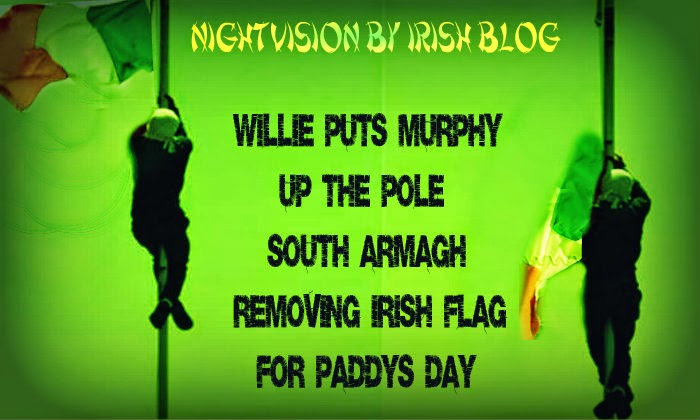
NewsFlash Newry/South Armagh Willie Frazer was caught on NightVision putting Conor Murphy up the pole in South Armagh, while removing the Irish tricolur from poles, before Saint Patricks Day. Reports are also coming in, that Sinn Fein have offered the RUC/psni the use of a portacabin to use as a canteen while they are removing dissident posters from the poles in the area. It will be very tricky, with an election looming, so every election poster, has to be strip searched and their anal cavity probed, for boobies. One traditional smuggler, who wishes to remain anonymous, said, "We have offered one of our biggest portacabins for use by the RUC/psni so they can all have a cup of tay and we'll throw in a drop of discount whiskey as well. We are also offering them discount cigarettes and diesel. It's one of our biggest portacabins and 20 RUC men could fit in there at a time. You could also throw in a few PSNI women if they are fit enough. However we want it back in time for the General election, so we can use it outside a polling station. We are also offering to send over a few of the Bhoys, for entertainment. Willie Frazer asked us to help them out, so that they can remove all the dissident posters and Tricolours in South Armagh. We can also supply them with a bit of Waccy Baccy and anti-depressants, to keep their spirits up. He also said that Willie and his loyal brethern, can also use it for a night, on their motorcade to Dublin, while British drones overhead, can escort it all the way to Dublin using the backroads across the border, round Cross. We've also offered Willie a few of our Bhoys for the night and for the Craic"
How Governments Twist Terrorism
States craft terror definitions and designations to absolve themselves and satisfy their constituencies. By Philip Giraldi March 12, 2015 "ICH" - "American Conservative" - The Washington Post reportsthat “terrorism trend lines are ‘worse than at any other point in history.’” But what is terrorism? It has frequently been pointed out that “terrorism” is a tactic, not an actual physical adversary, but it is less often noted that a simple definition of what constitutes terrorism is hardly universally accepted, while the designation itself is essentially political. The glib assertion that one man’s terrorist is another man’s freedom fighter fails to capture the distinction’s consequences as the terror label itself increasingly comes with a number of legal and practical liabilities attached. Describing an organization as terroristic in order to discredit it has itself become a tactic, and one that sometimes has only limited connections to what the group in question actually believes or does. The bone of contention in defining terrorism is where to draw the line in terms of the use of violence in furtherance of a political objective. In practice, it is generally accepted that state players who employ violence do so within a social framework that confers legitimacy, while nonstate players who use political violence are ipso facto terrorists, or at least susceptible to being tagged with that label, which confers upon them both illegitimacy and a particularly abhorrent criminality. But some on the receiving end of such a Manichean distinction object, noting that the laws defining terror are themselves drawn up by the governments and international organizations, which inevitably give themselves a pass in terms of their own potential liability. They would argue that established regimes will inevitably conspire to label their enemies terrorists to marginalize both resistance movements and internal dissent in such a way as to diminish the credibility of the groups that are so targeted. Turkish President Recep Tayyip Erdogan has recently been doing precisely that, and one might reasonably argue that government use of violence is often in practice indistinguishable from the actions of nonstate players. Some common dictionary definitions of terrorism include engaging in “the systematic use of terror,” surely an indication of the inscrutability of an issue when the word must be used to define itself. The United Nations has been unsuccessfully negotiating a Comprehensive Convention on International Terrorism since 2002 that would define terror as causing death or serious injury or destroying or damaging public or private property “to intimidate a population, or to compel a Government or an international organization to do or abstain from doing any act.” The United States Federal criminal code uses similar language, as does the Patriot Act, with the key elements being the use of violence or physical destruction to “intimidate or coerce” a civilian population or an existing government. Governments are aware of what can be accomplished by invoking the word “terrorism.” The diplomacy-averse United States frequently hides behind the label, as it is prohibited by law from negotiating with groups so-labeled, and thereby avoids having to confront the possible legitimacy of what they represent. And it also justifies a uniformly violent response, which is invariably described as self-defense. Fourteen years ago the “global war on terror” was used to justify wholesale American intervention in predominantly Muslim countries. A number of European countries, including France and Britain, have followed the example of the two Patriot Acts by introducing antiterrorism legislation that provides special police and intelligence service authorities that limit normal legal protections in terrorism cases. The broadly written laws have largely rendered the authorities immune from either regulation or prosecution, and governments in the West have generally been reluctant to allow any third-party inquiries into the related behavior of military and police forces. In the United States the state secret privilege, originally intended to prohibit the exposure of classified information in court, has been used to completely derail judicial proceedings relating to offenses allegedly committed by the government in terrorism cases. And critics of the essentially hypocritical double standard used in defining terrorism certainly have a point. One might reasonably argue that the use of drones, in which “signature” targets are killed because they match a profile, fits comfortably within the definition of terrorism. During 2003-4, American Army and Marine forces in Fallujah sometimes shelled and bombed targets in the city indiscriminately and were certainly responsible for hundreds of civilian deaths. The Israeli Defense Forces killed thousands of civilians in two incursions into Gaza as well as several attacks on Lebanon. There was no declaration of war to justify the use of armed force in either case, and independent observers noted that many of the civilian casualties could have been avoided, normally a defining factor that makes an incident terror. Both Israel and the United States turned the tables on the situation by referring to their opponents and victims as “terrorists.” There has been no accountability for the deaths because it was two governments that carried out the killing. In a world seemingly obsessed with terrorism it was inevitable that something like ananti-terrorism industry would grow dramatically. Every television and radio network has its own stable of pundits who pontificate on every violent incident, and there also are well-compensated freelancers, who describe themselves as experts, such as Evan Kohlmann and Steve Emerson. Emerson recently had to apologize after claiming that Birmingham, England had a number of no-go areas controlled by local Muslim extremists. It should be no surprise that lawyers have now also gotten into the game. In 1996 Congress passed the Anti-Terrorism and Effective Death Penalty Act, which allows victims of terrorism to file civil suits in federal and state courts against sponsors or supporters of terrorism. Once you have a group or individual labeled as terrorist, or providing assistance to terrorists, there are a number of options you can pursue. The burgeoning antiterrorism industry appears to be in some ways linked to the increasing employment of Lawfare, which uses the legal system to wage war by alternative means, making it possible to obtain a favorable judgment and damages from the assets of a recognized terrorist organization. Such litigation benefits from favorable legislation in the United States that makes terrorism a worldwide crime subject to U.S. judicial review. Recent court cases have involved both states that allegedly sponsor terrorism or actual organizations that are now parts of governments that either currently or at one time were perceived to be terrorists. Many of the groups targeted are enemies of Israel, and the Israeli Lawfare center Shurat HaDin is most active in pursuing such litigation. In a recent case in New York City, the Palestinian Authority was successfully sued by a group of Israelis and Americans over terrorist attacks that took place in Israel in 2002-4. If the appeal fails, the Palestinian Authority will be required to pay $1 billion in damages and will be bankrupted, with negative consequences for the United States, which has been seeking to create a viable government on the West Bank. The U.S. Department of State identifies four countries as state sponsors of terrorism, making them prime targets for sanctions and other legal action. They are Cuba, Sudan, Syria and Iran. Cuba is an anomaly as it has not threatened anyone in decades but remains on the list due to the deep passions within America’s politically powerful Cuban Lobby. Sudan likewise should not be so designated, as even the U.S. government admits that it is cooperative on terrorism issues. This leaves Syria and Iran, both of which are regarded as state sponsors of terrorism even though both are themselves victims of terrorist attacks carried out by groups supported by the United States. They are on the list because they harbor or cooperate with Hezbollah, Hamas, and Palestinian Islamic Jihad. All three groups consider themselves to be resistance movements against the illegal Israeli occupation of Palestine, but Israel regards all three as terrorists, a view shared by the United States on the state department’s Foreign Terrorist Organization list. That viewpoint is not necessarily shared by many European governments, which regard the organizations as having evolved into legitimate political parties. There are also thousands of individuals and groups considered to be terroristic or criminal, collected by the U.S. Department of Justice on its Special Designated Nationals List. Individuals and organizations on the list have their assets blocked and are subject to other punitive action by the United States government. Being designated by the Department of the Treasury or state does not necessarily mean that someone or some organization was actually involved in terrorism. The Texas-based Holy Land Foundation, an Islamic charity, was declared a terrorist organization in 2001. Its officers were convicted and imprisoned in a 2008 trial because the Treasury Department determined ex post facto that it had given money to Hamas before that group was itself named as a terrorist organization. Inclusion on the State or Treasury lists can mean that there is solid evidence of wrongdoing, but it can also represent mere insinuations or a strong desire to see a group singled out for punishment. In any event, once a group or person is designated for a list, it is difficult to get off. Organizations that have not engaged in terrorist activity for many years remain on the list while other groups that are active escape censure. Recently, the Mujaheddin e Khalq (MEK), an Iranian terrorist group thatkilled six Americans in the 1970s, was removed from the list under political pressure from Congress and the media. Again, Israel was involved. MEK is an enemy of the current government in Tehran and is itself an important component of the Israeli intelligence effort against Iran, having been involved in the fabrication of information suggesting that Iran has an active nuclear weapons program as well as participating in the assassinations of Tehran’s scientists. So what terrorism actually consists of very much depends on one’s perspective, rendering the word itself largely meaningless. But those who are listed as terrorists experience real consequences even accepting that the designation is both selectively applied and politicized. The United States and Israel in particular use the terrorism label to demonize opponents, drum up fear, and generate popular support for security policies that might otherwise be unpalatable. They also justify their own behavior by asserting that they occupy the moral high ground in the defense of the world against terror, a claim that certainly should be regarded with considerable skepticism. Philip Giraldi, a former CIA officer, is executive director of the Council for the National Interest
They say life is stranger than fiction but some of the stuff that's happening in South Armagh, is straght out of the Murphy's Law, textbook. A year ago today, one of Willie's Frazer's cult followers, was minding his own business, when one of Murphy's Sin Fein councillors brought his attention to two Irish tricolour flags, that were also minding their own business, in trees at the edge of lake in Bessbrook. Murphy's councillor brought Oswald Bradley's attention to the flags and said the Irish tricolours should come down. Sin Fein made the following statement at the time, calling for their removal, saying they were "overtly sectarian, intimidating and threatening," Well Willie Frazer's cult follower became enraged and emboldened by Sin Fein rhetoric, he started to have some very strong feelings about the presence of the Irish flags on the island on Mill Pond. So being a Willie Frazer man, he put a Union Jack flag in his pocket and started to swim out to replace the flags with the Union Jack, as Sin Fein had advised, when the poor man, got into trouble while swimming across to the flags. Oswald Bradley, a stout Orangeman in his 70s, entered the water at Bessbrook Mill Pond at 5pm and after getting into fierce difficulties, was pulled by the Orange Order and Sin Fein from the water. Despite all sorts of mouth to mouth resusitation to revive him, poor Oswald could not be saved and kicked the bucket. After the tragedy Sin Fein representatives arranged for a canoeist to go out in the lake and retrieve the Union Jack flag which was floating on the pond. Sin Fein also removed the two tricolours, which were doing nobody any harm at all, from trees on the pond island.
Pastor Barrie Halliday, a member of the Pentecostal Church and also a member of Willie Frazer's outfit, said Mr Bradley was also a member of Willie's organisation, and as a result of the Sin Fein controversy, that Oswald was upset about the presence of the Irish flags in the mixed village. He said Mr Bradley considered the recent erection in the village, an insult. Murphy's people in the area had attempted to swim out to remove the Irish flags, in days previous to the tragedy but found it too tough and turned back, leaving poor 70 year old Willie to die in the lake. He also said: "Ossie was a very down-to-earth man and he saw these flags as an act of cruelty." Now you would think by the law of averages, that would be that for a while, but this is South Armagh Occupied Ireland and last week, Murphy sent another crew to remove something, that was offending them, up a pole that promptly exploded and blew Murphy's man back down again, giving him a pair of black eyes and a very bloody nose. There was fierce weeping and gnashing of teeth about it altogether and Murphy took off to London to get away from it all, all expenses paid by Her Majesty the Queen of England of course. So a couple of nights ago, some republican stalwarts in Bessbrook, who hadn't forgotten about the Sin Fein removal of their tricolour a year previously, decided to erect a new tricolour and keep watch with camera on what would happen. Well last night a pickup came down the road crawling. It's not clear if it was one of Willie Frazers or Murphy's mob, with the intention to remove the tricolour. As they watched from an upstairs window, camer in hand, they could see one of their young fellows climb up the pole to remove it, when all of a sudden, there was an almighty blast and a bang, that blew him back down the pole again. His brethern came to his rescue, gave him mouth to mouth resusitation and put him in the back of the pick-up and drove off again. Now none of the media are covering the matter, so there appears to be a cover-up about the incident, because of embarrassment following events just a week earlier. The republicans being the gentlemen that they are, decided to remove the tricolour for dry cleaning, to prevent further cruelty to the eyes of South Armagh, at least for the time being. Now all of this takes me back to when Provisional Sinn Fein first participated in Assembly elections in South Armagh in 1982, and we were intending to drive through the mixed village of Bessbrook, in a motorcade through the village. Taxi Hughes from Newry and myself were to head the motorcade, with a tricolour, in a pickup not too different from the one last night. We weren't the owners, the Murphys would know who owned it. Of course the Newry lads had to do the dirty work and lead the motorcade, with the tricolour. The Murphys were way back, being soldiers of the rearguard. Well the sectarian RUC stopped us and apparently they regarded the Irish Flag, as cruelty to both their eyes and to some residents of Bessbrook. So Taxi and myself, bought as much time as we could, delaying the issue as best we could, until we got some support from the Murphy's behind. Well into the proceeding, I looked behind for the support but Lo and Behold! there wasn't a sign of the Murphy's. Well the two of us were well outnumbered by numerous angry RUC men, we held our ground as best we could but we couldn't breach their ranks, as our backs weren't covered. The lesson I learned that day, was always remember to have your back covered, by people you can definitely trust. Now of course the Murphy's will deny this but if you don't believe me, you can go into Newry and ask Taxi Hughes, a dacent man who did time for his country, who stood by the Irish Triolour. WHISKEY IN ME TAY
Come all ye bold teetotallers and list' to me a while, And if you close attention pay I'll cause you to smile; No story of Grecian queen, nor tale of Trojan say But a tale of woe that happened so with whiskey in me tay.
I was a bold teetotaller for three long years and more, The neighbours all respected me and decent clothes I wore, My family were fond of me till one unlucky day Just like a child I was beguiled with whiskey in me tay.
I only took the smallest sup when up the ructions rose, I saw that I was put upon and slaughtered friends and foes, A Polisman surrounded me and hauled me up next day, The charge was read and duly pled, 'twas whiskey in me tay.
From Carrickmacross to Crossmaglen the polisman(?) did vow There are more rogues than honest men as any will allow, It isn't rogues or honest men the Justice then did say, We deal with now, but a drunken row from whiskey in his tay.
This man he was a sober man for three long years or more The neighbours all respected him and decent clothes he wore, The story is an ancient one the justice did say, He'll pay up bail or go to gaol for whiskey in his tay.
So all bold teetotalers if sober you would be Be careful of your company and mind what happened to me, It wasn't the lads from Shercock or the boys from Ballybay, But the dealing men from Crossmaglen put whiskey in me tay.
Letter from the Craigavon Two
An open letter written by miscarriage of justice victims Brendan McConville and John-Paul Wootton, followed by a recent synopsis of the case. We acknowledge with interest the decision by the Director of Public Prosecutions, Barra McGrory, to investigate the circumstances surrounding the murder of Michael Tighe by the RUC in 1982.This was clearly a case of injustice in which vital evidence (a recording device) was destroyed to cover the realities of an RUC shoot-to-kill policy. It would be difficult to ignore the glaring parallels that exist between this case and our own with regard to the destruction of key evidence. This is especially so given the conclusion reached by a director of the company responsible for manufacturing the device which contributed to our wrongful convictions. At the trial he stated that the wiping of data “would not have been something that could have happened purely accidentally”. The question must now be asked: how can Mr McGrory attach such significance to the wiping of evidence in the Tighe case while at the same time ignoring similar misconduct in our case? Mr McGrory’s expressed concern that the case of Michael Tighe could potentially undermine the credibility of the Public Prosecution Service could equally apply to our case. In denying the truth Mr McGrory’s predecessors withheld justice from the family of Michael Tighe for more than 30 years. Does he intent to mimick what he now condemns and wait for his successor to address his current wrongs or is he now prepared to accept that justice was similarly perverted in a case in which he continues to be instrumental?
Injustice and the Craigavon 2 (by Thomas G Maher) In 2012, John Paul Wooten and Brendan McConville were convicted of the 2009 killing of PSNI Constable Steven Carroll in Craigavon, County Armagh. Both men have maintained their innocence since the day of their arrest and interrogation by the PSNI. John Paul Wooten was 17 at the time of his arrest and imprisoned at Maghaberry Prison, which is the adult committal prison for male prisoners in Northern Ireland. Brendan McConville at the time of his arrest was 38 years old and had previously served his community by being elected to Craigavon Borough Council. The trial was placed under the jurisdiction of the juryless court system in Northern Ireland, formerly known as “Diplock Courts”. A jury-less court in NI is established under the Criminal Justice Act 2003 (Act of British Parliament) and can try a case with a single judge presiding and hearing evidence. The evidence which the prosecution brought before the court was, as many legal experts have described, insufficient to be admissible as evidence, evidence was insufficient to carry a conviction and that the security services doctored the evidence. The evidence given by “Witness M” was only presented to the PSNI 11 months after the date of the murder. This witness placed Brenden McConville at the scene, however has admitted he (Witness M) was “intoxicated at the time”. However since then a family member of witness M, has come forward and given a statement questioning the statement of witness M and his ability to identify Brenden on the night of the murder. Since coming forward witness M has benefitted financially and has been placed into the witness protection programme. Witness M gave his testimony over tv link to the court. At the time of the murder John Paul Wooten had been under surveillance by the British Army and a tracking device had been affixed to John Paul’s car. After the arrest of both men on the same night, the tracking device was then removed from the car and brought back to an army base and the data on the device was retrieved and then the device was wiped clean of all data. This happened six days after the date of arrest which has been questioned by the defence as unacceptable to be admissible as evidence to court. Questions have also been raised as to the device’s ability to give accurate readings in GPS format and that it has been proven data has gone missing from the device which the defence argues should never of been allowed to be presented to court. These two pieces of evidence were the basis of the prosecutions case. It placed both suspects at the scene; made use of the corroborated evidence rule (requiring 2 pieces of evidence to be presented before any evidence is deemed to be admissible); both Brenden and John Paul were involved in republicanism (also covered by the “Hearsay rule” in English Law). The use of the juryless court system has been called into question by Amnesty International, the Irish Human Rights Council and by previously and current serving members of the Dail, Stormont and Westminster. To be tried under a juryless court is to be denied the very basic right under criminal law, to be tried by a jury of your peers. This right is the right of any person charged with a criminal offence and designed to give a fair balance of justice regarding the power of the state and allows for the person charged to be judge by the tested standards of the public and not that of the legal profession or the security services. In our society a miscarriage of justice is deemed to be the failing of the law to protect the rights of the individual under the legal system and therefore any conviction or sentence can be defined in law as “invalid”. This case has many parallels in The Republic of Ireland, most notably Ian Bailey, where the State’s agents and by definition the State, allegedly doctored evidence, perverted the course of justice and committed perjury in court by corroborating the evidence which is presented in court. At the very heart of this case is the juryless court system and its ability to give a fair and balanced trial. The Craigavon 2 have had their basic human rights under criminal law denied to them by the state, have been given life sentences based on questionable evidence and have had the appeal by the Court of Appeal in Belfast reserved with the convictions and sentences upheld. The next step for Brenden and John Paul is the Supreme Court in London. For more information on the Craigavon 2 go tohttps://www.facebook.com/JFTC2