

On the 2 March 1972, United Kingdom, Paedophile, Prime Minister, Edward Heath stated in the House of Commons:
"The Government, having reviewed the whole matter with great care and with reference to any future operations, have decided that the techniques ... will not be used in future as an aid to interrogation... The statement that I have made covers all future circumstances." Since that time, the UK have outsourced their torture and taught it to torturers worldwide. Now, the the British Government have declared, that they are leaving the European Court, because they can no longer comply with European Law, neither can the comply with International Law, and have refused to join the International Criminal Court. They are currently torturing, politically interned Irish POWs in Maghaberry, by unecessary strip searching and sticking everything up the arse, as in Kenya in the articles below, which is typical paedophile torture. There is modern equipment as used in airports and prisons all over the world, to carry out this work, without torture and degradation.
As far as Irish Blog is concerned, there is no need to write anymore about UK standards of injustice, the above actions, confirm in themaelves, their uncivilized status.They have just sent the SAS back into Ireland and without European Law, can torture at will in Occupied Ireland again in despite a PSEUDO PEACE PROCESS. They also plan to use Occupied Ireland again, as a test laboratory, to develop further drone technology.
In Irish Blog's Court, they are proven C(O)UNTS!
CASE DISMISSED !
Paper trail: from Northern Ireland’s hooded men to CIA’s global torture
In August 1971 the UK authorities arrested and interned hundreds of men in Northern Ireland. Fourteen of them were selected for "special treatment" - torture in a specially-built interrogation centre at a British Army camp. The men were subjected to the soon-to-be infamous "five techniques" of hooding, stress positions, white noise, sleep deprivation and deprivation of food and water - combined with brutal beatings & death threats.
Allegations soon emerged of abuse. Amnesty International sent its first ever research mission to the UK to investigate, interviewing the men and finding some of them to still be black and blue with bruises.
In it's October 30 1971 report, Amnesty found a "prima facie case of brutality and torture".
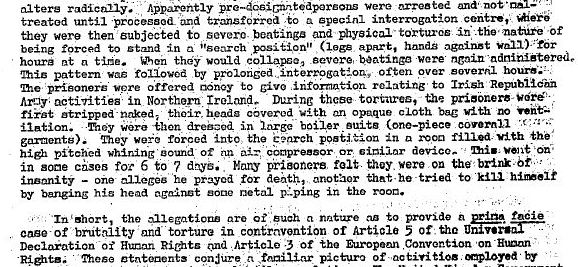
Responding to public outrage in Ireland, the Irish government made history by taking the first ever inter-state case under the European Convention of Human Rights, alleging the UK had tortured the men.
While the UK denied torture, Prime Minister Ted Heath soon announced a prohibition by UK forces of any future use of the techniques.
In 1976, the European Commission on Human Rights found that the UK had tortured the men, but the UK appealed the decision claiming that the techniques used had no long-term impact.
The appeal succeeded and in 1978 the European Court of Human Rights found that the interrogation amounted to "inhuman and degrading treatment" but not torture.
The difference was subsequently seized upon by those who wanted to use similar interrogation techniques.
In 2002, Jay Bybee in the US Attorney General's office prepared legal advice on what could and could not be done to interrogation subjects. He quoted liberally from the Ireland v UK 1978 decision in the infamous 'torture memos':
Within months, the CIA was using the "five techniques" in Iraq, Afghanistan and around the world.
Here's an excerpt from a CIA report on what they did when interrogating a "high value detainee" (HVD). The similarity of the torture techniques to those applied in Northern Ireland is striking.
With the publication today of the US Senate report into CIA torture, more of the horror of US abuses has now been laid bare.
Meanwhile, happy with the downgraded European Court decision and the "special stigma of torture" removed, the UK quietly forgot about Ted Heath's supposed probihition. In Iraq, the techniques were put to use again.
They cost Baha Mousa his life. The inquiry into his death found that the Iraqi's 2003 demise was caused by "factors including lack of food and water, heat, exhaustion, fear, previous injuries and the hooding and stress positions used by British troops - and a final struggle with his guards".
 Letter from Home Secretary Merlyn Rees to Prime Minister Jim Callaghan in 1977, when the UK was arguing (successfully, as it turned out) in Strasbourg that the techniques used were not torture
Meanwhile, through work by the Pat Finucane Centre, NUI Galway and RTÉ, files were discovered in the UK state archives in Kew suggesting that Britain misled the Court in 1978, withholding key evidence demonstrating they knew the techniques had long-term health impacts on the victims, and that the torture had been authorised at UK Cabinet level.
Following calls from Amnesty International and others, the Irish government has now decided to appeal the European Court decision in light of the new evidence. Perhaps the 'hooded men' will finally have their day in a Strasbourg Court with the full truth before it.
Shockingly, to date, no proper, independent investigation of the torture of the 'hooded men' has ever been carried out by the UK authorities and no-one has ever been held to account.
With total impunity in the UK for torture conducted in Northern Ireland in the 1970s, it is perhaps no wonder that the US followed the example of their closest ally when it came to fighting their 21st century "war on terror".New evidence of British colonial atrocities has not changed our national ability to disregard it
 Members of the Devon Regiment round up local people in a search for Mau Mau fighters in Kenya in 1954. Photograph: Popperfoto/Popperfoto/Getty Images
@GeorgeMonbiot
There is one thing you can say for the Holocaust deniers: at least they know what they are denying. In order to sustain the lies they tell, they must engage in strenuous falsification. To dismiss Britain's colonial atrocities, no such effort is required. Most people appear to be unaware that anything needs to be denied.
The story of benign imperialism, whose overriding purpose was not to seize land, labour and commodities but to teach the natives English, table manners and double-entry book-keeping, is a myth that has been carefully propagated by the rightwing press. But it draws its power from a remarkable national ability to airbrush and disregard our past.
Last week's revelations, that the British government systematically destroyed the documents detailing mistreatment of its colonial subjects, and that the Foreign Office then lied about a secret cache of files containing lesser revelations, is by any standards a big story. But it was either ignored or consigned to a footnote by most of the British press. I was unable to find any mention of the secret archive on the Telegraph's website. The Mail's only coverage, as far as I can determine, was an opinion piece by a historian called Lawrence James, who used the occasion to insist that any deficiencies in the management of the colonies were the work of "a sprinkling of misfits, incompetents and bullies", while everyone else was "dedicated, loyal and disciplined".
The British government's suppression of evidence was scarcely necessary. Even when the documentation of great crimes is abundant, it is not denied but simply ignored. In an article for the Daily Mail in 2010, for example, the historian Dominic Sandbrook announced that "Britain's empire stands out as a beacon of tolerance, decency and the rule of law … Nor did Britain countenance anything like the dreadful tortures committed in French Algeria." Could he really have been unaware of the history he is disavowing?
Caroline Elkins, a professor at Harvard, spent nearly 10 years compiling the evidence contained in her book Britain's Gulag: the Brutal End of Empire in Kenya. She started her research with the belief that the British account of the suppression of the Kikuyu's Mau Mau revolt in the 1950s was largely accurate. Then she discovered that most of the documentation had been destroyed. She worked through the remaining archives, and conducted 600 hours of interviews with Kikuyu survivors – rebels and loyalists – and British guards, settlers and officials. Her book is fully and thoroughly documented. It won the Pulitzer prize. But as far as Sandbrook, James and other imperial apologists are concerned, it might as well never have been written.
Elkins reveals that the British detained not 80,000 Kikuyu, as the official histories maintain, but almost the entire population of one and a half million people, in camps and fortified villages. There, thousands were beaten to death or died from malnutrition, typhoid, tuberculosis and dysentery. In some camps almost all the children died.
The inmates were used as slave labour. Above the gates were edifying slogans, such as "Labour and freedom" and "He who helps himself will also be helped". Loudspeakers broadcast the national anthem and patriotic exhortations. People deemed to have disobeyed the rules were killed in front of the others. The survivors were forced to dig mass graves, which were quickly filled. Unless you have a strong stomach I advise you to skip the next paragraph.
Interrogation under torture was widespread. Many of the men were anally raped, using knives, broken bottles, rifle barrels, snakes and scorpions. A favourite technique was to hold a man upside down, his head in a bucket of water, while sand was rammed into his rectum with a stick. Women were gang-raped by the guards. People were mauled by dogs and electrocuted. The British devised a special tool which they used for first crushing and then ripping off testicles. They used pliers to mutilate women's breasts. They cut off inmates' ears and fingers and gouged out their eyes. They dragged people behind Land Rovers until their bodies disintegrated. Men were rolled up in barbed wire and kicked around the compound.
Elkins provides a wealth of evidence to show that the horrors of the camps were endorsed at the highest levels. The governor of Kenya, Sir Evelyn Baring, regularly intervened to prevent the perpetrators from being brought to justice. The colonial secretary, Alan Lennox-Boyd, repeatedly lied to the House of Commons. This is a vast, systematic crime for which there has been no reckoning.
No matter. Even those who acknowledge that something happened write as if Elkins and her work did not exist. In the Telegraph, Daniel Hannan maintains that just eleven people were beaten to death. Apart from that, "1,090 terrorists were hanged and as many as 71,000 detained without due process".
The British did not do body counts, and most victims were buried in unmarked graves. But it is clear that tens of thousands, possibly hundreds of thousands, of Kikuyu died in the camps and during the round-ups. Hannan's is one of the most blatant examples of revisionism I have ever encountered.
Without explaining what this means, Lawrence James concedes that "harsh measures" were sometimes used, but he maintains that "while the Mau Mau were terrorising the Kikuyu, veterinary surgeons in the Colonial Service were teaching tribesmen how to deal with cattle plagues." The theft of the Kikuyu's land and livestock, the starvation and killings, the widespread support among the Kikuyu for the Mau Mau's attempt to reclaim their land and freedom: all vanish into thin air. Both men maintain that the British government acted to stop any abuses as soon as they were revealed.
What I find remarkable is not that they write such things, but that these distortions go almost unchallenged. The myths of empire are so well-established that we appear to blot out countervailing stories even as they are told. As evidence from the manufactured Indian famines of the 1870s and from the treatment of other colonies accumulates, British imperialism emerges as no better and in some cases even worse than the imperialism practised by other nations. Yet the myth of the civilising mission remains untroubled by the evidence.
• A fully referenced version of this article can be found at www.monbiot.com


 Liam Holden said the Army used water boarding to force him to confess to a murder he did not commit
 The documentary examines allegations of torture by the RUC at Castlereagh police station