Showing posts with label Prime Minister. Show all posts

Thursday, 12 March 2015

HAPPY PADDYS DAY COUNTS


On the 2 March 1972, United Kingdom, Paedophile, Prime Minister, Edward Heath stated in the House of Commons:


"The Government, having reviewed the whole matter with great care and with reference to any future operations, have decided that the techniques ... will not be used in future as an aid to interrogation... The statement that I have made covers all future circumstances." Since that time, the UK have outsourced their torture and taught it to torturers worldwide. Now, the the British Government have declared, that they are leaving the European Court, because they can no longer comply with European Law, neither can the comply with International Law, and have refused to join the International Criminal Court. They are currently torturing, politically interned Irish POWs in Maghaberry, by unecessary strip searching and sticking everything up the arse, as in Kenya in the articles below, which is typical paedophile torture. There is modern equipment as used in airports and prisons all over the world, to carry out this work, without torture and degradation.

As far as Irish Blog is concerned, there is no need to write anymore about UK standards of injustice, the above actions, confirm in themaelves, their uncivilized status.They have just sent the SAS back into Ireland and without European Law, can torture at will in Occupied Ireland again in despite a PSEUDO PEACE PROCESS. They also plan to use Occupied Ireland again, as a test laboratory, to develop further drone technology.

In Irish Blog's Court, they are proven C(O)UNTS!

CASE DISMISSED !


Paper trail: from Northern Ireland’s hooded men to CIA’s global torture


In August 1971 the UK authorities arrested and interned hundreds of men in Northern Ireland. Fourteen of them were selected for "special treatment" - torture in a specially-built interrogation centre at a British Army camp. The men were subjected to the soon-to-be infamous "five techniques" of hooding, stress positions, white noise, sleep deprivation and deprivation of food and water - combined with brutal beatings & death threats.

Allegations soon emerged of abuse. Amnesty International sent its first ever research mission to the UK to investigate, interviewing the men and finding some of them to still be black and blue with bruises.

In it's October 30 1971 report, Amnesty found a "prima facie case of brutality and torture".
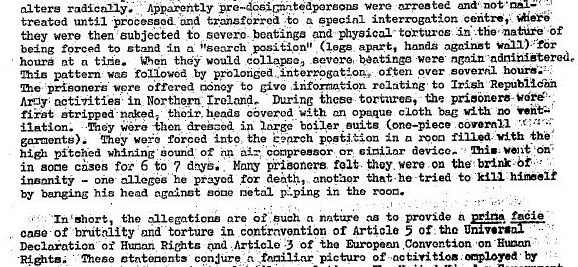


Responding to public outrage in Ireland, the Irish government made history by taking the first ever inter-state case under the European Convention of Human Rights, alleging the UK had tortured the men.

While the UK denied torture, Prime Minister Ted Heath soon announced a prohibition by UK forces of any future use of the techniques.

In 1976, the European Commission on Human Rights found that the UK had tortured the men, but the UK appealed the decision claiming that the techniques used had no long-term impact.

The appeal succeeded and in 1978 the European Court of Human Rights found that the interrogation amounted to "inhuman and degrading treatment" but not torture.

The difference was subsequently seized upon by those who wanted to use similar interrogation techniques.

In 2002, Jay Bybee in the US Attorney General's office prepared legal advice on what could and could not be done to interrogation subjects. He quoted liberally from the Ireland v UK 1978 decision in the infamous 'torture memos':


Within months, the CIA was using the "five techniques" in Iraq, Afghanistan and around the world.

Here's an excerpt from a CIA report on what they did when interrogating a "high value detainee" (HVD). The similarity of the torture techniques to those applied in Northern Ireland is striking.


With the publication today of the US Senate report into CIA torture, more of the horror of US abuses has now been laid bare.

Meanwhile, happy with the downgraded European Court decision and the "special stigma of torture" removed, the UK quietly forgot about Ted Heath's supposed probihition. In Iraq, the techniques were put to use again.

They cost Baha Mousa his life. The inquiry into his death found that the Iraqi's 2003 demise was caused by "factors including lack of food and water, heat, exhaustion, fear, previous injuries and the hooding and stress positions used by British troops - and a final struggle with his guards".
Letter from Home Secretary Merlyn Rees to Prime Minister Jim Callaghan in 1977, when the UK was arguing (successfully, as it turned out) in Strasbourg that the techniques used were not torture

Meanwhile, through work by the Pat Finucane Centre, NUI Galway and RTÉ, files were discovered in the UK state archives in Kew suggesting that Britain misled the Court in 1978, withholding key evidence demonstrating they knew the techniques had long-term health impacts on the victims, and that the torture had been authorised at UK Cabinet level.

Following calls from Amnesty International and others, the Irish government has now decided to appeal the European Court decision in light of the new evidence. Perhaps the 'hooded men' will finally have their day in a Strasbourg Court with the full truth before it.

Shockingly, to date, no proper, independent investigation of the torture of the 'hooded men' has ever been carried out by the UK authorities and no-one has ever been held to account.

With total impunity in the UK for torture conducted in Northern Ireland in the 1970s, it is perhaps no wonder that the US followed the example of their closest ally when it came to fighting their 21st century "war on terror".
New evidence of British colonial atrocities has not changed our national ability to disregard it
Members of the Devon Regiment round up local people in a search for Mau Mau fighters in Kenya in 1954. Photograph: Popperfoto/Popperfoto/Getty Images

@GeorgeMonbiot


There is one thing you can say for the Holocaust deniers: at least they know what they are denying. In order to sustain the lies they tell, they must engage in strenuous falsification. To dismiss Britain's colonial atrocities, no such effort is required. Most people appear to be unaware that anything needs to be denied.

The story of benign imperialism, whose overriding purpose was not to seize land, labour and commodities but to teach the natives English, table manners and double-entry book-keeping, is a myth that has been carefully propagated by the rightwing press. But it draws its power from a remarkable national ability to airbrush and disregard our past.

Last week's revelations, that the British government systematically destroyed the documents detailing mistreatment of its colonial subjects, and that the Foreign Office then lied about a secret cache of files containing lesser revelations, is by any standards a big story. But it was either ignored or consigned to a footnote by most of the British press. I was unable to find any mention of the secret archive on the Telegraph's website. The Mail's only coverage, as far as I can determine, was an opinion piece by a historian called Lawrence James, who used the occasion to insist that any deficiencies in the management of the colonies were the work of "a sprinkling of misfits, incompetents and bullies", while everyone else was "dedicated, loyal and disciplined".

The British government's suppression of evidence was scarcely necessary. Even when the documentation of great crimes is abundant, it is not denied but simply ignored. In an article for the Daily Mail in 2010, for example, the historian Dominic Sandbrook announced that "Britain's empire stands out as a beacon of tolerance, decency and the rule of law … Nor did Britain countenance anything like the dreadful tortures committed in French Algeria." Could he really have been unaware of the history he is disavowing?

Caroline Elkins, a professor at Harvard, spent nearly 10 years compiling the evidence contained in her book Britain's Gulag: the Brutal End of Empire in Kenya. She started her research with the belief that the British account of the suppression of the Kikuyu's Mau Mau revolt in the 1950s was largely accurate. Then she discovered that most of the documentation had been destroyed. She worked through the remaining archives, and conducted 600 hours of interviews with Kikuyu survivors – rebels and loyalists – and British guards, settlers and officials. Her book is fully and thoroughly documented. It won the Pulitzer prize. But as far as Sandbrook, James and other imperial apologists are concerned, it might as well never have been written.

Elkins reveals that the British detained not 80,000 Kikuyu, as the official histories maintain, but almost the entire population of one and a half million people, in camps and fortified villages. There, thousands were beaten to death or died from malnutrition, typhoid, tuberculosis and dysentery. In some camps almost all the children died.

The inmates were used as slave labour. Above the gates were edifying slogans, such as "Labour and freedom" and "He who helps himself will also be helped". Loudspeakers broadcast the national anthem and patriotic exhortations. People deemed to have disobeyed the rules were killed in front of the others. The survivors were forced to dig mass graves, which were quickly filled. Unless you have a strong stomach I advise you to skip the next paragraph.

Interrogation under torture was widespread. Many of the men were anally raped, using knives, broken bottles, rifle barrels, snakes and scorpions. A favourite technique was to hold a man upside down, his head in a bucket of water, while sand was rammed into his rectum with a stick. Women were gang-raped by the guards. People were mauled by dogs and electrocuted. The British devised a special tool which they used for first crushing and then ripping off testicles. They used pliers to mutilate women's breasts. They cut off inmates' ears and fingers and gouged out their eyes. They dragged people behind Land Rovers until their bodies disintegrated. Men were rolled up in barbed wire and kicked around the compound.

Elkins provides a wealth of evidence to show that the horrors of the camps were endorsed at the highest levels. The governor of Kenya, Sir Evelyn Baring, regularly intervened to prevent the perpetrators from being brought to justice. The colonial secretary, Alan Lennox-Boyd, repeatedly lied to the House of Commons. This is a vast, systematic crime for which there has been no reckoning.

No matter. Even those who acknowledge that something happened write as if Elkins and her work did not exist. In the Telegraph, Daniel Hannan maintains that just eleven people were beaten to death. Apart from that, "1,090 terrorists were hanged and as many as 71,000 detained without due process".

The British did not do body counts, and most victims were buried in unmarked graves. But it is clear that tens of thousands, possibly hundreds of thousands, of Kikuyu died in the camps and during the round-ups. Hannan's is one of the most blatant examples of revisionism I have ever encountered.

Without explaining what this means, Lawrence James concedes that "harsh measures" were sometimes used, but he maintains that "while the Mau Mau were terrorising the Kikuyu, veterinary surgeons in the Colonial Service were teaching tribesmen how to deal with cattle plagues." The theft of the Kikuyu's land and livestock, the starvation and killings, the widespread support among the Kikuyu for the Mau Mau's attempt to reclaim their land and freedom: all vanish into thin air. Both men maintain that the British government acted to stop any abuses as soon as they were revealed.

What I find remarkable is not that they write such things, but that these distortions go almost unchallenged. The myths of empire are so well-established that we appear to blot out countervailing stories even as they are told. As evidence from the manufactured Indian famines of the 1870s and from the treatment of other colonies accumulates, British imperialism emerges as no better and in some cases even worse than the imperialism practised by other nations. Yet the myth of the civilising mission remains untroubled by the evidence.

• A fully referenced version of this article can be found at www.monbiot.com

Tuesday, 18 November 2014

BURIED STORIES OF PRISON PLANET NEWRY


“Truth is stranger than fiction, but it is because Fiction is obliged to stick to possibilities; Truth isn't.”

― Mark Twain

The army asked me to make bombs for the IRA, told me I had the Prime Minister's blessing ... then tried to kill me


Neil Mackay

Exclusive: confessions of a secret agent turned terrorist

KEVIN Fulton is very clear about where the orders were coming from. 'I was told that this was sanctioned right at the top,' he says, sipping a Pepsi in the bar of a Glasgow hotel. 'I was told 'there'll be no medals for this, and no recognition, but this goes the whole way to the Prime Minister. The Prime Minister knows what you are doing.'
This was 1980, and if Margaret Thatcher knew about the activities of military intelligence agents such as Fulton, then she was also aware her own military officers were planning to infiltrate British soldiers as 'moles' into the IRA. These moles were ordered by their handlers to carry out terrorist crimes in order to keep their cover within the Provos so they could feed information on other leading republicans back to security forces.

For almost two years the Sunday Herald has been investigating the activities of the FRU -- the Force Research Unit, an ultra-secret wing of British military intelligence. Fulton worked for the FRU for much of his career as an IRA mole. This unit, which has been under investigation by Scotland Yard commissioner Sir John Stevens for more than a decade, was involved in the murder of civilians in Northern Ireland.

Nicholas Benwell, a detective sergeant formerly attached to the Stevens Inquiry, says the Scotland Yard team came to one conclusion: that military intelligence was colluding with terrorists to help them kill so-called 'legitimate targets' such as active republicans. FRU handlers passed documents and photographs to their agents operating within paramilitary groups detailing targets' movements and the whereabouts of their homes. Pictures were also handed over to help gunmen identify their victims. But there was a problem. The targeting was far from professional and many of the victims of these government-backed hit squads were innocent civilians.

In 1989 the FRU passed information to the UDA which the loyalist gang used to murder the Belfast solicitor Pat Finucane, who was shot dead in front of his wife and children. Last week, Prime Minister Tony Blair pledged that the Government was determined to uncover the truth about Finucane's murder. The Canadian judge Peter Cory who was called in by the government to investigate the case is expected to recommend a public inquiry. The Irish government is also pressing for an inquiry of its own.

So who was the overall controller of the FRU with its 'licence to kill' republicans? Until now it seemed that responsibility for the activities of the FRU rested on the shoulders of one man -- Brigadier Gordon Kerr, the Scottish officer who led the unit and is now the British military attach? to Beijing. A two-part BBC Panorama programme, concluding tonight, much of it based on the Sunday Herald's previous investigations, puts Kerr squarely in the frame.

But if Fulton's claims are correct, then Kerr, soon to be questioned by the Stevens team, was just one link in a chain of command which went all the way to the cabinet and the Prime Minister. As Fulton says: 'Kerr was just following orders. Soldiers don't make up the rules, they just do as they're told.'

Fulton's story begins in 1979. He was 19, and had just enlisted in the First Battalion Royal Irish Rangers. Kevin Fulton isn't his real name, but a pseudonym used to protect his identity since turning whistle-blower on the activities of the British military, the RUC and the security services in Ulster's 'dirty war'. His work for military intelligence has been confirmed by FRU sources.

Fulton's military file quickly found its way onto the desks of the Intelligence Corps, the regiment which includes the FRU. It made interesting reading. Here was a Catholic from Newry, in the heart of a republican strong-hold, who seemed a loyal servant of the Crown. After only a few weeks in the army, Fulton's staff sergeant approached him. 'I was told that some guys from military intelligence wanted to speak to me,' Fulton says. 'They asked me if I'd like to work for them and I said 'no' as I wanted to remain in uniform. They told me to think about the offer. They added that I shouldn't tell anyone about the visit and that if I was asked I should say they were from a military welfare group. The next time we met they asked me if I'd go to Newry with them. We looked through pictures of local characters and I put names to faces, saying if they had a republican background or not.'

The two FRU officers, one of whom was Scottish, continued to try and persuade him to work with them. 'They confessed they needed guys like me -- Catholics from that part of Northern Ireland -- in order to get inside the Provos,' he says.


Fulton was still unsure, so the FRU asked him if he could help recruit a Catholic civilian in Newry who might be willing to go inside the IRA. He did. It was an old friend, who he refers to as Agent Washington. He and Fulton accompanied FRU members to the army training camp at Ballykinlar in County Down. 'He was given weapons training. They taught him how to fire an M16, AK-47s, Remington wingmaster shotguns, Sterling sub-machine guns and a Browning 9mm,' says Fulton. 'Remember that this was a civilian going inside the IRA.'

Fulton finally decided he'd work with military intelligence. In 1981, he was officially given a compassionate discharge from his regiment on the fictitious grounds that his father was seriously ill. He also received papers claiming he'd been thrown out for republican sympathies -- a great document to present to the IRA men he would soon befriend.

From then until 1995, Fulton remained on full army pay as he worked his way through the ranks of the IRA. He began drinking in republican bars in Dundalk and socialising with senior IRA officers, including Patrick Joseph Blair, who the Sunday Herald named this year as one of the men behind the Omagh bombing. Blair later went on to became Fulton's 'mentor'.

Not long after his discharge, he told one prominent IRA man that he wanted to join the organisation. He was taken to a room above a bar and confronted by a number of men in balaclavas. 'I'd told them that I'd been kicked out of the army and they started shouting at me saying 'So you're telling us you'd shoot your f***ing comrades if you saw them in Crossmaglen?' I said 'Yes, of course'.

'They started calling me a tout (republican slang for an informer) and saying they were going to shoot me. Eventually, they dragged me outside. They told me to kneel and say the Act of Contrition. I heard a huge bang behind me. It was them banging a big bit of wood on the ground to pretend to be a gunshot. They were testing me. They told me to come back when I was ready.

'My handlers thought this was great. I offered my services to the IRA saying I'd help carry out robberies to fund them. This was all with the knowledge of my handlers in the FRU. I made pals with a prominent Sinn Fein councillor in Newry who suggested I hijack a lorry carrying TVs. I knew that this would give me credibility, so that's what I did. I took a lorry in Belfast with about £100,000 of TVs inside.'

Fulton was later arrested for the robbery and served a year in the Crumlin Road prison in Belfast. Because of his republican connections he was denied the usual privileges of an ODC -- an ordinary decent criminal. This also gave him additional credibility with the IRA.

Fulton was released in 1986 and inducted straight into the IRA. 'My handlers told me to do anything to win their confidence. That's what I did. My brief was that if I got into a situation where I couldn't get to my handlers but I had to break the law, I was to try not to take a life. I was to shoot high or blow up a bomb prematurely. But that isn't always possible. If I f***ed up all the time, then the IRA would shoot me. Don't forget I also ran the risk of getting shot by the army and the police. I mixed explosive and I helped develop new types of bombs. I moved weapons. If you ask me, 'Did I kill anyone?' then I will say 'no'. But if you ask me if the materials I handled killed anyone, then I will have to say that some of the things I helped develop did kill.

'I reiterate, my handlers knew everything I did. I was never told not to do something that was discussed. How can you pretend to be a terrorist and not act like one? You can't. You've got to do what they do. The people I was with were hard-hitters. They did a lot of murders. If I couldn't be any good to them, then I was no use to the army either. I had to do what the man standing next to me did.'

This took an especially dark turn when Fulton became a member of the IRA's 'internal security squad' -- also know as the 'torture unit' -- which interrogated and executed suspected informers. 'I remember once when a guy had been questioned for three days in a safe-house in the Republic,' says Fulton. 'They eventually rolled out a sheet of plastic and decided we were going to 'nut' him. We drew straws to decide on who would do the shooting. Luckily, I didn't draw the short straw.'

In 1992, Fulton told his handlers -- this time in both the FRU and MI5, that his IRA mentor Blair was planning to use a horizontally-fired mortar for an attack on the police. His handlers did nothing. Within days, Blair fired the device at an armoured RUC Land Rover in Newry, in the process killing policewoman Colleen McMurray. Another RUC officer lost both his legs.

Fulton then travelled to the US and helped develop light-sensitive bombs, activated by photographic flashes, to overcome the problem of IRA remote-control devices having their detonation signal jammed by army radio units.

'I broke the law seven days a week and my handlers knew that. They knew that I was making bombs and giving them to other members of the IRA and they did nothing about it. If everything I touched turned to shit then I would have been dead. The idea was that the only way to beat the enemy was to penetrate the enemy and be the enemy. At the time I'd no problem with this way of thinking.'

The claim that the cabinet and Thatcher knew of these types of operations is startling. Thatcher's office has refused to comment on Fulton's claims. It is known, though, that intelligence supplied by other British army moles inside the republican movement was being read at cabinet level. One such mole, Willie Carlin, was flown out of Northern Ireland in Thatcher's Prime Ministerial jet in 1985 after his cover was blown. As chairman of the Joint Intelligence Committee, which met weekly at Number 10, Thatcher was kept informed of FRU activities. Whether this ran to the day-to-day details of agent-handling is not known. Thatcher did grant the FRU extra funding to recruit agents in the wake of the IRA's Remembrance Day bombing in Enniskillen.

Fulton split with both the IRA and military intelligence in the mid-1990s after a number of terrorist operations went disastrously wrong. Once his handlers told him to get a mobile phone and a car for a planned hit in 1994 on a senior RUC officer in Belfast. The IRA team was arrested on its way to carry out the murder.

Fulton believes his handlers thought he had outlived his usefulness and deliberately linked him to the operation before tipping off the police about the plan. By then, the army had secured a far more highly-placed mole within the IRA -- a man still active and codenamed Stakeknife. Fulton is sure that he was compromised, so the IRA would kill him and believe they were free of informers, allowing Stakeknife to pass top-grade information to the military without risk of being detected. 'If I was dead that would have been the end of it,' he says. 'There would have been no embarrassment to the army.'

From 1995 until now Fulton has been fighting the MoD -- demanding they clear his criminal record, give him a new identity, a relocation package and provide a military pension. 'If they hadn't screwed me, then I wouldn't be screwing them now,' he says. 'If the IRA ever find me I'm dead. I accept I'm a marked man, but I intend to take everyone down with me who was in on this -- no matter how high up the stink goes.'

Tuesday, 11 June 2013

EXPOSING PRIME MINISTER HEATH A CLASSIC TORY BLUENOSE


Prime Minister Heath Visits Kincora Boys Rape Home with Agents of Clockwork Orange in British Occupied Ireland


The Tory British Prime Minister Edward Heath, was targeted by the IRA, for introducing political internment without trial, which started a war that has lasted more than 40 years, in British Occupied Ireland. In December 1974, the Balcombe Street ASU, threw a bomb onto the first-floor balcony of his home in Wilton Street, Belgravia, where it exploded. 


Heath was conducting a concert at Broadstairs and arrived home, 10 minutes after the bomb exploded. Heath the former British Prime Minister, described in the accompanying tape above, is an example of a typical Tory Bluenose, some of whom are appointed Viceroyals, with dictatorial powers, to intern without trial, the dispossessed native Irish people of no property, in British Occupied Ireland.


The Tory bluenose is the work of generations of the British class system. The civil rights movement in Ireland didn't become mediagenic until the 1960s. Women only gained a modest degree of physical autonomy in the 70s. Neither of those were slumbering before that. The paranoid, blue nose, bigoted British security state, is embellished with a further layer of mentored orange order sectarianism, being still the norm of governance in British Occupied Ireland. All Tory blue nose male dominated pyramid hierarchies tend in that direction.


A traditional Tory Blue nose started each day by eating a poor person for breakfast, served to him by a stable of butlers and attendants. Before his round of morning polo (in which the head of a homeless man was used for a ball), a Tory bluenose (including Orange Order brethren) spends half an hour, in the Tory Blue Nose family room, where he and his father, reaffirm their ancestral connection to blue-blooded types, who either owned slaves or coveted them.


If you are worried that Tory bluenoses might try and bring back slavery, we will do absolutely nothing to allay your fears. A Tory nose from the City of London, recently paid an exorbitant sum, for a colon operation, that made his gas smell like daisies. When asked a difficult question by a company shareholder, he will silently break wind and ask, "My gosh. Do you smell daisies?" as a diversion. Its a typical case of the stiff upper nose, as opposed to the stiff upper lip.


The Devil's Dictionary Pronouces - NOSE, n. The extreme outpost of the face. Getius, whose writings antedate the age of humor, calls the Tory bluenose the organ of quell. It has been observed that Tory bluenoses are never so happy, as when thrust into the affairs of other nations, such as Ireland for example, from which some physiologists, have drawn the inference, that the British Tory nose is devoid of any natural human sense of smell, other than the smell of blood, cultivated over many generations, since they were first blooded with cruel intent and smeared with fox blood as children, at the their first traditional Tory foxhunt.

There's a Tory with a Nose,
And wherever he goes
The people run from him and shout:
"No cotton have we
For our ears if so be
He blow that interminous snout!"

So the lawyers applied
For injunction. "Denied,"
Said the Judge: "the defendant prefixion,
Whate'er it portend,
Appears to transcend
The bounds of this court's jurisdiction."


A bit like political internment, beyond t
he bounds of the court's jurisdiction, eh?


One of the many current political internees, since internment has been reintroduced, after the Irish Peace Process without Due Process, is a fragile 63 year old man, called Martin Corey in the photograph with a link to details below:


Details:  http://www.releasemartincorey.com