Showing posts with label AYMAN AL GILMORE. Show all posts

Sunday, 6 October 2013

THE KILLING OF FATBARSTURD AYMAN AL GILMORE


A few weeks ago Eamon Gilmore the Irish foreign Minister was campaigning around the world for an invasion of Syria like his mentor Tony Blair did with Iraq. How can this happen? This can be when you have the media, the Church, big business, the banks and many people in the community who are either pro-war, don't care, or suck-up everything these establishment groups and Labour fatbarsturds tell them. As long as the bourgeoisie feel comfortable, people in poor countries can starve, thousands of other people in other countries can be murdered in war, and the Western world can plunder the rest for geo-political advantage and resources.
Until we have co-ordinated action by the victims of these things and those who desperately want to help them - that will be the way it goes. 

Vive la Revolution.


The Party Game is Over. Stand and Fight

By John Pilger
"Rise like lions after slumber
In unvanquishable number!
Shake your chains to earth, like dew
Which in sleep had fall'n on you:
Ye are many - they are few."
October 05, 2013 "Information Clearing House - These days, the stirring lines of Percy Shelley's "Mask of Anarchy" may seem unattainable. I don't think so. Shelley was both a Romantic and political truth-teller. His words resonate now because only one political course is left to those who are disenfranchised and whose ruin is announced on a government spreadsheet.

Born of the "never again" spirit of 1945, social democracy has surrendered to an extreme political cult of money worship. This reached its apogee when £1trn of public money was handed unconditionally to corrupt banks by a Labour government whose leader, Gordon Brown, had previously described "financiers" as the nation's "great example" and his personal "inspiration".

This is not to say parliamentary politics is meaningless. It has one meaning now: the replacement of democracy with a business plan for every human activity, every dream, every decency, every hope, every child born.

The old myths of British rectitude, imperial in origin, provided false comfort while the Blair gang built the foundation of the present "coalition". This is led by a former PR man for an asset stripper and by a bagman who will inherit his knighthood and the tax-shielded fortune of his father, the 17th Baronet of Ballintaylor. David Cameron and George Osborne are essentially fossilised spivs who, in colonial times, would have been sent by their daddies to claim foreign terrain and plunder.

Today, they are claiming 21st-century Britain and imposing their vicious, antique ideology, albeit served as economic snake oil. Their designs have nothing to do with a "deficit crisis". A deficit of 10 per cent is not remotely a crisis. When Britain was officially bankrupt at the end of the Second World War, the government built its greatest public institutions, such as the National Health Service and the arts edifices of London's South Bank.

There is no economic rationale for the assault described cravenly by the BBC as a "public spending review". The debt is exclusively the responsibility of those who incurred it, the super-rich and the gamblers. However, that's beside the point. What is happening in Britain is the seizure of an opportunity to destroy the tenuous humanity of the modern state. It is a coup, a "shock doctrine" as applied to Pinochet's Chile and Yeltsin's Russia.

In Britain, there is no need for tanks in the streets. In its managerial indifference to the freedoms it is said to hold dear, bourgeois Britain has allowed parliament to create a surveillance state with 3,000 new criminal offences and laws: more than for the whole of the previous century. Powers of arrest and detention have never been greater. The police have the impunity to kill; and asylum-seekers can be "restrained" to death on commercial flights.

Athol Fugard is right. With Harold Pinter gone, no acclaimed writer or artist dare depart from their well-remunerated vanity. With so much in need of saying, they have nothing to say. Liberalism, the vainest ideology, has hauled up its ladder. The chief opportunist, Nick Clegg, gave no electoral hint of his odious faction's compliance with the dismantling of much of British postwar society. The theft of £83bn in jobs and services matches almost exactly the amount of tax legally avoided by piratical corporations. Without fanfare, the super-rich have been assured they can dodge up to £40bn in tax payments in the secrecy of Swiss banks. The day this was sewn up, Osborne attacked those who "cheat" the welfare system. He omitted the real amount lost, a minuscule £0.5bn, and that £10.5bn in benefit payments was not claimed at all. Labour is his silent partner.

The propaganda arm in the press and broadcasting dutifully presents this as unfortunate but necessary. Mark how the firefighters' action is "covered". On Channel 4 News, following an item that portrayed modest, courageous people as basically reckless, Jon Snow demanded that the leaders of the London Fire Authority and the Fire Brigades Union go straight from the studio and "mediate" now, this minute. "I'll get the taxis!" he declared. Forget the thousands of jobs that are to be eliminated from the fire service and the public danger beyond Bonfire Night; knock their jolly heads together. "Good stuff!" said the presenter.

Ken Loach's 1983 documentary series Questions of Leadership opens with a sequence of earnest young trade unionists on platforms, exhorting the masses. They are then shown older, florid, self-satisfied and finally adorned in the ermine of the House of Lords. Once, at a Durham Miners' Gala, I asked Tony Woodley, now joint general secretary of Unite, "Isn't the problem the clockwork collaboration of the union leadership?" He almost agreed, implying that the rise of bloods like himself would change that. The British Airways cabin crew strike, over which Woodley presides, is said to have made gains. Has it? And why haven't the unions risen against totalitarian laws that place free trade unionism in a vice?

The BA workers, the firefighters, the council workers, the post office workers, the NHS workers, the London Underground staff, the teachers, the lecturers, the students can more than match the French if they are resolute and imaginative, forging, with the wider social justice movement, potentially the greatest popular resistance ever. Look at the web; listen to the public's support at fire stations. There is no other way now. Direct action. Civil disobedience. Unerring. Read Shelley and do it.
www.johnpilger.com

Friday, 4 October 2013

SATANIC ORANGE ORDER Ayman Al Gilmore


The Sparks of Rebellion
By Chris Hedges
Editor’s note: Chris Hedges will be giving a talk titled “The Myth of Human Progress and the Collapse of Complex Societies” on Oct. 13 in the Los Angeles area. Click here for more information.
September 30, 2013 "Information Clearing House - "Truthdig" - I am reading and rereading the debates among some of the great radical thinkers of the 19th and 20th centuries about the mechanisms of social change. These debates were not academic. They were frantic searches for the triggers of revolt.
Vladimir Lenin placed his faith in a violent uprising, a professional, disciplined revolutionary vanguard freed from moral constraints and, like Karl Marx, in the inevitable emergence of the worker’s state.Pierre-Joseph Proudhon insisted that gradual change would be accomplished as enlightened workers took over production and educated and converted the rest of the proletariat. Mikhail Bakunin predicted the catastrophic breakdown of the capitalist order, something we are likely to witness in our lifetimes, and new autonomous worker federations rising up out of the chaos. Pyotr Kropotkin, like Proudhon, believed in an evolutionary process that would hammer out the new society. Emma Goldman, along with Kropotkin, came to be very wary of both the efficacy of violence and the revolutionary potential of the masses. “The mass,” Goldman wrote bitterly toward the end of her life in echoing Marx, “clings to its masters, loves the whip, and is the first to cry Crucify!”
The revolutionists of history counted on a mobilized base of enlightened industrial workers. The building blocks of revolt, they believed, relied on the tool of the general strike, the ability of workers to cripple the mechanisms of production. Strikes could be sustained with the support of political parties, strike funds and union halls. Workers without these support mechanisms had to replicate the infrastructure of parties and unions if they wanted to put prolonged pressure on the bosses and the state. But now, with the decimation of the U.S. manufacturing base, along with the dismantling of our unions and opposition parties, we will have to search for different instruments of rebellion.
We must develop a revolutionary theory that is not reliant on the industrial or agrarian muscle of workers. Most manufacturing jobs have disappeared, and, of those that remain, few are unionized. Our family farms have been destroyed by agro-businesses. Monsanto and its Faustian counterparts on Wall Street rule. They are steadily poisoning our lives and rendering us powerless. The corporate leviathan, which is global, is freed from the constraints of a single nation-state or government. Corporations are beyond regulation or control. Politicians are too anemic, or more often too corrupt, to stand in the way of the accelerating corporate destruction. This makes our struggle different from revolutionary struggles in industrial societies in the past. Our revolt will look more like what erupted in the less industrialized Slavic republics, Russia, Spain and China and uprisings led by a disenfranchised rural and urban working class and peasantry in the liberation movements that swept through Africa and Latin America. The dispossessed working poor, along with unemployed college graduates and students, unemployed journalists, artists, lawyers and teachers, will form our movement. This is why the fight for a higher minimum wage is crucial to uniting service workers with the alienated college-educated sons and daughters of the old middle class. Bakunin, unlike Marx, considered déclassé intellectuals essential for successful revolt.
It is not the poor who make revolutions. It is those who conclude that they will not be able, as they once expected, to rise economically and socially. This consciousness is part of the self-knowledge of service workers and fast food workers. It is grasped by the swelling population of college graduates caught in a vise of low-paying jobs and obscene amounts of debt. These two groups, once united, will be our primary engines of revolt. Much of the urban poor has been crippled and in many cases broken by a rewriting of laws, especially drug laws, that has permitted courts, probation officers, parole boards and police to randomly seize poor people of color, especially African-American men, without just cause and lock them in cages for years. In many of our most impoverished urban centers—our internal colonies, as Malcolm X called them—mobilization, at least at first, will be difficult. The urban poor are already in chains. These chains are being readied for the rest of us. “The law, in its majestic equality, forbids rich and poor alike to sleep under bridges, beg in the streets or steal bread,” W.E.B. Du Bois commented acidly.
Erica Chenoweth and Maria J. Stephan examined 100 years of violent and nonviolent resistance movements in their book “Why Civil Resistance Works.” They concluded that nonviolent movements succeed twice as often as violent uprisings. Violent movements work primarily in civil wars or in ending foreign occupations, they found. Nonviolent movements that succeed appeal to those within the power structure, especially the police and civil servants, who are cognizant of the corruption and decadence of the power elite and are willing to abandon them.
“History teaches that we have the power to transform the nation,” Kevin Zeese said when I interviewed him. Zeese, who with Dr. Margaret Flowers founded PopularResistance.org and helped plan theoccupation of Freedom Plaza in Washington, D.C., continued: “We put forward a strategic framework that would allow people to work together in a common direction to end the rule of money. We need to be a nationally networked movement of many local, regional and issue-focused groups so we can unite into one mass movement. Research shows that nonviolent mass movements win. Fringe movements fail. By ‘mass’ we mean with an objective that is supported by a large majority and 1 percent to 5 percent of the population actively working for transformation.”
Zeese said this mass resistance must work on two tracks. It must attempt to stop the machine while at the same time building alternative structures of economic democracy and participatory democratic institutions. It is vital, he said, to sever ourselves from the corporate economy. Money, he said, has to be raised for grass-roots movements since most foundations that give grants are linked to the Democratic Party. Radical student and environmental groups especially need funds to build national networks, as does the public banking initiative. This initiative is essential to the movement. It will never find support among legislative bodies, for public banks would free people from the tyranny of commercial banks and Wall Street.
The most important dilemma facing us is not ideological. It is logistical. The security and surveillance state has made its highest priority the breaking of any infrastructure that might spark widespread revolt. The state knows the tinder is there. It knows that the continued unraveling of the economy and the effects of climate change make popular unrest inevitable. It knows that as underemployment and unemployment doom at least a quarter of the U.S. population, perhaps more, to perpetual poverty, and as unemployment benefits are scaled back, as schools close, as the middle class withers away, as pension funds are looted by hedge fund thieves, and as the government continues to let the fossil fuel industry ravage the planet, the future will increasingly be one of open conflict. This battle against the corporate state, right now, is primarily about infrastructure. We need an infrastructure to build revolt. The corporate state is determined to deny us one.
The corporate state, unnerved by the Occupy movement, has moved to close any public space to movements that might reignite encampments. For example, New York City police arrested members of Veterans for Peace on Oct. 7, 2012, when they stayed beyond the 10 p.m. official closing time at the Vietnam Veterans Memorial. The police, who in some cases apologized to the veterans as they handcuffed them, were open about the motive of authorities: Officers told those being taken to jail they should blame the Occupy movement for the arrests.
The state has, at the same time, heavily infiltrated movements in order to discredit, isolate and push out their most competent leaders. It has used its vast surveillance capacities to monitor all forms of electronic communications, as well as personal relationships between activists, giving the state the ability to paralyze planned actions before they can begin. It has mounted a public relations campaign to demonize anyone who resists, branding environmental activists as “ecoterrorists,” charging activists under draconian terrorism laws, hunting down whistle-blowers such as Chelsea Manning, Julian Assange and Edward Snowden who shine a light on the inner secrets of power and condemning them as traitors and threats to national security. The state has attempted—and in this effort some in the Black Bloc proved unwittingly useful—to paint the movement as violent and directionless.
Occupy articulated the concerns of the majority of citizens. Most of the citizenry detests Wall Street and big banks. It does not want more wars. It needs jobs. It is disgusted with the subservience of elected officials to corporate power. It wants universal health care. It worries that if the fossil fuel industry is not stopped, there will be no future for our children. And the state is using all its power to stymie any movement that expresses these concerns. Documents released under the Freedom of Information Act show Homeland Security, the FBI, the Federal Protective Service, the Park Service and most likely the NSA and the CIA (the latter two have refused to respond to FOIA requests) worked with police across the country to infiltrate and destroy the encampments. There were 7,765 arrests of people in the movement. Occupy, at its peak, had about 350,000 people—or about 0.1 percent of the U.S. population.
“Look how afraid the power structure was of a mere 1/10th of 1 percent of the population,” Zeese said. “What happens when the movement grows to 1 percent—not a far reach—or the 5 percent that some research shows is the tipping point where no government, dictatorship or democracy can withstand the pressure from below?”
The state cannot allow workers at Wal-Mart, or any other nonunionized service center, to have access to an infrastructure or resources that might permit prolonged strikes and boycotts. And the movement now is about nuts and bolts. It is about food trucks, medical tents, communications vans and musicians and artists willing to articulate and sustain the struggle. We will have to build what unions and radical parties supplied in the past.
The state, in its internal projections, has a vision of the future that is as dystopian as mine. But the state, to protect itself, lies. Politicians, corporations, the public relations industry, the entertainment industry and our ridiculous television pundits speak as if we can continue to build a society based on limitless growth, profligate consumption and fossil fuel. They feed the collective mania for hope at the expense of truth. Their public vision is self-delusional, a form of collective psychosis. The corporate state, meanwhile, is preparing privately for the world it knows is actually coming. It is cementing into place a police state, one that includes the complete evisceration of our most basic civil liberties and the militarization of the internal security apparatus, as well as wholesale surveillance of the citizenry.
The most pressing issue facing us right now is the most prosaic. Protesters attempting to block the Keystone XL pipeline can endure only for so long if they have nothing to eat but stale bagels. They need adequate food. They need a system of communication to get their message out to alternative media that will amplify it. They need rudimentary medical care. All of these elements were vital to the Occupy movement. And these elements, when they came together, allowed the building of a movement that threatened the elite. The encampments also carried within them internal sources of disintegration. Many did not adequately control some groups. Many were hijacked or burdened by those who drained the political work of the movement. Many found that consensus, which worked well in small groups, created paralysis in groups of several hundred or a few thousand. And many failed to anticipate the numbing exhaustion that crushed activists. But these encampments did provide what was most crucial to the movement, something unions or the old Communist Party once provided to militants in the past. They provided the logistics to sustain resistance. And the destruction of the encampments, more than anything else, was a move by the state to deny to us the infrastructure needed to resist.
Infrastructure alone, however, will not be enough.  The resistance needs a vibrant cultural component. It was the spirituals that nourished the souls of African-Americans during the nightmare of slavery. It was the blues that spoke to the reality of black people during the era of Jim Crow. It was the poems of Federico Garcia Lorca that sustained the republicans fighting the fascists in Spain. Music, dance, drama, art, song, painting were the fire and drive of resistance movements. The rebel units in El Salvador when I covered the war there always traveled with musicians and theater troupes. Art, as Emma Goldman pointed out, has the power to make ideas felt. Goldman noted that when Andrew Undershaft, a character in George Bernard Shaw’s play “Major Barbara,” said poverty is “[t]he worst of crimes” and “All the other crimes are virtues beside it,” his impassioned declaration elucidated the cruelty of class warfare more effectively than Shaw’s socialist tracts. The degradation of education into vocational training for the corporate state, the ending of state subsidies for the arts and journalism, the hijacking of these disciplines by corporate sponsors, severs the population from understanding, self-actualization and transcendence. In aesthetic terms the corporate state seeks to crush beauty, truth and imagination. This is a war waged by all totalitarian systems.
Culture, real culture, is radical and transformative. It is capable of expressing what lies deep within us. It gives words to our reality. It makes us feel as well as see. It allows us to empathize with those who are different or oppressed. It reveals what is happening around us. It honors mystery. “The role of the artist, then, precisely, is to illuminate that darkness, blaze roads through the vast forest,” James Baldwin wrote, “so that we will not, in all our doing, lose sight of its purpose, which is, after all, to make the world a more human dwelling place.”
Artists, like rebels, are dangerous. They speak a truth that totalitarian systems do not want spoken. “Red Rosa now has vanished too. …” Bertolt Brecht wrote after Luxemburg was murdered. “She told the poor what life is about, And so the rich have rubbed her out.” Without artists such as musician Ry Cooder and playwrights Howard Brenton and Tarell Alvin McCraney we will not succeed. If we are to face what lies ahead, we will not only have to organize and feed ourselves, we will have to begin to feel deeply, to face unpleasant truths, to recover empathy and to live passionately. Then we can fight.
Chris Hedges, whose column is published Mondays on Truthdig, spent nearly two decades as a foreign correspondent in Central America, the Middle East, Africa and the Balkans. He has reported from more than 50 countries and has worked for The Christian Science Monitor, National Public Radio, The Dallas Morning News and The New York Times, for which he was a foreign correspondent for 15 years
 which he was a foreign correspondent for 15 years

Friday, 13 September 2013

AYMAN AL GILMORE AL QAEDA SHANNON RAINBOW TANAISTE

Whistleblowing ‘Guantanamo granny’ back in court

category clare | anti-war | news report author Friday September 13, 2013 13:49author by Margaretta D'Arcy Report this post to the editors
Court Case of Shannon Airport arrests Margaretta D'Arcy and Nial Farrel
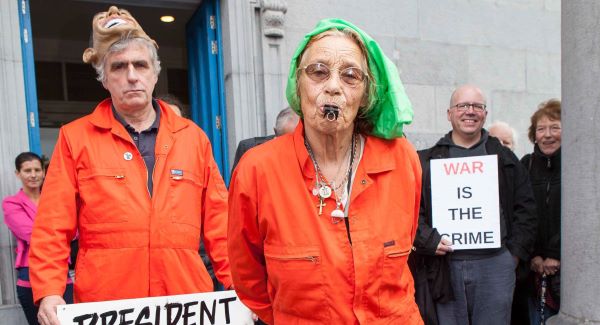
A packed courtroom yesterday erupted into laughter after ‘Guantanamo Granny’-79-year-old anti-war activist Margaretta Darcy,
blew a whistle and declared: “I am a whistleblower”.
Margaretta D'Arcy and Nial Farrel outside Ennis Court
Margaretta D'Arcy and Nial Farrel outside Ennis Court 
Unusually, the case against Margaretta D'Arcy and Niall Farrell was dealt with before lunch at Ennis District court yesterday (Wednesday, 11th Sept). Normally cases involving peace activists tend to be postponed until the end of the court session, thereby inconveniencing the peace activists as much as possible. Perhaps it was because Margaretta and Niall were dressed in orange Guantanamo style boiler suits that the authorities decided to get them out of court as quickly as possible.

Because of the nature and possibly seriousness of the charges, Judge Durkan had mentioned at the previous hearing on 10 July that issues of jurisdiction arose in the case, so there was a question of whether the case would be referred to the higher Circuit Court level. Judge Durkan announced on Wednesday that the DPP had decided that the case/cases should be dealt with at the lower District Court level, and he also announced that he, Judge Durkan had decided that he himself would also accept jurisdiction over the cases. This seemed to indicate that the State wished to play down the importance of the cases, perhaps to ensure the matters get as little publicity as possible.

It was also noticeable at the hearing that the Judge and the Gardai adopted a very tolerant approach to the defendants in spite of the manner of their dress in court that at times included Niall Farrell wearing an Obama mask, and in spite of what could be termed "political" type remarks by the defendants. Judge initially said he wished to deal with the cases and the charges separately, but eventually he agree to consider them all together.

Since the last hearing on 10 July when the same Judge was considering the alleged offences of Margaretta D'Arcy and Niall Farrell being on the main runway at Shannon airport on 7 October 2012, Margaretta and Niall were once again arrested on the same main runway at Shannon airport on 1 September 2013. Their reasons for this second incursion on to the runway included the fact that the "improper" use of Shannon airport by the US military and CIA that they had been protesting in 2012 was still going on, and the possibility of a US military attack on Syria being facilitated by Shannon airport obliged them to once again highlight this improper use of the main runway at Shannon airport.

Inspector Kennedy stated that Garda witnesses in these cases included Garda O'Connor and Garda Sergeant Michael O'Connor. He said that Garda statements and papers in this case were still being compiled and he suggested adjourning the cases until 2nd October 2013. It was not clear whether this was an adjournment for mention and setting a future date for trial, or if the trial was to go ahead on 2nd of October. From previous experiences it is most likely that the 2nd October hearing is for mention only and dealing with preliminary matters. Niall Farrell asked for a Garry Doyle order whereby the State's witness statements and other case papers would be made available to the defence and this was agreed.

Niall Farrell said that they had not committed any offence and that their actions were acts of humanity highlighting crimes against humanity. He was ordered to sit down and remain silent by the judge who said that otherwise he would be removed from the court. Niall then said that the public and the all the people of Ireland had blood on their hands as a result of the actions of our Government at Shannon airport. Niall was then removed from the court and as he was being removed he put on his Obama mask. As Niall was being removed from the court he said loudly: "you can remove me from the court but you can't remove the blood that stains Shannon airport and the hands of the Irish people."

Margaretta D'Arcy said that their actions were the actions of whistle-blowers, and she then took a whistle out of her pocket and blew the whistle loudly in the court-room.She stated “I am a whistle blower and I witnessed the build-up of the USA warmongers to the invasion of Syria last weekend at Shannon. The Irish Government are complicit in this threatened illegal invasion by aiding and abetting the warmongers at Shannon The people of the World have said No to WAR.”

This action did not seem to incur the same reaction from the Judge as he had reacted to Niall Farrell's remarks. Margaretta emphasised that actions were to expose the crimes against humanity being facilitated by US warplanes at Shannon, and she stated that over the past week, there were increased number of such warplanes at Shannon.

The hearing ended quickly just before lunchtime, when Inspector Kennedy and Judge Durcan agree that the hearing be adjourned until 2 October. When Margaretta attempted to make further remarks the Judge called for the next case, and the defendants and their supporters retired to a local hostelry for a well-deserved lunch.

It should be noted perhaps that the judges at Nuremberg were succinct when they stated that: "Individual citizens have the duty to violate domestic laws to prevent crimes against peace and humanity." Margaretta and Niall strongly believe that the ordinary people of Syria, and countless others, and their own self-respect, deserve nothing less now.
Related Link: http://www.irishexaminer.com/ireland/whistleblowing-gua....html
Irish Anti-War Activists in Court for Blocking Shannon Airport's Runway,

author by fredpublication date Fri Sep 13, 2013 14:34Report this post to the editors
For treating the kangaroo court system with the respect it deserves because of it's consistent collusion in the deliberate ill treatment of democratic protesters over the years.
author by brionOcleirigh - AllVoicespublication date Fri Sep 13, 2013 15:44Report this post to the editors
"In a time of universal deceit, telling the truth becomes a revolutionary act" George Orwell, so yes they are both brave whistleblowers and A great example for the Irish youth still brainfilthed !

Al Qaeda AirForce Out Of Shannon Ireland NOW!
AL QAEDA AIRFORCE OUT OF SHANNON
AL QAEDA AIRFORCE OUT OF SHANNON 
Related Link: http://irishblog-irelandblog.blogspot.com