Showing posts with label CONSPIRACY. Show all posts

Tuesday, 19 August 2014

A JEW WARNS AMERICA AGAINST ISRAEL ON WW3


Foreword 


Some of my best friends, mentors, intelligent 

and  talented friends are Jewish. Indeed I once 

had a girlfriend who is Jewish. 


I am not anti-semitic and it is very important, 

that the reader of the following article, 

distinguishes between Zionist and Jew. 

However having witnessed first hand, British 

repression injustice and war crimes against

humanity in my own country, I have come to 

recognize the barbaric ethnic cleansing in 

Palestine, which has captured world headlines 

incessantly, in my lifetime as a litany of war 

crimes and atrocities that dehumanize us all. I 

believe a universal boycott of Israel is the only 

peaceful way to bring it to a conclusion.

Brian Clarke


A Jewish Defector Warns America
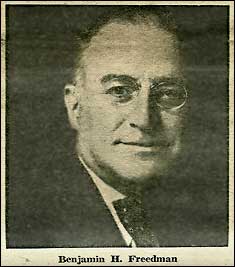
Benjamin Harrison Freedman
Benjamin Freedman’s warning is one of the most important documents of the 20th century.
by Benjamin H. Freedman
Introductory Note:
Benjamin H. Freedman was one of the most intriguing and amazing individuals of the 20th century. Mr. Freedman, born in 1890, was a successful Jewish businessman of New York City who was at one time the principal owner of the Woodbury Soap Company.
He broke with organized Jewry after World War II, and spent the remainder of his life and the great preponderance of his considerable fortune, at least 2.5 million dollars, exposing the Jewish power structure which dominates the United States.
Mr. Freedman’s testimony is especially important because he had been an insider at the highest levels of Jewish organizations and Jewish machinations to gain power over our nation. Mr. Freedman was personally acquainted with Bernard Baruch, Samuel Untermyer, Woodrow Wilson, Franklin Roosevelt, Joseph Kennedy, John F. Kennedy, and many more movers and shakers of our times.
This speech was given before a patriotic audience in 1961 at the Willard Hotel in Washington, D.C., on behalf of Conde McGinley’s patriotic newspaper of that time, Common Sense. Though in some minor ways this wide-ranging and extemporaneous speech has become dated, Mr. Freedman’s essential message to us — his warning to the West — is more urgent than ever before. – Kevin Alfred Strom
A JEWISH DEFECTOR WARNS AMERICA
a speech by Benjamin H. Freedman
From a letter by Benjamin Freedman in the Revilo Oliver archives
HERE IN THE UNITED STATES, the Zionists and their co-religionists have complete control of our government. For many reasons, too many and too complex to go into here at this time, the Zionists and their co-religionists rule these United States as though they were the absolute monarchs of this country. Now you may say that is a very broad statement, but let me show you what happened while we were all asleep.
The First World War
What happened? World War I broke out in the summer of 1914. There are few people here my age who remember that. Now that war was waged on one side by Great Britain, France, and Russia; and on the other side by Germany, Austria-Hungary, and Turkey.
Within two years Germany had won that war: not only won it nominally, but won it actually. The German submarines, which were a surprise to the world, had swept all the convoys from the Atlantic Ocean. Great Britain stood there without ammunition for her soldiers, with one week’s food supply — and after that, starvation. At that time, the French army had mutinied. They had lost 600,000 of the flower of French youth in the defense of Verdun on the Somme. The Russian army was defecting, they were picking up their toys and going home, they didn’t want to play war anymore, they didn’t like the Czar. And the Italian army had collapsed.
Not a shot had been fired on German soil. Not one enemy soldier had crossed the border into Germany. And yet, Germany was offering England peace terms. They offered England a negotiated peace on what the lawyers call a status quo ante basis. That means: “Let’s call the war off, and let everything be as it was before the war started.” England, in the summer of 1916 was considering that — seriously. They had no choice. It was either accepting this negotiated peace that Germany was magnanimously offering them, or going on with the war and being totally defeated.
Stalemate in 1916; Zionists Offer to get USA into the War
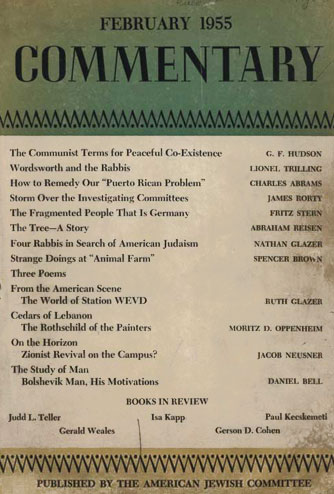
Benjamin Freedman was attacked by the Jewish establishment, as in this issue of the American Jewish Committee's Commentary magazine
Benjamin Freedman was attacked by the Jewish establishment, as in this 1955 issue of the American Jewish Committee's magazine, Commentary
While that was going on, the Zionists in Germany, who represented the Zionists from Eastern Europe, went to the British War Cabinet and — I am going to be brief because it’s a long story, but I have all the documents to prove any statement that I make — they said: “Look here. You can yet win this war. You don’t have to give up. You don’t have to accept the negotiated peace offered to you now by Germany. You can win this war if the United States will come in as your ally.”
The United States was not in the war at that time. We were fresh; we were young; we were rich; we were powerful. They told England: “We will guarantee to bring the United States into the war as your ally, to fight with you on your side, if you will promise us Palestine after you win the war.”
In other words, they made this deal: “We will get the United States into this war as your ally. The price you must pay is Palestine after you have won the war and defeated Germany, Austria-Hungary, and Turkey.”
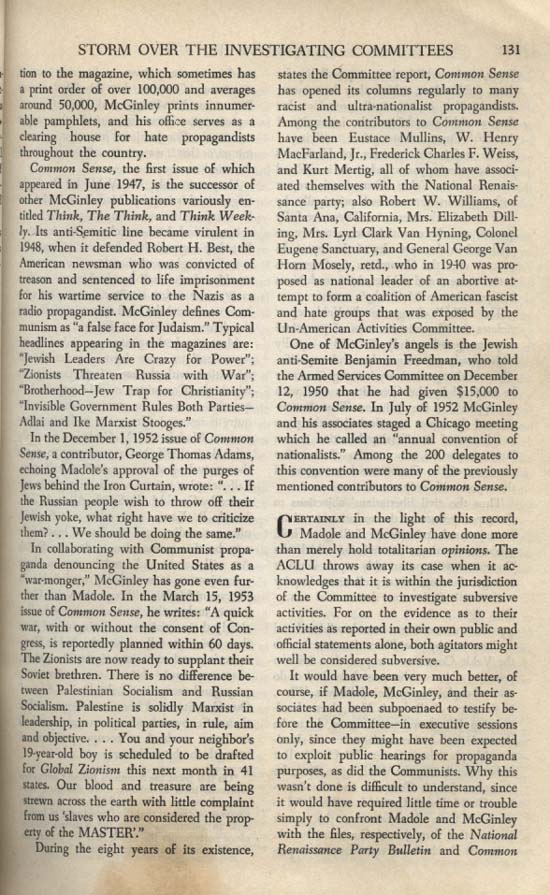
1955  Commentary article mentioning Benjamin Freedman
1955 Commentary article mentioning Benjamin Freedman
Now England had as much right to promise Palestine to anybody, as the United States would have to promise Japan to Ireland for any reason whatsoever. It’s absolutely absurd that Great Britain, that never had any connection or any interest or any right in what is known as Palestine should offer it as coin of the realm to pay the Zionists for bringing the United States into the war. However, they did make that promise, in October of 1916. And shortly after that — I don’t know how many here remember it — the United States, which was almost totally pro-German, entered the war as Britain’s ally.
I say that the United States was almost totally pro-German because the newspapers here were controlled by Jews, the bankers were Jews, all the media of mass communications in this country were controlled by Jews; and they, the Jews, were pro-German. They were pro-German because many of them had come from Germany, and also they wanted to see Germany lick the Czar. The Jews didn’t like the Czar, and they didn’t want Russia to win this war. These German-Jew bankers, like Kuhn Loeb and the other big banking firms in the United States refused to finance France or England to the extent of one dollar. They stood aside and they said: “As long as France and England are tied up with Russia, not one cent!” But they poured money into Germany, they fought beside Germany against Russia, trying to lick the Czarist regime.
Now those same Jews, when they saw the possibility of getting Palestine, went to England and they made this deal. At that time, everything changed, like a traffic light that changes from red to green. Where the newspapers had been all pro-German, where they’d been telling the people of the difficulties that Germany was having fighting Great Britain commercially and in other respects, all of a sudden the Germans were no good. They were villains. They were Huns. They were shooting Red Cross nurses. They were cutting off babies’ hands. They were no good. Shortly after that, Mr. Wilson declared war on Germany.
USA Railroaded into World War I; Balfour Declaration
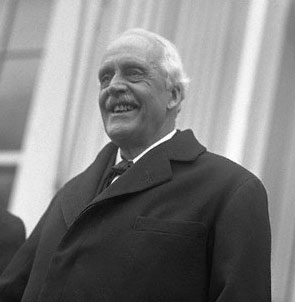
Arthur Balfour, author of the infamous declaration
The Zionists in London had sent cables to the United States, to Justice Brandeis, saying “Go to work on President Wilson. We’re getting from England what we want. Now you go to work on President Wilson and get the United States into the war.” That’s how the United States got into the war. We had no more interest in it; we had no more right to be in it than we have to be on the moon tonight instead of in this room. There was absolutely no reason for World War I to be our war. We were railroaded into — if I can be vulgar, we were suckered into — that war merely so that the Zionists of the world could obtain Palestine. That is something that the people of the United States have never been told. They never knew why we went into World War I.
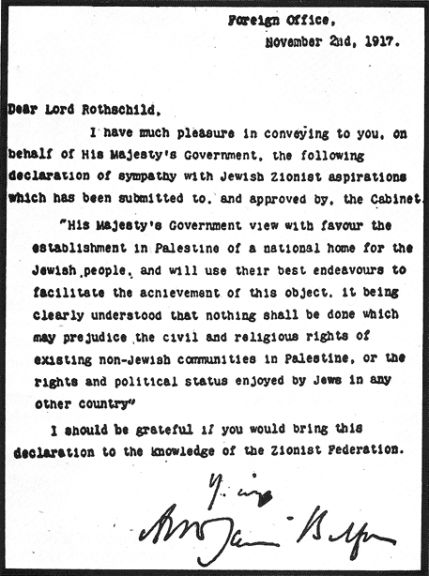
The Balfour Declaration
After we got into the war, the Zionists went to Great Britain and they said: “Well, we performed our part of the agreement. Let’s have something in writing that shows that you are going to keep your bargain and give us Palestine after you win the war.” They didn’t know whether the war would last another year or another ten years. So they started to work out a receipt. The receipt took the form of a letter, which was worded in very cryptic language so that the world at large wouldn’t know what it was all about. And that was called the Balfour Declaration.
The Balfour Declaration was merely Great Britain’s promise to pay the Zionists what they had agreed upon as a consideration for getting the United States into the war. So this great Balfour Declaration, that you hear so much about, is just as phony as a three dollar bill. I don’t think I could make it more emphatic than that.
Versailles
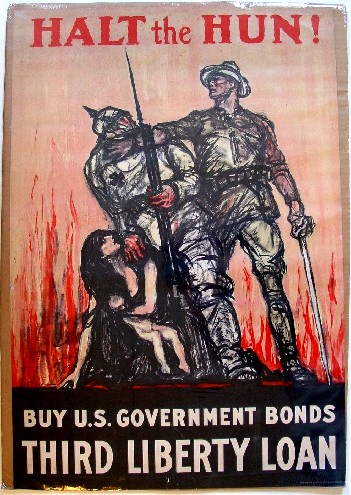
Propaganda to make us hate those whom the Zionists wish us to war against did not begin with Iraq: a poster from WW1, illustrating the common but utterly false characterization of Germans as so-called Huns threatening women
That is where all the trouble started. The United States got in the war. The United States crushed Germany. You know what happened. When the war ended, and the Germans went to Paris for the Paris Peace Conference in 1919 there were 117 Jews there, as a delegation representing the Jews, headed by Bernard Baruch. I was there: I ought to know.
Now what happened? The Jews at that peace conference, when they were cutting up Germany and parceling out Europe to all these nations who claimed a right to a certain part of European territory, said, “How about Palestine for us?” And they produced, for the first time to the knowledge of the Germans, this Balfour Declaration. So the Germans, for the first time realized, “Oh, so that was the game! That’s why the United States came into the war.” The Germans for the first time realized that they were defeated, they suffered the terrific reparations that were slapped onto them, because the Zionists wanted Palestine and were determined to get it at any cost.
Effect on Germans when they understood Jewish Activity
That brings us to another very interesting point. When the Germans realized this, they naturally resented it. Up to that time, the Jews had never been better off in any country in the world than they had been in Germany. You had Mr. Rathenau there, who was maybe 100 times as important in industry and finance as is Bernard Baruch in this country. You had Mr. Ballin, [Albert Ballin - RW] who owned the two big steamship lines, the North German Lloyd’s and the Hamburg-American Lines. You had Mr. Bleichroder, who was the banker for the Hohenzollern family. You had the Warburgs in Hamburg, who were the big merchant bankers — the biggest in the world. The Jews were doing very well in Germany. No question about that. The Germans felt: “Well, that was quite a sellout.”
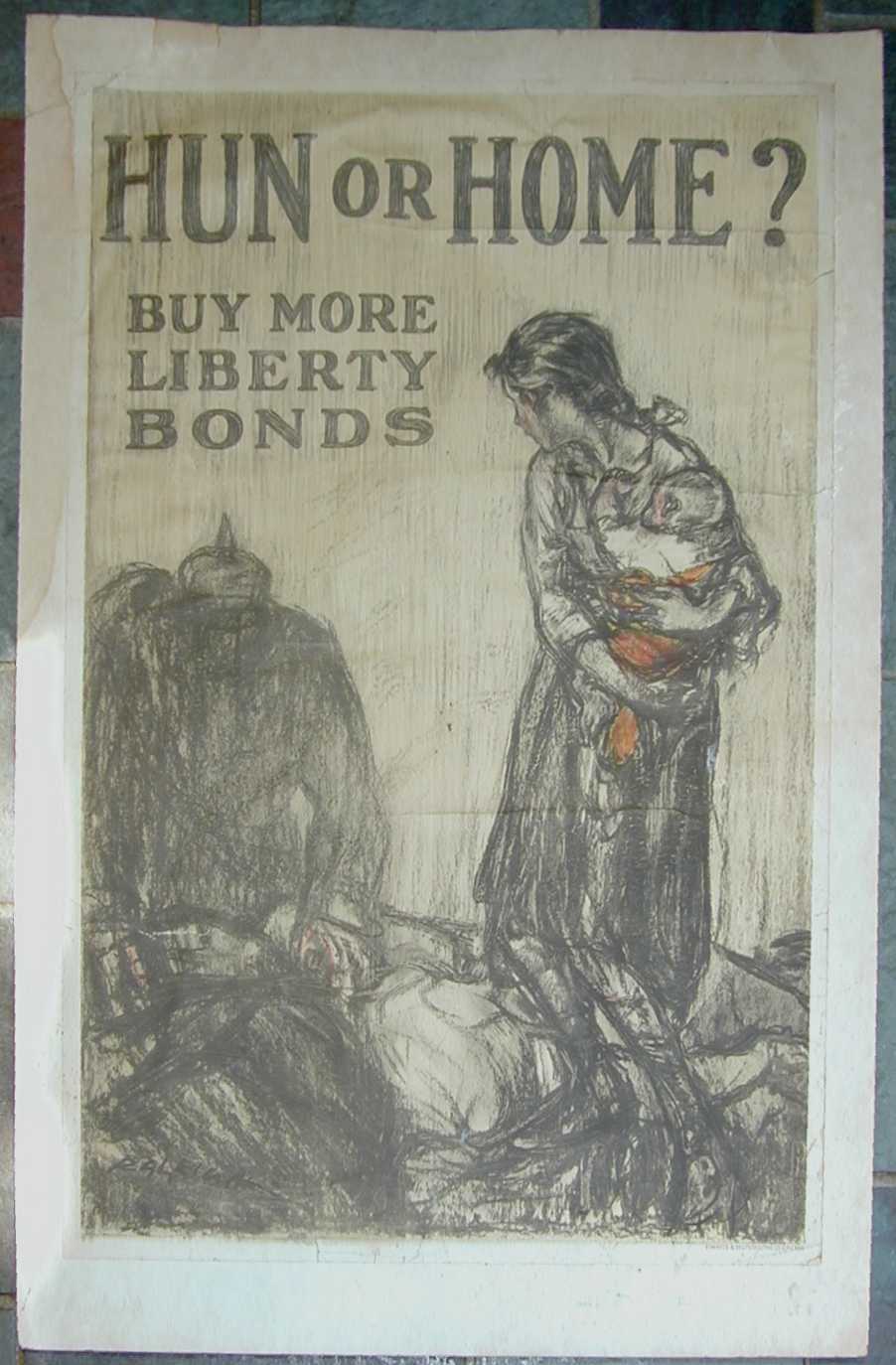
Further demonization of those whom the Zionists wished us to hate: World War 1 poster
It was a sellout that might be compared to this hypothetical situation: Suppose the United States was at war with the Soviet Union. And we were winning. And we told the Soviet Union: “Well, let’s quit. We offer you peace terms. Let’s forget the whole thing.” And all of a sudden Red China came into the war as an ally of the Soviet Union. And throwing them into the war brought about our defeat. A crushing defeat, with reparations the likes of which man’s imagination cannot encompass. Imagine, then, after that defeat, if we found out that it was the Chinese in this country, our Chinese citizens, who all the time we had thought were loyal citizens working with us, were selling us out to the Soviet Union and that it was through them that Red China was brought into the war against us. How would we feel, then, in the United States against Chinese? I don’t think that one of them would dare show his face on any street. There wouldn’t be enough convenient lampposts to take care of them. Imagine how we would feel.
Well, that’s how the Germans felt towards these Jews. They’d been so nice to them: from 1905 on, when the first Communist revolution in Russia failed, and the Jews had to scramble out of Russia, they all went to Germany. And Germany gave them refuge. And they were treated very nicely. And here they had sold Germany down the river for no reason at all other than the fact that they wanted Palestine as a so-called “Jewish commonwealth.”
Now Nahum Sokolow, and all the great leaders and great names that you read about in connection with Zionism today, in 1919, 1920, 1921, 1922, and 1923 wrote in all their papers — and the press was filled with their statements — that the feeling against the Jews in Germany is due to the fact that they realized that this great defeat was brought about by Jewish intercession in bringing the United States into the war. The Jews themselves admitted that. It wasn’t that the Germans in 1919 discovered that a glass of Jewish blood tasted better than Coca-Cola or Muenschner Beer. There was no religious feeling. There was no sentiment against those people merely on account of their religious belief. It was all political. It was economic. It was anything but religious. Nobody cared in Germany whether a Jew went home and pulled down the shades and said “Shema’ Yisroel” or “Our Father.” Nobody cared in Germany any more than they do in the United States. Now this feeling that developed later in Germany was due to one thing: the Germans held the Jews responsible for their crushing defeat.
Freedman says World War I was started against Germany
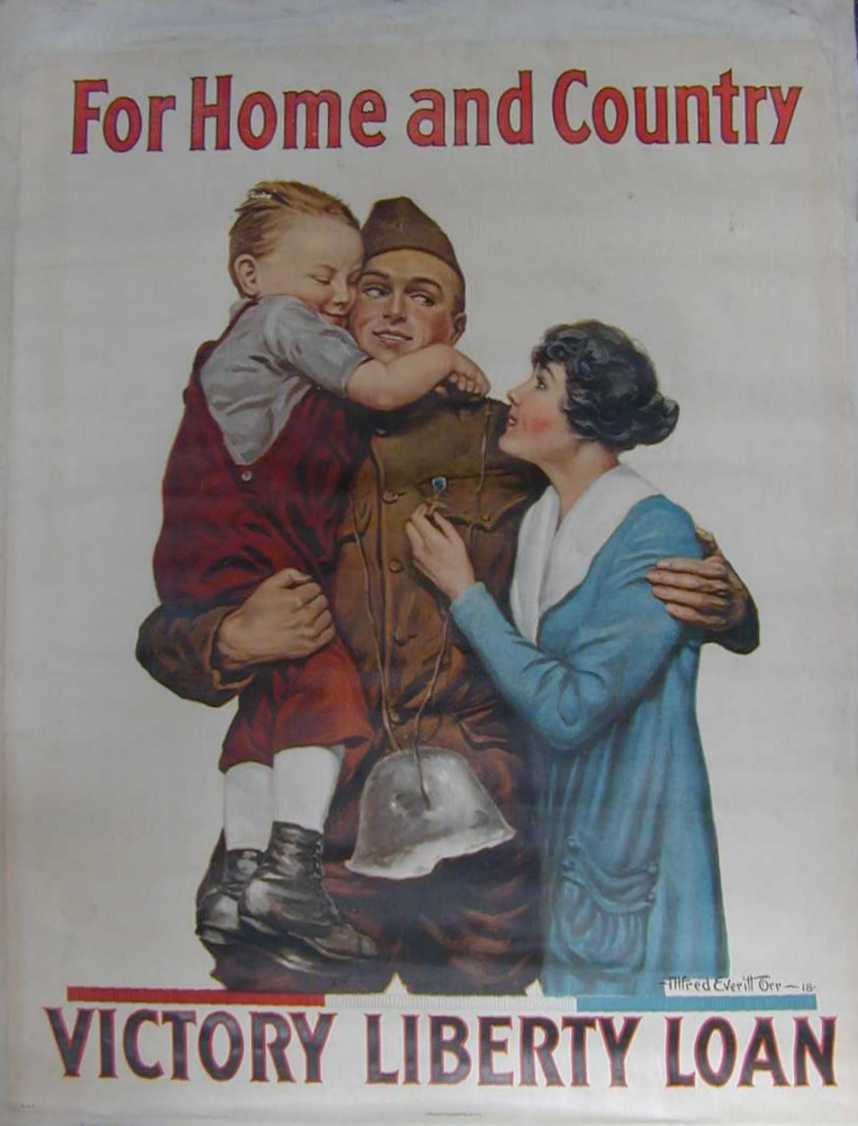
But it had nothing to do with home and country -- just as the current wars have nothing to do with fighting terrorism. Click to see a larger version and note the emotional triggers: the wife fingering a cross, the child, the grisly souvenir of a dead man's helmet.
But it had nothing to do with home and country -- just as the current wars have nothing to do with fighting terrorism. Click to see a larger version of this WW1 poster and note the emotional triggers: the wife fingering a cross, the child, the grisly souvenir of a dead man's helmet.
And World War I had been started against Germany for no reason for which Germany was responsible. They were guilty of nothing. Only of being successful. They built up a big navy. They built up world trade. You must remember that Germany at the time of the French Revolution consisted of 300 small city-states, principalities, dukedoms, and so forth. Three hundred separate little political entities. And between that time, between the times of Napoleon and Bismarck, they were consolidated into one state. And within 50 years they became one of the world’s great powers. Their navy was rivaling Great Britain’s, they were doing business all over the world, they could undersell anybody, they could make better products. What happened as a result of that?
There was a conspiracy between England, France, and Russia to slap down Germany. There isn’t one historian in the world who can find a valid reason why those three countries decided to wipe Germany off the map politically.
German Camps in 1933
When Germany realized that the Jews were responsible for her defeat, they naturally resented it. But not a hair on the head of any Jew was harmed. Not a single hair. Professor Tansill, of Georgetown University, who had access to all the secret papers of the State Department, wrote in his book, and quoted from a State Department document written by Hugo Schoenfelt, a Jew whom Cordell Hull sent to Europe in 1933 to investigate the so-called camps of political prisoners, who wrote back that he found them in very fine condition. They were in excellent shape, with everybody treated well. And they were filled with Communists. Well, a lot of them were Jews, because the Jews happened to comprise about 98 per cent of the Communists in Europe at that time. And there were some priests there, and ministers, and labor leaders, and Masons, and others who had international affiliations.
Germans fought Jewish Control
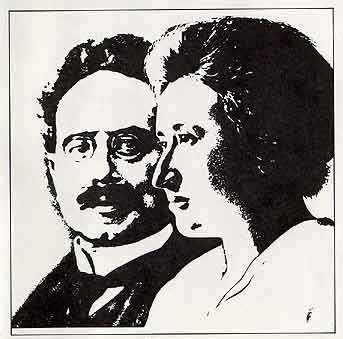
Rosa Luxemburg and Karl Liebknecht
Some background is in order: In 1918-1919 the Communists took over Bavaria for a few days. Rosa Luxemburg and Karl Liebknecht and a group of other Jews took over the government for three days. In fact, when the Kaiser ended the war he fled to Holland because he thought the Communists were going to take over Germany as they did Russia and that he was going to meet the same fate as the Czar. So he fled to Holland for safety, for security.
After the Communist threat in Germany was quashed, the Jews were still working, trying to get back into their former status, and the Germans fought them in every way they could without hurting a single hair on anyone’s head. They fought them the same way that, in this country, the Prohibitionists fought anyone who was interested in liquor. They didn’t fight one another with pistols. Well, that’s the way they were fighting the Jews in Germany. And at that time, mind you, there were 80 to 90 million Germans, and there were only 460,000 Jews. About one half of one per cent of the population of Germany were Jews. And yet they controlled all the press, and they controlled most of the economy because they had come in with cheap money when the mark was devalued and bought up practically everything.
The Jews tried to keep a lid on this fact. They didn’t want the world to really understand that they had sold out Germany, and that the Germans resented that.
The Germans took appropriate action against the Jews. They, shall I say, discriminated against them wherever they could. They shunned them. The same way that we would shun the Chinese, or the Negroes, or the Catholics, or anyone in this country who had sold us out to an enemy and brought about our defeat.
1933: Jews Declare “Holy War” (and Trade War) on Germany
After a while, the Jews of the world called a meeting in Amsterdam. Jews from every country in the world attended this meeting in July 1933. And they said to Germany: “You fire Hitler, and you put every Jew back into his former position, whether he was a Communist or no matter what he was. You can’t treat us that way. And we, the Jews of the world, are serving an ultimatum upon you.” You can imagine what the Germans told them. So what did the Jews do?
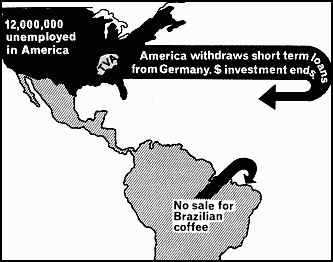
In 1933, when Germany refused to surrender to the world conference of Jews in Amsterdam, the conference broke up, and Mr. Samuel Untermyer, who was the head of the American delegation and the president of the whole conference, came to the United States and went from the steamer to the studios of the Columbia Broadcasting System and made a radio broadcast throughout the United States in which he in effect said, “The Jews of the world now declare a Holy War against Germany. We are now engaged in a sacred conflict against the Germans. And we are going to starve them into surrender. We are going to use a world-wide boycott against them. That will destroy them because they are dependent upon their export business.”
And it is a fact that two thirds of Germany’s food supply had to be imported, and it could only be imported with the proceeds of what they exported. So if Germany could not export, two thirds of Germany’s population would have to starve. There was just not enough food for more than one third of the population.
Now in this declaration, which I have here, and which was printed in the New York Times on August 7, 1933, Mr. Samuel Untermyer boldly stated that “this economic boycott is our means of self-defense. President Roosevelt has advocated its use in the National Recovery Administration,” which some of you may remember, where everybody was to be boycotted unless he followed the rules laid down by the New Deal, and which was declared unconstitutional by the Supreme Court of that time.
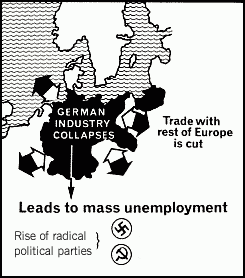
Nevertheless, the Jews of the world declared a boycott against Germany, and it was so effective that you couldn’t find one thing in any store anywhere in the world with the words “made in Germany” on it. In fact, an executive of the Woolworth Company told me that they had to dump millions of dollars worth of crockery and dishes into the river; that their stores were boycotted if anyone came in and found a dish marked “made in Germany,” they were picketed with signs saying “Hitler,” “murderer,” and so forth, something like these sit-ins that are taking place in the South.
At a store belonging to the R. H. Macy chain, which was controlled by a family called Strauss who also happen to be Jews, a woman found stockings there which came from Chemnitz, marked “made in Germany.” Well, they were cotton stockings and they may have been there 20 years, since I’ve been observing women’s legs for many years and it’s been a long time since I’ve seen any cotton stockings on them. I saw Macy’s boycotted, with hundreds of people walking around with signs saying “murderers,” “Hitlerites,” and so forth. Now up to that time, not one hair on the head of any Jew had been hurt in Germany. There was no suffering, there was no starvation, there was no murder, there was nothing.
Naturally, the Germans said, “Who are these people to declare a boycott against us and throw all our people out of work, and make our industries come to a standstill? Who are they to do that to us?” They naturally resented it. Certainly they painted swastikas on stores owned by Jews. Why should a German go in and give his money to a storekeeper who was part of a boycott that was going to starve Germany into surrendering to the Jews of the world, who were going to dictate who their premier or chancellor was to be? Well, it was ridiculous.
“Kristallnacht” and Rearmament
The boycott continued for some time, but it wasn’t until 1938, when a young Jew from Poland walked into the German embassy in Paris and shot a German official, that the Germans really started to get rough with the Jews in Germany. And you found them then breaking windows and having street fights and so forth.
Now I don’t like to use the word “anti-Semitism” because it’s meaningless, but it means something to you still, so I’ll have to use it. The only reason that there was any feeling in Germany against Jews was that they were responsible for World War I and for this world-wide boycott. Ultimately they were also responsible for World War II, because after this thing got out of hand, it was absolutely necessary for the Jews and Germany to lock horns in a war to see which one was going to survive. In the meanwhile, I had lived in Germany, and I knew that the Germans had decided that Europe is going to be Christian or Communist: there is no in between. And the Germans decided they were going to keep it Christian if possible. And they started to re-arm. In November 1933 the United States recognized the Soviet Union. The Soviet Union was becoming very powerful, and Germany realized that “Our turn was going to come soon, unless we are strong.” The same as we in this country are saying today, “Our turn is going to come soon, unless we are strong.” Our government is spending 83 or 84 billion dollars for defense. Defense against whom? Defense against 40,000 little Jews in Moscow that took over Russia, and then, in their devious ways, took over control of many other countries of the world.
Nuclear War for Israel?
For this country now to be on the verge of a Third World War, from which we cannot emerge a victor, is something that staggers my imagination. I know that nuclear bombs are measured in terms of megatons. A megaton is a term used to describe one million tons of TNT. Our nuclear bombs had a capacity of 10 megatons, or 10 million tons of TNT, when they were first developed. Now, the nuclear bombs that are being developed have a capacity of 200 megatons, and God knows how many megatons the nuclear bombs of the Soviet Union have.
What do we face now? If we trigger a world war that may develop into a nuclear war, humanity is finished. Why might such a war take place? It will take place as the curtain goes up on Act 3: Act 1 was World War I, Act 2 was World War II, Act 3 is going to be World War III. The Jews of the world, the Zionists and their co-religionists everywhere, are determined that they are going to again use the United States to help them permanently retain Palestine as their foothold for their world government. That is just as true as I am standing here. Not alone have I read it, but many here have also read it, and it is known all over the world.
Zionist wars can happen again
What are we going to do? The life you save may be your son’s. Your boys may be on their way to that war tonight; and you don’t know it any more than you knew that in 1916 in London the Zionists made a deal with the British War Cabinet to send your sons to war in Europe. Did you know it at that time? Not a person in the United States knew it. You weren’t permitted to know it. Who knew it? President Wilson knew it. Colonel House knew it. Other insiders knew it.
Did I know it? I had a pretty good idea of what was going on: I was liaison to Henry Morgenthau, Sr., in the 1912 campaign when President Wilson was elected, and there was talk around the office there. I was “confidential man” to Henry Morgenthau, Sr., who was chairman of the finance committee, and I was liaison between him and Rollo Wells, the treasurer.
So I sat in these meetings with President Wilson at the head of the table, and all the others, and I heard them drum into President Wilson’s brain the graduated income tax and what has become the Federal Reserve, and I heard them indoctrinate him with the Zionist movement. Justice Brandeis and President Wilson were just as close as the two fingers on this hand. President Woodrow Wilson was just as incompetent when it came to determining what was going on as a newborn baby.
That is how they got us into World War I, while we all slept. They sent our boys over there to be slaughtered. For what? So the Jews can have Palestine as their “commonwealth.” They’ve fooled you so much that you don’t know whether you’re coming or going.
Now any judge, when he charges a jury, says, “Gentlemen, any witness who you find has told a single lie, you can disregard all his testimony.” I don’t know what state you come from, but in New York state that is the way a judge addresses a jury. If that witness told one lie, disregard his testimony.
History of ‘Jews’
What are the facts about the Jews? (I call them Jews to you, because they are known as Jews. I don’t call them Jews myself. I refer to them as so-called Jews, because I know what they are.) The eastern European Jews, who form 92 per cent of the world’s population of those people who call themselves Jews, were originally Khazars. They were a warlike tribe who lived deep in the heart of Asia. And they were so warlike that even the Asiatics drove them out of Asia into eastern Europe. They set up a large Khazar kingdom of 800,000 square miles. At the time, Russia did not exist, nor did many other European countries. The Khazar kingdom was the biggest country in all Europe — so big and so powerful that when the other monarchs wanted to go to war, the Khazars would lend them 40,000 soldiers. That’s how big and powerful they were.
They were phallic worshippers, which is filthy and I do not want to go into the details of that now. But that was their religion, as it was also the religion of many other pagans and barbarians elsewhere in the world. The Khazar king became so disgusted with the degeneracy of his kingdom that he decided to adopt a so-called monotheistic faith — either Christianity, Islam, or what is known today as Judaism, which is really Talmudism. By spinning a top, and calling out “eeny, meeny, miney, moe,” he picked out so-called Judaism. And that became the state religion.
He sent down to the Talmudic schools of Pumbedita and Sura and brought up thousands of rabbis, and opened up synagogues and schools, and his people became what we call Jews. There wasn’t one of them who had an ancestor who ever put a toe in the Holy Land. Not only in Old Testament history, but back to the beginning of time. Not one of them! And yet they come to the Christians and ask us to support their armed insurrections in Palestine by saying, “You want to help repatriate God’s Chosen People to their Promised Land, their ancestral home, don’t you? It’s your Christian duty. We gave you one of our boys as your Lord and Savior. You now go to church on Sunday, and you kneel and you worship a Jew, and we’re Jews.” But they are pagan Khazars who were converted just the same as the Irish were converted.
It is as ridiculous to call them “people of the Holy Land,” as it would be to call the 54 million Chinese Moslems “Arabs.” Mohammed only died in 620 A.D., and since then 54 million Chinese have accepted Islam as their religious belief. Now imagine, in China, 2,000 miles away from Arabia, from Mecca and Mohammed’s birthplace. Imagine if the 54 million Chinese decided to call themselves “Arabs.” You would say they were lunatics. Anyone who believes that those 54 million Chinese are Arabs must be crazy. All they did was adopt as a religious faith a belief that had its origin in Mecca, in Arabia. The same as the Irish. When the Irish became Christians, nobody dumped them in the ocean and imported to the Holy Land a new crop of inhabitants. They hadn’t become a different people. They were the same people, but they had accepted Christianity as a religious faith.
These Khazars, these pagans, these Asiatics, these Turko-Finns, were a Mongoloid race who were forced out of Asia into eastern Europe. Because their king took the Talmudic faith, they had no choice in the matter. Just the same as in Spain: If the king was Catholic, everybody had to be a Catholic. If not, you had to get out of Spain. So the Khazars became what we call today Jews.
Now imagine how silly it was for the great Christian countries of the world to say, “We’re going to use our power and prestige to repatriate God’s Chosen People to their ancestral homeland, their Promised Land.” Could there be a bigger lie than that?
Because they control the newspapers, the magazines, the radio, the television, the book publishing business, and because they have the ministers in the pulpit and the politicians on the soapboxes talking the same language, it is not too surprising that you believe that lie. You’d believe black is white if you heard it often enough. You wouldn’t call black black anymore — you’d start to call black white. And nobody could blame you.
That is one of the great lies of history. It is the foundation of all the misery that has befallen the world.
Kol Nidre: Evidence of Disloyalty
Do you know what Jews do on the Day of Atonement, that you think is so sacred to them?
I was one of them. This is not hearsay. I’m not here to be a rabble-rouser. I’m here to give you facts.
When, on the Day of Atonement, you walk into a synagogue, you stand up for the very first prayer that you recite. It is the only prayer for which you stand. You repeat three times a short prayer called the Kol Nidre. In that prayer, you enter into an agreement with God Almighty that any oath, vow, or pledge that you may make during the next twelve months shall be null and void. The oath shall not be an oath; the vow shall not be a vow; the pledge shall not be a pledge. They shall have no force or effect.
And further, the Talmud teaches that whenever you take an oath, vow, or pledge, you are to remember the Kol Nidre prayer that you recited on the Day of Atonement, and you are exempted from fulfilling them. How much can you depend on their loyalty? You can depend upon their loyalty as much as the Germans depended upon it in 1916. We are going to suffer the same fate as Germany suffered, and for the same reason.
*   *   *
Subsequent research has shown that the “Khazar hypothesis,” i.e., Freedman’s and Arthur Koestler’s idea that Ashkenazi Jews are almost entirely of Khazar descent, is wildly exaggerated. For example, Science News for October 3, 1998 stated “Wider genetic studies of diverse present day Jewish communities show a remarkable genetic cohesiveness. Jews from Iran, Iraq, Yemen, North Africa and European Ashkenazim all cluster together with other Semitic groups, with their origin in the Middle East. A common geographical origin can be seen for all mainstream Jewish groups studied. This genetic research has clearly refuted the Khazar story — Khazars: a pre-10th century Turko-Asian empire which reportedly converted en masse to Judaism. Researchers compared the DNA signature of the Ashkenazi Jews against those of Turkish-derived people, and found no correspondence. …The DNA tests results support the hypothesis that the paternal gene pools of Jewish communities from Europe, North Africa and the Middle East descended from a common Middle Eastern ancestral population, and suggest that most Jewish communities have remained relatively isolated from neighboring non-Jewish communities during and after the Diaspora.”
The demise of the Khazar hypothesis doesn’t much vitiate Freedman’s argument that the “blood right” of Jews — who do show some degree of mixture with their host populations and who are probably less related to the original inhabitants of “Israel” than are the Palestinians — to take over Palestine is a sham. And, of course, it doesn’t at all affect his insider revelations of Zionist intrigue. – Kevin Alfred Strom
This article was transcribed and prepared for publication by Kevin Alfred Strom, with additional work by Rae West.

Thursday, 26 June 2014

ORANGE ORDER ORGIES EYES WIDE SHUT SICK AS OUR SECRETS CONSPIRACY


Mosley in Ireland


Maurice Walsh


The first time I met Oliver Cromwell
The poor man was visibly distressed.
‘Buffun,’ says he, ‘things are gone to the devil
In England. So I popped over here for a rest.
Say what you will about Ireland, where on
Earth could a harassed statesman find peace like
This in green unperturbed oblivion? …’

Brendan Kennelly, from ‘Cromwell’


1

In 1951, John Arthur Burdett Trench – obsessive huntsman since the age of eight, polo player and, in his mid sixties, possessor of a memory of having ridden home the winner of the Grand National at Fairyhouse at a time when English officers could still relax in the grandstand – sold Clonfert Palace near Eyrecourt in Co. Galway to an English family not long arrived in Ireland. The house had belonged to the Trenches for generations and had once been the residence of Church of Ireland bishops. It stood on the flood plain of the Shannon, a short walk from Clonfert Cathedral, hidden away behind its famous avenue of yew trees, an inconspicuous island of Ascendancy civility on the frontier of the vast bog. Like many other ancient mansions, its comforts and refinements had not survived the privations of the twentieth century and it was badly in need of restoration. Every day for months the new lady of the house would drive across the bogland roads from her temporary accommodation in Tipperary to supervise the installation of bathrooms, electricity and central heating, an Aga in the kitchen. Word spread that Clonfert Palace was being returned to its former glory and that there was work to be had from the new owners. They turned the ballroom into a drawing room and brought a carpenter from Banagher to build bookshelves that covered an entire wall. They filled the once-dilapidated rooms with fine furniture, replaced the broken sash cords on the windows, draped curtains made to measure in Dublin and hung paintings of their ancestors on the wall. They recruited a gardener, a housekeeper and a cook. Occasionally the lady’s husband would arrive in a large, exotic Buick driven by a French chauffeur.

Soon, it became known that the family bringing Clonfert Palace back to life was Sir Oswald and Lady Diana Mosley and their two sons. On the fifteenth of February 1952, the Westmeath Independent carried a short item entitled ‘Distinguished Residents’, disclosing that the previous Friday the Mosley family had ‘moved into occupation’ of the palace. ‘Sir Oswald and Lady Mosley, who have a large staff, are charmed with Ireland, its people, the tempo of its life and its scenery,’ the paper related, dutifully informing readers in a final sentence that ‘Sir Oswald was the former leader of a political movement in England.’


2

Many years before he became the nearest thing to a British Mussolini in the 1930s, Oswald Mosley achieved political prominence as a parliamentary critic of Lloyd George’s campaign to use the Black and Tans to crush the IRA. Late in 1920, as a twenty-four-year-old Conservative MP, he was a believer in the League of Nations and condemned the Amritsar massacre in India as ‘Prussian frightfulness inspired by racism’. In his memoir, My Life, published in 1968, Mosley recalled that the war in Ireland had ‘evoked intense moral feeling’. With each atrocity committed by the Black and Tans he felt ‘that the name of Britain was being disgraced, every rule of good soldierly conduct disregarded, and every decent instinct of humanity outraged’. Mosley was one of a small handful of MPs who pursued Lloyd George and his blustering secretary for Ireland, Sir Hamar Greenwood, over the unacknowledged policy of reprisals.

Mosley’s speeches and questions, preserved in the columns of Hansard, are fluent, precise and lucid: reading them evokes the pleasure of observing a clever barrister at work in a trial. At the time he betrayed no sympathy for the IRA. In one of his early contributions he accepted that ‘in the present state of Ireland one certainly cannot deny the right to shoot a man who, when challenged, refuses to hold up his hands. Anything of that sort is perfectly legitimate.’ And after the Bloody Sunday massacres Mosley told the Commons that law-abiding people in Ireland were being intimidated by ‘a small gang of desperate men’, or, as he put it shortly afterwards, ‘the murder gang of Sinn Féin’. The root of Mosley’s case against the Black and Tans was that their behaviour undermined the superiority of British imperial rule. ‘No Empire, no Government, has been long sustained except by the power of moral force,’ he told the House of Commons after Bloody Sunday. ‘Our Empire stands alone, from the Imperial ruins of history, in its recognition of and obedience to this fundamental law. It is because I am a passionate believer in the destiny and in the yet unfulfilled mission of British Empire, that I am unwilling to sacrifice the inviolate tradition of the ages even to satisfy the transient purpose of this gambler’s expedient …’

Mosley’s own solution to the Irish question was a version of the agreement by which the United States granted Cuba independence after the Spanish– American war but reserved the right to invade if any disturbance threatened American interests. Under such an arrangement between Britain and an independent Ireland, Mosley wrote, any infringement could legitimately provoke ‘a bombardment of Dublin and all the principal cities of Ireland from sea and air’. Mosley was certain it would never come to that because a government supported by the Irish people would guarantee British interests, especially since, as he presciently noted, all the signs were that the first Irish government would be conservative and stable.

To read Mosley’s memoir is to come away with the impression that he single-handedly dragged the damning evidence of the atrocities committed by the Black and Tans into the spotlight and created a scandal in parliament. He was not the only MP, however, to ask uncomfortable questions amidst a fear that the campaign in Ireland threw a spotlight on the unacceptable face of imperial policing. And crusading British newspaper correspondents, aided by Sinn Féin propaganda, did as much to disseminate the detail of the Black and Tan atrocities as the Peace with Ireland Council, the extra-parliamentary pressure group that Mosley helped to run. But Mosley’s decision in November 1920 to break with the Conservative Party and Lloyd George’s coalition government over the reprisals in Ireland was the making of his parliamentary reputation. Thereafter, he followed a dizzying trajectory, joining the Labour Party and becoming a junior minister in the minority Labour government of 1929; resigning the following year when the cabinet rejected his radical plan for large-scale borrowing and public works to deal with the colossal unemployment caused by the Depression; founding a new party and, eventually, launching the British Union of Fascists in 1932. His denunciation of the Black and Tans survived this political odyssey to achieve a permanent place in the Mosley myth. In 1923 T.P. O’Connor, the veteran Home Rule MP for Liverpool, had written to Mosley’s first wife, Cynthia, praising him as ‘the man who really began the break up of the Black and Tan savagery’. A decade later this reputation was revived in an attempt to attract Irish emigrants in Britain to the fascist cause. Studies of the membership of the British Union of Fascists are imprecise as to how many recruits were of Irish origin, but circumstantial evidence suggests the number may have been substantial. Several fascist leaders in the north of England were Catholic; there were so many in Leeds that Mosley was known there as ‘The Pope’. T.P. O’Connor’s letter was quoted from platforms when Mosley made an explicit appeal for the Irish vote in local elections in London in 1937.

The irony, of course, was that Mosley’s most prominent Irish acolyte, William Joyce, had been an ostentatious sympathizer with the Black and Tans as a sixteen-year-old in Galway. Mosley ended up hating Joyce (largely because he sensed a potential rival), but by the end of the war Mosley and Lord Haw Haw – as Joyce was now universally known – were synonymous in the British public imagination with betrayal. Despite insisting that if the Germans invaded he would wear a uniform and fight for his country, Mosley had been interned in 1940 as a potential quisling. He was released three years later because of his poor health, although his glamorous marriage and connections (Mosley’s first wife, Cynthia, was the daughter of Lord Curzon, once viceroy of India, and his second, Diana, was one of the famous Mitford sisters related to Winston Churchill) also helped him receive more lenient treatment than many other members of the BUF, who languished in jail throughout the war and emerged broken men. In his memoir, Beyond the Pale, Nicholas Mosley (his son from his first marriage) recalls that the revulsion against his father was so strong that booths were erected on street corners in London to gather signatures to petition for his re-imprisonment.

At this low point, effectively the end of his political career, Mosley received a letter from Ireland which became just as important to him as T.P. O’Connor’s testimonial in 1923. It arrived at his London address shortly after he was released from Holloway prison and placed under house arrest. In two neat, tightl
Scheduley packed sheets of thick writing paper, J.D. O’Connell, the county solicitor for Kerry, reminded Mosley that they had met in London 1921 when O’Connell, then a prominent member of Sinn Féin, had been lobbying against the Black and Tans. The solicitor in Tralee assured Mosley that ‘your good name will be remembered here long after those who now try to belittle you will be clean forgotten’. He then took it upon himself, on behalf of the Irish people, to invite Sir Oswald and his wife to take advantage of a native hospitality for which he half apologized in advance: ‘We are neutral in the present turmoil. If you and Lady Mosley are at liberty to come here we should be very happy indeed to receive you in our own poor and humble ways.’ Sir Oswald’s predicament, O’Connell told him, was equivalent to the type of persecution the Irish themselves had suffered. ‘We in this country have been called nasty names and we have experience of internment camps, and so we understand your position.’

It was three years before Mosley acted on O’Connell’s suggestion. In 1946, through his solicitor, Mosley told officials in Dublin that he was interested in settling in Ireland. De Valera was consulted and Mosley’s solicitor was summoned to the Department of Justice to be told that ‘the time was perhaps not opportune for him to take up permanent residence and that he might delay his decision for some time until international tempers were quieter’. Five years later with the hostility he encountered in Britain showing no sign of abating, Mosley moved to Ireland.


3

Mosley had been trying to gather the remnants of his supporters into a new organization called the Union Movement. In a statement published in theUnion newspaper in March 1951, Mosley said he had come to Ireland because it was a free country, whereas England had become ‘an Island Prison’. He told his followers that as a guest in Ireland he would take no part in Irish politics: ‘Long ago I fought in Parliament for the freedom of Ireland, and for the right of the Irish people to manage their own affairs. Therefore the last thing I should now try to do would be to interfere in them.’ This promise served as a public reassurance to the authorities in Dublin that he would not be an embarrassment, as well as a reminder that he had once been a famous friend of Irish nationalism. Union printed two letters criticizing Mosley for leaving, one of them likening his withdrawal across the Irish Sea to the action of a military leader deserting his troops: ‘I do feel that a general should remain in the field with his men rather than back at H.Q. miles away, if you get my point … I wonder what would have happened if Hitler had gone and lived in Italy after he came out of prison in the early days.’ Freedom was not the only advantage that Ireland offered. Mosley’s second wife, Diana Mitford, was well connected there. Her younger sister Deborah was married to the Duke of Devonshire and lived at Lismore Castle in Co. Waterford. Her older sister Pamela was married to the physicist Derek Jackson, who had known Mosley since the 1930s, and they lived at Tullamaine Castle in Co. Tipperary. This is where the Mosleys stayed while they searched Ireland for a suitable house.

It was a good time to be on the lookout for a lofty residence going cheap. Many Big Houses had been burned to the ground or abandoned during the revolution; others were boarded up or left in a state of neglect during the economic war of the 1930s. The vital social hinterland of these houses and their inhabitants had vanished; there were no dashing young officers to grace winter balls or amuse the ladies during tennis parties in the summer. Nor were the Big Houses any longer, in De Valera’s Ireland, beacons of authority in the social order: that position was now occupied by the cosy homesteads of the peasant farmers who had once been tenants.

The privations of the war, the levelling force of the mobilization it made necessary and the dream of a welfare state it engendered made Atlee’s Britain a markedly less congenial place for the landed elite and aristocratic gentry than the country Neville Chamberlain had reluctantly and belatedly placed in Hitler’s path. By the mid fifties a British country house was being demolished almost every week. Some members of the embattled aristocracy looked to Ireland as a place where the old world could be recreated. Dublin auctioneers acting for English clients in search of property placed advertisements in local newspapers. In 1946 Evelyn Waugh toured Ireland searching for a romantic pile. He made an offer to the owners of Gormanston Castle in Co. Meath but withdrew it when he heard that Billy Butlin was thinking of building a holiday camp nearby. Vita Sackville-West’s brother, Edward, moved to a country house in Tipperary in 1956 and found to his delight that Ireland was like Portugal, possessed of the same ‘backwaters quality & the equally warm, intensely religious peasantry’. Even Americans found that Ireland was somewhere one could play at being gentry. When ice and snow closed down their own hunts in the winter of 1952, a party of wealthy New Yorkers spent a month in Galway hunting with the Blazers and living at the Great Southern Hotel. That same year the film director John Huston rented a Georgian mansion in Co. Kildare and discovered that Ireland was ‘a wonderful place for a man to go when he’s tired of fighting traffic and taxes’. Three years later he purchased an eighteenth-century mansion near Galway Bay and hired a staff of eight to look after the grounds, his family and their guests. He was enchanted by the hunting life, the intimacy of social relations and the generous hospitality, reckoning that Ireland in the 1950s was what the Old South in the United States must have been like.

This influx of British aristocrats and arriviste Americans was much commented on at the time, and made a vivid contrast with the mass emigration that was depopulating virtually every town and village in the country. In a book of essays called The Vanishing Irish, which gathered contributions from contemporary commentators on the pressing questions of emigration and the low birth rate, Edmund J. Murray described the influx of wealthy estate-seekers as ‘a new plantation movement in Anglo-Irish history on a money-for-acre basis, rather than by royal grant’. Shane Leslie was sure who the speculators were: ‘Jews (and can you blame them?) have bought up many urban properties and leading stores and shops. The English and Scotch follow them.’ The truth was, however, that the Irish state held well-bred Englishmen with cash in greater esteem than industrious Jewish refugees. We know this because in a memorandum written during the war, the secretary of the Department of Justice worried that emergency measures designed to keep out ‘Jews and other undesirables’ might have to be revoked if they deterred wealthy English people from moving to Ireland.


4

Today, Clonfert Palace looks like a well-preserved ruin. Trees, nettles and thistles grow in the middle of it but the outer walls have been remarkably sturdy, belying the little yellow plastic signs warning that they might come tumbling down. What once had been lawns and gardens in front of the mansion is now a large field. When I first went there three summers ago with Christy Cunniffe, whose parents and grandfather had worked in the grounds, a flock of boisterous black-faced sheep came running toward us, nosing my notebook. ‘They’ll eat the notebook,’ I said. ‘They’d eat yourself,’ Christy said. Small white clouds skirred across the blue sky and I tried to imagine Oswald Mosley standing here on an August day fifty years before, surveying the generous acres that secluded him from a hostile world.

A few months after moving to Clonfert, Oswald Mosley opened an account at the Bank of Ireland in College Green in Dublin to trade in stocks and shares. He had holdings in major American corporations like Phelps Dodge and Twentieth Century Fox, Brazilian Light and Power and South African mines. He and Diana continued to refine Clonfert Palace to their taste. They brought over from London gilt-framed chairs, mahogany cupboards and cabinets, a gilt oval table, wool carpets, a bronze eighteenth-century bust and some Nankin treasures.

Daily life at Clonfert was self-contained. The two boys were educated at home by a tutor called Leigh Williams. Alexander was bookish but Max was wild. His love of hunting was indulged by his parents; sometimes he would ride off with a little food and water and not be seen for days. Max was also a prankster who laughed at admonishment. Once, he put six-inch nails on the lawn when Harry Cunniffe, the gardener, was trying out his new mower.

Sir Oswald would take his breakfast in bed. The Irish Times and Financial Times would be delivered from Eyrecourt. Lady Mosley would give her orders for the day to Mrs Swan, the cook. When Sir Oswald surfaced he might go for a long walk along the Shannon, passing the barges hauling cargoes of porter, coal or flour. On return he would set to work in his study. Nicholas Mosley has written about his father’s attachment to ‘the hierarchical … classless patterns of life … in the semi-feudal grandeur’ of the estate where he grew up in Staffordshire; in Clonfert Mosley seems to have replicated this idyll. Just as his grandfather had produced wholemeal bread, Sir Oswald supervised the growing of vegetables and ploughed the paddock to plant lucerne, a clover-like plant used for fodder.

Now and again he might turn up at a gymkhana or an agricultural show in the grounds of the workhouse in Portumna, but rarely did Sir Oswald attract public attention in Ireland. Just over a year after he arrived in Clonfert the German chancellor, Konrad Adenauer, accused Mosley of sending money to help Werner Naumann, a former associate of Hitler who had been arrested by the British occupation authorities for trying to infiltrate neo-Nazis into positions of influence in West Germany. When Adenauer’s accusations appeared in the press, the issue was raised in the House of Commons and it was pointed out that Mosley was now a resident of Ireland. In Dublin, a question was put down in the Dáil for the Minister for Finance, Sean MacEntee, asking if Mosley had transferred money to Germany from Ireland. In a written reply, MacEntee said no exchange-control approval had been given for any transfer of funds by Mosley to Germany. But a briefing note prepared for MacEntee at the time discloses how after several pleas from Mosley’s accountants in Dublin, officials at the Department of Finance quietly relaxed rules forbidding Irish residents from opening foreign bank accounts and allowed Mosley to open an account in Paris so that he could lodge payments from a Swiss publisher (another neo-Nazi, although they didn’t appear to be aware of it). This money, they acknowledged, could have been transferred to Germany by Mosley without any need for permission. The officials revealed in their briefing note to the Minister that one of the reasons they bent the rules for Mosley was because ‘he is a man of considerable wealth and should be encouraged to retain his Irish domicile’.

Mosley accepted an invitation to speak at a meeting of Trinity College Philosophical Society in October 1954 on the subject of how to avoid a Third World War. Some college officials objected to the invitation on the grounds that to give Mosley a platform was carrying free speech too far, but the event went ahead without much incident. The British Labour MP Hector Hughes came all the way from London but refused to speak. Mosley was heard respectfully by an audience that included women for the first time in the Phil’s history. He argued that a small band of highly trained guerrillas could defeat the world’s greatest military powers if they had the support of a civilian population, an allusion to not-so-distant history that might have gone down better with a different Irish audience. ‘The future’, Sir Oswald prophesied, ‘belongs to the people who can produce a great idea.’ Senator Owen Sheehy Skeffington was among a handful of people who afterwards wrote to the president of the Phil to protest against Mosley’s appearance. He explained to the Irish Times that he objected not to hearing a fascist per se but ‘to allowing a speech by Mosley to be made a feature of a college public occasion’.

A curious feature of the coverage of Mosley’s appearance at Trinity in theIrish Times and elsewhere was the omission of any mention that he lived in Ireland. This silence may have arisen from a sense or a wish that he was, as The Leader described him in a commentary on the Trinity controversy, ‘simply a survivor of an earlier era, without significance to the political life of this generation’. This certainly was the hope of the military intelligence officers who had kept an eye on him from the moment he arrived in the country. A month after the Mosleys had moved into Clonfert Palace, Colonel Dan Bryan wrote to the secretary of the Department of External Affairs, Sean Nunan, to reassure him that Mosley seemed to have kept his promise: there was no evidence of Mosley taking part in any political activities in Ireland. ‘My information’, wrote Bryan, ‘is that he seems more or less to have lost interest in the remnants of his Union movement in England.’ Mosley’s movements between Clonfert and Lismore or Clonfert and Paris – where in 1951 he and Diana had bought a house called Le Temple de la Gloire, which gradually became their favourite residence – were recorded in a series of terse memos from military intelligence to the Department of Justice. This information was then relayed to the British embassy; there was some concern among officials that it should be passed on verbally and not in writing. In September 1952 the British ambassador in Dublin, John Chadwick, informed the Department of Justice that he had information from London that Mosley was due to meet leaders of the Union movement at the Russell Hotel in Dublin at the end of the month. ‘It is thought in London that Mosley today is a spent force politically and that he has little security interest,’ Chadwick wrote. ‘Despite this, we should be most grateful for any information which you may receive about the projected meeting in Dublin, or as regards any other activities on the part of Mosley or his lieutenants.’ Mosley was accordingly watched on 27 September as he met the Union leaders in the hotel, but the intelligence officers were content, in their report to the Irish ambassador in London, to echo the British embassy’s assessment: ‘It is possible that little significance need be attached to Sir Oswald’s movements.’

There is little evidence that the Irish authorities were aware of Mosley’s travels to Europe for conferences to try to revive fascist parties – detailed in Stephen Dorril’s recent biography – or of his writings at the time. The meeting in the Russell Hotel had been called to launch a journal called The European, essentially a vehicle to propagate Mosley’s ideas among intellectuals. Here, Mosley advanced his argument that the Second World War was Churchill’s fault, that Germany should have been left alone to bring order to the backward peoples of Eastern Europe and that Hitler’s passionate desire to reach an understanding with the English people cost him victory and ultimately caused his suicide. Mosley’s new idea was a united Europe that would control Africa, dividing the whole continent between white and black populations. ‘The combined manpower of Europe would develop a living room containing our own supply of raw materials and our own markets, within which the European genius could speedily build the highest civilisation the world has yet seen.’

The catastrophic record of the Nazis is largely evaded in Mosley’s polemics and the Holocaust is never mentioned. ‘It has long been clear that both sides committed atrocities in the late war; so far only one side has been punished for them …’ Diana used the pages of the journal to defend Hitler. She was particularly disapproving of repentant memoirs by ex-Nazis. ReviewingHitler: The Missing Years by Putzi Hanfstaengl, a press officer who served the Führer, she expressed outrage: ‘More than twelve years have passed since Hitler died, and it may seem astonishing that Dr Hanfstaengl should still feel obliged to write with such exaggerated spite about the man he was once proud to call his friend.’ Diana sought to propagate the idea the Hitler’s Germany had been pacific and tolerant. ‘For the German masses,’ she wrote in September 1954, ‘including millions who had voted communist under the Weimar Republic … the Germany of 1933–39 was a fine, prosperous, successful country, and the traveller saw a healthy, contented-looking population.’ Referring to an account by Alan Moorehead of how British soldiers had tortured SS guards captured at Belsen, Diana asserted that – with the exception of the Black and Tans (‘in part recruited from the sweepings of Johannesburg’) – British troops were decent and well disciplined: the soldiers who had taken revenge at Belsen were acting against their better nature because of the propaganda they had heard about the Nazis.

If she tried, Diana might have found willing listeners in Ireland for the view that the Nazis had a bad press. In Dublin during the war, John Betjeman spent much of his time trying to persuade people that the Nazis were anti-Christian, hanging pictures of bombed out London churches in his office in Upper Mount Street. ‘I find even among the most sincere Catholics a refusal to believe in stories of German persecution,’ he wrote in a despatch to London. At the time the Mosleys were living in Clonfert, the German writer Heinrich Böll moved into a cottage on Achill Island. In a pub he met ‘Padraic’ who confided his belief that Hitler was ‘not such a bad man really … only … he went a bit too far.’ When Böll replied that ‘we know exactly how far Hitler went, he went over the corpses of millions of Jews, children’, Padraic looked pained and accused him of being ‘taken in by British propaganda’.


5

One foggy night a few weeks before Christmas 1954, while Diana was visiting London, the Mosleys’ neighbours the Blake-Kellys were woken just before two o’clock by the whinnying of a pony in their stables. From their window they could see flames and smoke billowing from the Palace next door. Mrs Blake-Kelly sent her son to bang on the Mosleys’ front door and within minutes Sir Oswald, Alexander and their servants were standing on the lawn watching the flames consume their house. A French maid, Mademoiselle Cerrecoundo, rushed back into the house to fetch some clothes and was trapped at an upstairs window. Sir Oswald, Alexander and the chauffeur, Monsieur Thevenon, held a blanket under the window and she leaped to safety, hurting her back and her hand. Monsieur Thevenon drove to the Garda station in Eyrecourt and from there fire brigades were summoned from Ballinasloe and Birr. It took an hour and a half for the engines to arrive and by then more than half the house was lost to the blaze. The firemen cut through the roof with their axes to create a barrier to the advancing flames. Six rooms were saved and some furniture, antiques and a valuable carpet retrieved.

By morning, when the firemen had finished their work and stood gazing at the hole rent through the roof of the house, cold westerly winds were gathering strength. It was the beginning of the worst storm in the midlands for a hundred years. Rain, sleet and snow poured down on the smouldering ruins of Clonfert and the winds reached hurricane force, knocking trees across the roads and felling the electricity wires that had been strung only in the last few years. Within a few days thousands of acres of land by the Shannon were flooded. The army came to evacuate farmhouses which were under three or four feet of water and drive cattle to high ground. Stone outhouses were washed away, corn stooks submerged and the swollen bodies of cows and pigs that could not be saved were left bobbing in the water.

The morning after the fire, Oswald had gone to Dublin airport to meet Diana coming back from London. She recalled in her memoirs the jolt of seeing him standing there as she came through customs, his face grave and bristly with stubble. He told her the story of the fire. If they hadn’t had to persuade the French maid to jump for her life from the second-floor window, Diana realized, they could have saved the pictures in the dining room before the ceiling collapsed. She thought of her mahogany four-poster bed with a canopy of blue taffeta now burnt to cinders. The fire had apparently started in the chimney of the maids’ sitting room where an old beam had been dried out by the central heating. Because of the storm and the floods it was a few days before she could go back to Clonfert to see the ruin. Her hands trembled so much she could hardly hold a pen. The family spent Christmas in Lismore Castle, with Diana’s sister Deborah and the Duke of Devonshire. But they had promised the children of Clonfert a Christmas party in the Palace and so, a few days before New Year, they gathered the toys they had bought in Cork and drove in the rain from Lismore to St Brendan’s National School in Killoran, about a mile from the burnt-out wreck of their house. Lady Mosley called each child up individually to receive a present. She later wrote that on the drive back to Lismore she felt sad because it was as if they were turning their backs on a place where they had been treated with kindness and where their presence could have helped a poor and neglected neighbourhood.


6

Early in 1955 the Mosleys found a new home just outside Fermoy, Co. Cork. Ileclash was a Georgian house built on an elevation over the Blackwater with a walled garden and terraced lawns. It had been restored by a retired British army captain, Percy Benson, who sold it to the Mosleys after his wife died.

Sometime in February that year, Lance Corporal Jerry Lehane was waiting for his discharge from the army in Cork when he replied to an add in the Cork Examiner for a ‘butler/chauffeur willing to travel’. He was invited to Ileclash for an interview on a Sunday. He remembers how Diana towered over him and how her husband, when he came to join the conversation, was just as striking. They told him they would be in France for two and half months and they wouldn’t need someone until they came back at Easter. But as he was walking away, the maid Emily – whom Jerry would eventually marry – came running after him to call him back to the house: the Mosleys wanted him to start the next day.

At Ileclash Jerry would look after Sir Oswald: bring him a boiled egg in the morning, lay out his clothes for the day. Sometimes Sir Oswald might walk into Fermoy, over the bridge past the Caltex petrol pumps and down MacCurtain Street under the Coca-Cola sign and the shop awnings stretching over the pavement. Until the start of the troubles, Fermoy had been a thriving garrison town where Irish and British regiments returned from campaigns in India and Africa displaying pet monkeys and exotic birds and spending the wages they had saved up while defending the empire. After Liam Lynch led a party of IRA volunteers in an attack on soldiers from the Shropshire Light Infantry as they made their way to the Wesleyan Church one Sunday in September 1919, Fermoy was the scene of the first military reprisal of the War of Independence. When the local coroner’s jury refused to describe the death of the single private killed in the raid as murder, two hundred soldiers rampaged through the town, looting drapery stores and shoe shops. The following year drunken Auxiliaries drowned a man in the Blackwater.

The Mosleys’ first summer at Ileclash was blissful, with weeks of unbroken sunshine ‘browning Irish faces so that their eyes looked like aquamarines’, as Diana wrote in the diary she contributed to The European. As she climbed down the cliff to the Blackwater, the river looked ‘as blue as the bay of Naples in August’. Sir Oswald would spend hours on the riverbank, casting his line in the Blackwater while Diana sat reading a book nearby. According to the locals, he would talk to anybody who came sauntering along. Local boys were allowed to fish for eels or take timber from the land in front of Ileclash or play football matches in the fields around the house. One St Stephen’s Day, Tommy Rice, whose father often talked to Sir Oswald, went with the wren boys to Ileclash and was brought in and given five pounds.

In the late fifties, Sir Oswald spent increasing amounts of time mixing with aspirant neo-fascists in Europe and with the theorists of apartheid in South Africa. In Britain, meanwhile, a new issue was developing that offered him a route back into proper politics: West Indian immigration. In August 1958 race riots erupted in Notting Hill, an area where a growing number of West Indians – many of them recruited to work as nurses or on the London Underground – were settling alongside other immigrants, including a large Irish population. Mosley’s Union movement immediately saw the potential for capitalizing on popular resentment and came to the defence of the gangs of Teddy boys who had been prosecuted for ‘nigger-bashing’. In April 1959, Mosley announced that he would stand in the general election to be held the following September as a candidate in North Kensington, the constituency that encompassed Notting Hill. For the rest of the spring and throughout the summer Mosley busied himself making his face familiar again as a campaigner on the streets of London. In August he appeared in court alongside two brothers accused of assaulting and shooting a black medical student. It was probably the renewed publicity Mosley was attracting that summer that provoked Noel Browne to describe him in the Dáil as an ‘undesirable’ who might use his residence in the Republic of Ireland as a ‘funk hole’ to allow him to engage in racist activities elsewhere.

As election day approached he was speaking four times a week from the back of a truck with a message that immigrants should be given compulsory free passage back to the West Indies with a promise that Britain would buy all its sugar from Jamaica to guarantee local employment. What people remembered, however, was his remark that West Indians were able to work for low wages because they could live off a tin of Kit-E-Kat a day. His supporters circulated leaflets describing Sir Oswald as ‘the best friend the Irish have in British politics’, reminding potential Irish voters that he had ‘fought for them in the British Parliament and lived among them in Ireland’. As in the heyday of of Mosley’s fascist electioneering in the 1930s, T.P. O’Connor’s letter saluting his stand against the Black and Tans was reprinted. Through questioning and debate, the leaflets pointed out, Sir Oswald had begun the work of getting the Black and Tans out of Ireland; now, ‘the same power of question and debate can get the Blacks out of North Kensington’.

Mosley convinced himself that he would get a third of the vote and win. On the night of the count a large noisy crowd of his supporters gathered outside Kensington Town Hall. He was shocked to discover that he had received only 8 per cent of the vote and lost his deposit. After the debacle of North Kensington, the Mosleys spent more and more of their time in Paris and less and less in Fermoy. Ileclash was sold in 1963.


7

Oswald Mosley never lived in Ireland again but he continued to proclaim an affinity for it, summoning up the experience of opposing the war in 1920 as a form of superior wisdom. At the height of the Vietnam war he argued that ‘everything that happened in Vietnam and Algeria occurred [first] in Ireland’. When the troubles began in Northern Ireland he circulated a paper advocating the transfer of most Catholics to the Republic and the re-drawing of the border. And when he tried to distinguish himself from Enoch Powell in the 1970s he cited his attitude to Ireland as evidence that he was the more enlightened. ‘Powell lumps Irishmen from the Republic along with Indians, Pakistanis and Jamaicans as immigrants,’ a paper prepared by Mosley’s supporters explained. ‘Union movement on the other hand has always differentiated on the Irish [sic], whether from the Republic or the Six Counties, on the grounds that for centuries they have served in the British Army and the Navy, and have staffed our hospitals and made our roads for decades.’

In November 1977 – three years before he died – Mosley took part in a debate at the King’s Inns in Dublin with Jack Lynch, who was then Taoiseach. He spoke of the necessity of making Europe great again and of how ‘the wisdom of Irish statesmanship’ could make its contribution. There is a photograph of Lynch looking uncomfortable and impatient as he sat alongside the aged Mosley. Around this time, Mosley also appeared on theLate Late Show with Gay Byrne. It’s not possible to watch it anymore; it was one of the editions of the show erased by RTÉ because the film was more valuable than what was on it. I saw the programme at the time and remember Mosley, sitting in the front row of the audience, an old man defending himself vigorously against passionate denunciation. At that stage, to me, he was just the notorious British fascist and I had no idea of his connection with Ireland or of how much authority he derived from his early stand against the Black and Tans.

It was this episode, his first political success, that he would return to again and again, burnishing it in the retelling. In the House of Commons in 1920 Mosley referred to Sinn Féin as a ‘murder gang’. But when he came to write his memoirs nearly a half-century later he would recall that ‘the large majority of the Irish guerrillas … were idealists in the highest degree’. Ireland, however, meant more than votes or refuge for Mosley: it was the best evidence he could produce that a fascist could have a moral compass. Thus, his opposition to a war with Hitler in 1939 was recast in the same light as his opposition to the Black and Tans. And it was his speeches on Ireland in 1920 which enabled the elder Mosley to sidestep the question of the Nazi atrocities: ‘I have a long record of opposition to the vile crime of killing or ill-treating the defenceless in various spheres, and it is one of the subjects on which I feel most strongly.’


I would like to thank the following people for help in the research of this article: Christy Cunniffe, Joe McAvoy, Norma Joyce, Christy Walsh, Catriona Crowe at the National Archives, Dublin, and Phillipa Bassett at the Special Collections Library, Birmingham University.