Showing posts with label SHATTERED. Show all posts

Thursday, 8 May 2014

DARK FORCES OF GERRY ADAMS SHATTERED


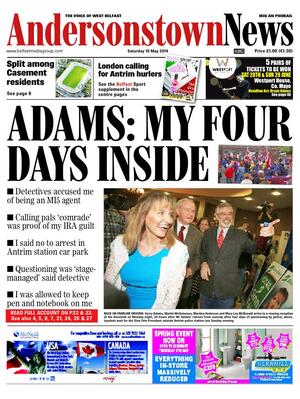
BnGbiwvIEAANU2r.jpg large“I was told that the interrogations were an evidence-gathering process, and that the police would be making the case that I was a member of the IRA; that I had a senior IRA managerial role in Belfast at the time of Jean McConville’s abduction; and that I was therefore bound to know about her killing.
I challenged my interrogators to produce the new evidential material. They said that this would happen at a later interview but they wanted to take me through my childhood, family history and so on. Over the following four days it became clear that the objective of the interviews was to get to the point where they could charge me with IRA membership and thereby link me to the McConville case. The membership charge was clearly their principal goal. The interrogators made no secret of this. At one point the male detective described their plan as “a stage-managed approach”. It later transpired that it was a phased strategy, with nine different phases.
The first phases dealt with my family history of republican activism. My own early involvement in Sinn Féin as a teenager – when it was a banned organisation. My time in the 1960s in the civil rights movement and various housing action groups in west Belfast, the pogroms of 1969 and the start of the Troubles.
It was asserted that I was guilty of IRA membership through association because of my family background – my friends. They referred to countless pieces of “open source” material that, they said, linked me to the IRA. These were anonymous newspaper articles from 1971 and 1972, photographs of Martin McGuinness and me at republican funerals, and books about the period.
If any of these claimed I was in the IRA, then that was, according to my interrogators, evidence. They consistently cast up my habit of referring to friends as “comrades”. This, they said, was evidence of IRA membership. They claimed I was turned by special branch during interrogations in Belfast’s Palace Barracks in 1972 and that I became an MI5 agent! They also spoke about the peace talks in 1972, and my periods of internment and imprisonment in Long Kesh. This was presented as “bad-character evidence…”
Gerry Adams.

Monday, 31 March 2014

SHATTERED INFORMER BODIES Lying All Over the Cuntry


Attorney General ordered Garda not to destroy tapes


More evidence of MI5’s network of informers and provocateurs in the IRA

According to the Observer, shortly before taking him into “protective custody,” it was MI5 itself that warned Roy McShane that he was in danger of being exposed as another British spy close to leadership of the Irish Republican Army (IRA).
MI5 apparently knew of an internal IRA investigation that had revealed McShane’s affiliations. How it knew the article did not say, but McShane’s exposure in February this year sheds further light on the criminal and murderous operation mounted by British intelligence against the IRA and Sinn Fein.
Alongside the more well-known British state collusion with loyalist paramilitary gangs, state infiltration and manipulation of the IRA, particularly its security unit, was a vital component of the dirty war in Northern Ireland.
McShane was one of a pool of drivers for Sinn Fein President Gerry Adams, from 1994 onwards. He was apparently always vociferous in denouncing informers and would inevitably have been privy to many crucial conversations. The drivers’ pool was headed by a close ally of Adams, Terence Clarke. In 1998 the Labour government’s then Northern Ireland Secretary, Mo Mowlam, authorised the bugging of a car used to transport Ireland’s present Deputy First Minister Martin McGuinness to and from negotiations to set up devolved government in Northern Ireland.
Greater significance should be attached to McShane’s previous role. He would appear to have links to the IRA’s former internal security unit, the so-called “nutting squad.” It emerged in 2003 that this internal security unit, established by Adams in the 1970s in response to a number of security disasters, was rapidly subverted by the British Army. The security unit’s deputy leader, Freddie Scappaticci, was exposed as the British agent “Stakeknife.”
Scappaticci was the focal point of an entire operation run by the British Army’s Force Research Unit (FRU). McShane, according to the Irish News, used to work with Scappaticci in the “nutting squad,” only being moved to the drivers’ pool when the IRA leadership came to have concerns about the security unit itself.
According to British Irish Rights Watch, an NGO, the IRA reportedly killed around 50 individuals accused of being informers. Of these, any number of those targeted by the “nutting squad” could have been entirely innocent and the victims of real informers such as Scappatichi and McShane, because they either had suspicions about the unit’s real agenda or were becoming an obstacle to the FRU operation.
When British agent Kevin Fulton came under suspicion within the IRA, he considered his life was about to be sacrificed in order to protect “Stakeknife.” Fulton bailed out and has since sought to embarrass his former handlers into providing him with a decent pension.
The “Stakeknife” operation also coincided with some of the IRA’s worst operational disasters, including the Loughall and Gibraltar massacres where IRA members were killed by British forces through what appeared to be serious security breaches.
At the time “Stakeknife” was exposed, British Irish Rights Watch made the point that the operation around Scappaticci, run with Whitehall approval, had also provided the British government with accusations that one “leading high-profile republican” had shot an informer in the head. The operation undoubtedly provided a rich supply of valuable compromising information to the British government and intelligence services with which to apply pressure to the Sinn Fein leadership.
The “Stakeknife” revelations were followed in 2006 by the exposure of Denis Donaldson, the former head of the IRA’s international relations. As an agent, Donaldson, who was said to have distanced himself from his security handlers, was assassinated later in 2006 in an isolated border cottage. No one has ever been charged with his murder.
There were perhaps hundreds of state informers in both republican and loyalist paramilitary groups. Many of these people are undoubtedly still operating, in the pay of MI5 or the Police Service of Northern Ireland (PSNI). Many more will have been stood down, hoping that details of their role will remain buried.
On January 21, the inquiry into the killing of Billy Wright, reputed loyalist killer and opponent of power-sharing with Sinn Fein, issued a 75-page statement accusing the PSNI of refusing to provide it with relevant information on Wright’s killing. Many documents had been destroyed or gone missing, including thousands of security files relating to prisoners held in the Maze prison, where Wright was murdered. However, the inquiry stated that it was in possession of a file making clear that it was a Special Branch informer amongst the Maze prisoners who smuggled a gun into the hands of Wright’s killers, Irish National Liberation Army members John Glennon and Christopher McWilliams. The PSNI says this informer, whose name has not been released, is now dead.
A number of very serious questions arise.
It now seems that for a long time, counted in decades, the British government not only had a window into the IRA’s internal discussion and organisation but the means to pull levers and eliminate opponents within it.
At least from the date of Scappaticci offering his services to MI5, reportedly in 1978, and the consolidation of the security unit around him, it is difficult to see how any major IRA operation could have taken place without some level of British knowledge, conceivably before and certainly after the event. The atmosphere of internal distrust over that period is well documented in journalist Ed Moloney’s A Secret History of the IRA.
It is also clear that the military disasters suffered served to strengthen the influence of the leadership around Adams and McGuinness, who were advocating a constitutional settlement with the British government.
However, Britain’s spies would not have simply been used to thwart IRA operations. They would have colluded with many of them and allowed them to be successful if this was considered to be politically expedient.
The conflict’s worst single atrocity, the Omagh bombing in 1998, left 29 dead and 220 injured. The bomb’s maker is alleged to have been an intelligence asset along with the man who stole the car used for the attack. Omagh—allegedly carried out by the hard-line splinter group, the Real IRA, in an effort to sabotage the Good Friday Agreement establishing the Northern Ireland Assembly—had the opposite effect.
The horrific deaths of both Protestants and Catholics prompted even greater popular support for an end to the conflict and Sinn Fein’s first-ever condemnation of republican violence. The INLA soon declared its own ceasefire, and the Real IRA suspended its operations. It subsequently issued a statement claiming that its own involvement was “minimal” and that the bombing was the work of two MI5 agents—an allegation lent credence by BBC’s “Panorama,” which insisted that police on both sides of the Irish border had knowledge of the bomb plot.
How many similar attacks were allowed to go ahead? What was known beforehand of Bloody Friday, July 21, 1972, when 22 bombs were exploded in central Belfast killing nine bystanders; or of the series of pub bombings in the UK in the 1970s; the 1982 Hyde Park and Regent’s Park bombs; the 1987 Remembrance Day attack on Enniskillen; or the 1990s London and Manchester bombings? How many of the countless sectarian killings in Northern Ireland were carried out with at least some level of insight, foreknowledge or even approval from the British authorities?
IRA bombings were seized on by successive British governments and the military to legitimise all manner of undemocratic measures—the maintenance of a large standing army in Northern Ireland and the creation of a special apparatus skilled in surveillance, infiltration, entrapment, assassination, and psychological operations, as well as to manipulate public opinion and justify repressive and undemocratic measures in the name of combating terrorism.
Just as fundamentally, terrorist outrages and killings served to deepen the sectarian divisions in the working class in Northern Ireland. Belfast is still divided along religious lines by concrete walls, a precursor to the policy now pursued by the UK and the United States in Iraq. Northern Ireland has thus provided British imperialism with a vital training ground in which to hone its counterinsurgency techniques.
Notwithstanding Sinn Fein’s intermittent left rhetoric, the IRA complemented the loyalist gangs and death squads in dividing and terrorising ordinary working people. For decades, the IRA recruited on the most minimal basis—family ties, opposition to British rule, and the willingness to shoot soldiers. It is this that allowed the likes of British Spy Kevin Fulton, having served in the British Army, to infiltrate the organisation after mouthing a few nationalist phrases and playing on his penchant for guns and trouble.
As to the scale of such infiltration, some indication has been provided by material shown to members of the Consultative Group on the Past (CGP), established in 2007 by then Northern Ireland Secretary Peter Hain and claiming to be dedicated to “building a shared future that is not overshadowed by the events of the past.”
The group, led by Lord Robin Eames, a former bishop and primate with the Church of Ireland, and Denis Bradley, a former priest, journalist and member of the Northern Ireland policing board, was reportedly shown 10 filing cabinets containing records relating to agents and informers in both loyalist and republican groups. Three related to informers within the IRA.

Friday, 14 February 2014

GSOC SHATTERED BUGGER COALITION TRAINSPOTTING


GSOC Controversy Highlights the Joke of a Democratic Ireland

The notion that we live in a true democracy is a joke, judging by the response by Government, gardaí, and parts of the media to suspected bug at GSOC offices, saysMichael Clifford

By Michael CliffordWHO would be a watchdog in a dysfunctional democracy? The events of the last five days demonstrate that in one vital area, this State resembles something plucked from the dark imagination of Franz Kafka, rather than amodern European country.

Last Sunday, The Sunday Times revealed that the Garda Síochána Ombudsman Commission’s premises had, in layman’s terms, been bugged.

Three different potential security breaches were identified in sweeps last September and October. Modern surveillance techniques ensure that the presence of interception cannot be definitively established. But in one of the three threats, the possibility that it was not bugged was rated at “close to nil” by the counter-surveillance company which discovered it.

In most democracies, this would be a matter of grave concern. Who could be bugging GSOC? Who, other than members of An Garda Síochána, would have any reason to do so? It is possible that highly organised criminals might engage in this behaviour, but surely they would have more interesting targets to bug — the gardaí themselves, for example.

The implications are enormous. Yet among large sections of government, media, and the national police force, a concerted effort was made to divert all attention from a possible assault on the heart of our alleged democracy.

On Monday, the Irish Independent ran with the headline ‘Garda Watchdog to be grilled over failure to report spying probe’. The thrust of the story was that GSOC was in the dock for not reporting that it had been bugged. It was akin to suggesting that the victim of an assault was to blame for the crime because they didn’t report it to the gardaí.

Taoiseach Enda Kenny picked up on the theme. Later that day, he played down the notion of a bugging scandal, and instead had a cut at GSOC.

“Most importantly, Section 80 subsection 5 of the Garda Síochána Act requires that GSOC would report unusual matters or matters of exceptional importance to the minister for justice and that’s a fundamental issue that GSOC needs to explain to the minister for justice,” said Kenny.

Kenny is not noted for his grasp of detail, but here he was quoting the exact provision of a law. Except there was no such law, unless the Taoiseach had, in a Kafkaesque flourish, taken it upon himself to invent one as he went along.

The section he quoted states that GSOC “may” inform the minister if it believes a serious issue warrants his attention. There was no obligation on GSOC to inform Shatter, but Kenny, like others, was seeking some deflection from the real story.

It didn’t matter who had bugged GSOC. What was at issue was the GSOC heads hadn’t informed the minister for justice. If they had, Alan Shatter would presumably have donned a Superman cape and flown off to nab the bad guys.

The chairman of GSOC, Simon O’Brien, was summoned to Shatter’s office to explain why he hadn’t informed the minister. After the meeting, O’Brien issued a statement in which he said he “regretted” not telling Shatter earlier.

Shatter is charged with overseeing justice, security, and policing in this state. Yet his main concern over the breach of surveillance in GSOC was that he hadn’t been filled in.

Shatter effectively carpeted O’Brien. In doing so, the minister dealt a blow to the independence of GSOC. Could anybody imagine Shatter dressing down the Garda commissioner in a similar manner? Since he came to power, Shatter has repeatedly sided with the gardaí when tensions flared between the force and GSOC. Here he was now, putting the independent agency in its place.

The GSOC statement on Monday evening included a line that the security breach unearthed “no evidence of garda misconduct”.

Cue righteous indignation from Garda commissioner Martin Callinan. A few weeks back, the commissioner didn’t mince his words in relation to whistleblowers in the force making allegations about garda misconduct. “Frankly, I think it’s disgusting,” he said then.

Now, with grave suspicions that the offices of an independent state agency had been bugged, the top cop in the country was more concerned with perceived insensitivities towards the force. He lined up to take a shot at O’Brien and his colleagues.

“It is a cause of grave concern that the Garda Síochána Ombudsman Commission’s statement contains a clear indication that An Garda Síochána was in some way suspected of complicity in this matter despite GSOC’s overall finding that the existence of technical and electronic anomalies could not be conclusively explained,” Callinan stated.

Who did he think might be suspected of bugging an organisation charged with investigating gardaí? Mrs Brown’s boys? Donald Duck? The reference to the gardaí in the GSOC statement was made in the context of the whole country assuming that the person or persons most likely to have bugged the office would have come from Garda ranks. However, Callinan couldn’t pass up the opportunity to have a cut. Another blow for GSOC, another chip away at its independence, a few more inches gained in shoving it towards the abyss of irrelevance.

By the next day, the Association of Garda Sergeants and Inspectors was calling for O’Brien’s head. Who cares who bugged GSOC? The commission was on the ropes, lined up to hand out another pummelling.

SINCE its inception under the 2005 Garda Síochána Act, GSOC has been held in barely concealed contempt by large swathes of the force.

In the early days, the investigative body made some mistakes. On one occasion, when an officer had taken his own life, GSOC swooped on the station with precious little sensitivity for bereaved colleagues of the dead man. In another instance, a GSOC member left a voice message for an officer which was interpreted as heavy-handed and legally threatening.

Yet, apart from incidents such as these, the main issue is that many in the force still balk at the spectre of an outside agency investigating how it does its business. Both the AGSI and the Garda Representative Association have been highly critical of GSOC at various junctures in the last six years.

This is the context in which the AGSI stuck the boot in this week, calling for O’Brien’s head, which would have undoubtedly further weakened GSOC’s independence.

On Tuesday evening, Shatter told the Dáil there was nothing to see here. There was no “definitive evidence” of a bugging, but the failure of GSOC to tell him about it “is a matter of substantial concern to me”.

Tell him about what? If he was to be believed, there was precious little to report. The main thing, though, was that everybody got off the bugging business. Move along there, now.

By Wednesday, the Indo had the whole thing nailed down: “Watchdog defies call to quit in ‘bugging’ scandal”. It was all about O’Brien limping on in this scandal that required inverted commas. Eyes front. No bugging in sight.

Later that day, at an Oireachtas hearing, O’Brien laid out the reality. He had been highly suspicious that somebody had at least been trying to breach the security of the agency. This position was at odds — certainly in emphasis — with that laid out by Shatter the previous day.

What angle is taken by RTÉ? That a major hunt was now on in GSOC to find out who leaked the story to The Sunday Times. Bugging, what bugging? The story had moved on from the failure to report to Shatter to the hunt for the leaker.

Quite obviously, some reporters who followed this thread have no grasp of irony.

Many crime reporters in this country, with some honourable exceptions, rely nearly exclusively on highly placed leaks within the force for their information. The relationship is grossly imbalanced, ensuring that reporters are reluctant to say or write anything that might not meet with approval in garda management. Yet now the GSOC story was the leak. What dastardly cur dared to leak information from a State agency concerned with security? It was a revealing week.

When faced with the prospect of upsetting their cozy cartel, garda management, government, and elements of the media moved swiftly to eliminate unpalatable truths. A possible scandal drawing in members of the gardaí would just not be tolerated by any of the parties. There is simply too much to lose. Lip service to democratic values is all very well, but when it comes to the crunch, everybody knows where their bread is buttered.

It is almost certain that somebody attempted to, or succeeded in, bugging the offices of an independent agency charged with policing the police. So what?

Those holding the reins of power apparently see their responsibilities purely in terms of their own positions. The notion that we live in a proper democracy is little short of a joke.

Wednesday, 12 February 2014

SHATTERED BUGGER COVER UP


The Irish Council for Civil Liberties has described as “highly credible” reports of the offices of the Irish police, the Garda Síochána Ombudsman Commission were bugged. 


ICCL director Mark Kelly had said the body was “gravely concerned by highly credible reports that GSOC has been subjected to covert surveillance” by persons unknown.

The claim revealed in The Sunday Times of a security analysis by a British company which found that emails, wi-fi, and phone systems in the offices were targeted.
In a last minute effort of cover-up on speculation of Garda involvement,reports have now been changed to say there was “no evidence of Garda misconduct”.

The new report was issued after a two-hour compromise meeting between GSOC chairman Simon O’Brien and Alan Shatter playing hardball as the Fine Gael justice minister.

Initial reports had claimed the equipment used to bug GSOC offices was “government-led technology” but the story has now been changed as a result of pressure and arm twisting, demanding GSOC resignations.

Mr Kelly of t
he Irish Council for Civil Liberties  said: “In this State, two specific agencies, Garda Special Branch and the Defence Forces Intelligence Branch have been granted surveillance powers of the Interception of Postal Packets and Telecommunications Messages. Since both of these agencies are under the ultimate authority of minister, Mr Alan Shatter TD, the ICCL demands that the minister provide unequivocal assurances that neither agency has been involved in spying on GSOC. He said it was “deeply troubling” that the privacy and security of the body entrusted with independent oversight of the police service had been violated.

He also said “In the event that it remains impossible to identify the culprits with the necessary degree of certainty, an inquiry of a judicial nature may be required.” He further stated that the ICCL said the current oversight of surveillance in Ireland was “inadequate”, with no direct parliamentary scrutiny.

Garda Commissioner Martin Callinan expressed “grave concern” that gardaí were “suspected of complicity in this matter” by GSOC and wanted to know the basis of this suspicion. He has also asked for clarification as to whether GSOC believe a criminal offence had been committed and did the matter require investigation by gardaí.

GSOC statement stated:

In the course of our operations, the Commission has always been conscious of the need for appropriate confidentiality and proper levels of security. The Commission has brought this to the attention of staff from time to time. On two occasions, since commencing operations, security experts have been consulted. A sweep of the building, and tests on the integrity of our telecommunications security, have been undertaken.

A security sweep of GSOC’s offices was conducted on the evenings of 23 to 27 September, 2013. This was conducted by a specialist UK security firm that had been recommended. The overall cost of the security checks undertaken was just under €18,000.

“As well as the general check of our building, the Commission also sought expert advice on the sorts of capabilities that exist in relation to the interception of communications, including telephones.

The investigation was completed on 17 December, 2013. It confirmed the existence of three technical and electronic anomalies.

Tuesday, 11 February 2014

SHATTERED PIGS OF GSOC SQUEAL TO DISTRACT


Bringing in British outsiders to conduct a bugging sweep and an investigation points to suspected corruption and criminal conduct at the highest levels of the Irish Department of Justice and the Irish police force, the Gardai...Irish Blog


Comments below Irish Times,

Conor Kelly
"which begs the question as to..." No. That is not 'begging the question'.

Other flabby phrases used: "It is probably fair to say that...."; "... but that points up a disquieting level of..."; "It appears that...".

Good article otherwise.
Malleus Maleficarum
Makes me think that resources were undoubtedly poured into this operation - our taxes - paying people to sit around doing their best to pervert the mission of the Ombudsman's Commission. The people responsible need their backsides kicked, so they do. A posting to Inis Meaan might be in order.
AnthonyGallagher
SIMON o Brien is being hung out to dry ,with kenny the main cheer leader ,not one of these guys mentioned the crime committed ,this tells us all where their loyalty lays ,self preservation ,shatter and callinan should go ,not simon o brien ,as jonesy allways says in dads army ,they dont like it up em capt mannering ,callinan must go .
PeterMurray
2. Most interestingly, GSOC made the (probably wise) decision not to tell the Dept of Justice because (presumably) the latter couldn't be trusted not to tip off the Gardaí.

This entire imbroglio needs to be investigated thoroughly by an independent, body from beyond our cosy, corrupt, shores. In fact, GSOC should be given the necessary resources. The Dept of Justice needs to be cleaned out too.
paddy16b
Was it wise to call in a British security firm employing ex British security personnel to do this work. Now security at GSOC may be really compromised? If a crime is committed in this state
surely the Garda are the first port of call-- irrespective of suspicion?
PeterMurray
Where the victim of the bugging is the agency charged with investigating the Gardaí it is difficult to imaging any body less appropriate to investigate than the Gardaí.
paddy16b
Who else has the powers to investigate crime in Ireland? A Dail committee
perhaps? Don't think so. And by the way are GSOC outside the law? If a member of staff is suspected of stealing paper clips (for e.g.) who should investigate?
Brian Phelan
Paddy. GSOC ought to be capable of conducting its own investigations utilising any resources at its disposal. Failing that, within Ireland, the only other statutory body it might have called upon for assistance would have been the Intelligence Services, a department of the Military. Given that the offices of Minister of Justice and Minister of Defence are conflated in the person of the same man, who would have been required to authorise such an intervention, this would have been (rightly) considered problematic by GSOC.

As yet we don't know that there is evidence of a crime, as such, having been committed. It may be that the 'anomalies' referred to in the report may simply be suggestive electronic 'footprints' within GSOC's systems rather than anything so crude as microphones or cameras.
paddy16b
Hi Brian, have GSOC powers of arrest of citizens? surely only an Garda have such powers? Have GSOC any right to consider an elected government minister as
"problematic"? I think thats outrageous.
PeterMurray
1. The notion that there should be "trust" between the GSOC and the Gardaí and Dept. of Justice is a nonsense. GSOC investigates allegations of corrupt policing and police. The important thing is that it keeps itself at arms length from the Gardaí, and given that the Gardaí (rogue or official) must be prime suspects on grounds of motive or opportunity, it would be bizarre to bring the Gardaí in to investigate this matter.
RDublinC
Looks like the Head of GSOC will be the fall guy for their naivety in not bringing this to Shatter forcing him to deal with it and focussing responsibility on him. Now we will have the situation where the lack of accountability of An Garda Siochana and the Minister for Justice will prevail. How convenient for the forces of inertia and stasis.
oliver_moran
Taoiseach said: "Section 80 subsection 5 of the Garda Siochana Act requires that GSOC would report unusual matters ..." - http://url.ie/m8c2

Section 80 subsection 5 of the Garda Siochana Act says: "The Ombudsman Commission may make any other reports that it considers appropriate for drawing to the Minister’s attention ..." - http://url.ie/m8c3

No such "requirement", Taoiseach. So, why is the Taoiseach lying about what the Commission is "required" to do?
MartinRoche
How naive of callinan and the contempt he holds for public opinon that he and the establishment attack the Ombudsman, does he or the politicial low life's think for one moment that their posturing would sway the public ? GSOC's remit hold the police to account,callinan refuses to allow 100% access to GSOC's requests for information.
to carry out their remit, GSOC"s offices bugged, in the court of public opinon, points to one arm of the state only and rightly so, this corroupt regime must go
IanBahHumbugFoley
The other question is why noone in the media challenged kennys blatant untruth about s80. Even this article shies away from prperly calling him out on it
Brian Phelan
There's a rule in politics that when the story is against you, you should change the story. Kenny's application of it in redirecting attention to GSOC's alleged 'failure' has been clumsy. The profound difference between 'may report' and 'shall report' provides GSOC with its operational independence. Kenny has either been ill-advised on this or he has chosen to mislead the public debate for reasons we can only guess at.
mrandrewlally
Let's not lose sight of the overriding wrong done here - somebody was bugging the watchdog!
Forget the political propaganda and mock horror to defend the reputation of the guards.
Gareth Keeley
This article is so homophobic...
insider_ie
For goodness sake, it was common sense to call in a private company. Any right-thinking organisation overseeing a police force would have done the same. In fact, it would have been irresponsible if not negligent to do otherwise. What a sensationalist headline.
Malleus Maleficarum
You can rely on SC to trot out the preferred official line.
Why, for heaven's sake, should the Garda and the Ombudsman's Commission 'trust' one another?

I don't know about anyone else but the more I see of this story the less I trust the Garda and the more respect I have for the Ombudsman's Commission. They didn't shout about what they had found, they quietly took evasive action. There's no real evidence against the Garda but their virtual fingerprints is all over it.
NollaigOC
Quis custodiet ipsos custodes? "Who will guard the guards themselves?"
Also sometimes rendered as "Who watches the watchmen?", the phrase has other idiomatic translations and adaptations such as "Who will watch the watch-guards?"
In modern usage, it is frequently associated with the political philosophy of Plato and the problem of political corruption.

SHELL INDUSTRIAL SCALE CORRUPTION OF IRISH POLICE

Astonishingly, none of these Shell officials, nor John Gilligan, Alan Shatter, or anyone else in the Irish government, police, or any oversight body, has asked me to supply the voluminous evidence. No one seems shocked, or even interested. There have been no denials issued, nor have I received any threats of litigation, as could be anticipated if the allegations were without foundation. This seems to be a rotten state of affairs? I am now beginning to wonder if Shell has bought the whole Irish Establishment?

EMAIL SENT BY JOHN DONOVAN TO EVERY MEMBER OF THE IRISH PARLIAMENT (THE DAIL)

From: John Donovan <john@shellnews.net>
Subject: SHELL INDUSTRIAL SCALE CORRUPTION OF THE IRISH POLICE
Date: 6 May 2013 15:32:09 GMT+01:00
To: shane.ross@oireachtas.ie

Irish Police corruption, booze and violence sponsored by Shell

Dear Mr Shane Ross TD
I am writing to you and all other members of the Dail on an exceptional basis concerning a matter that should be a cause of great concern.
I sent an email to your Justice Minister Mr Alan Shatter over a month ago concerning alleged widespread corruption of the Garda by Shell E&P Ireland.
Mr Shatter is aware that I have in my possession a vast array of what I believe to be related authentic documents and correspondence.  It includes an invoice from a small firm – The OSSL Company – to Shell E&P Ireland for over 35,000 euros (plus VAT) spent on the procurement of alcohol distributed to the Garda by OSSL, on behalf of its long time client, Shell.
I understand that the cost would be substantially higher if the alcohol was purchased on a legitimate basis, bearing in mind the possibility, in view of the content of the invoice in question, that the alcohol was smuggled across the border. If so, that might also raise taxation and criminal law issues.
I also supplied Mr Shatter with a copy of a letter marked “Strictly Private & Confidential” dated 28 February 2011 from The OSSL Company to Garda Superintendent Mr. John Gilligan. The letter discussed the purchase and delivery of festive gifts to the Garda and claimed that the gifts were purchased by OSSL on behalf of Shell E&P Ireland. According to the letter: “At Shell’s insistence these gifts came with a high degree of confidentiality, which we have adhered to until this very day.” 
Emails sent to OSSL from Michael Crothers, the Chief Executive of Shell E&P Ireland, provide some confirmation of claims made by OSSL. There are signs that Mr Crothers is uncomfortable with the toxic mess he has inherited from his predecessors.
Thus far, all I have received from Mr Shatter is a series of acknowledgement emails sent on his behalf, the most expansive one, dated 5 April, stated: “I write to acknowledge receipt of your email today and can confirm the matter is being dealt with.” That could just mean that my emails have been placed on file.
There has been a similar astonishing lack of curiosity by other parties I have contacted, including senior Shell officials Linda Szymanski, Chief Ethics & Compliance Officer of Royal Dutch Shell Plc; Michiel Brandjes,Company Secretary & General Counsel Corporate, and Julia Busby, head of Shell Legal Dept.
Detective Chief Superintendent John Gilligan, who is alleged to have had a direct hand in the scandal, did not reply to my email inviting him to comment.
Astonishingly, none of these Shell officials, nor John Gilligan, Alan Shatter, or anyone else in the Irish government, police, or any oversight body, has asked me to supply the voluminous evidence. No one seems shocked, or even interested. There have been no denials issued, nor have I received any threats of litigation, as could be anticipated if the allegations were without foundation.
This seems to be a rotten state of affairs? I am now beginning to wonder if Shell has bought the whole Irish Establishment? Please tell me that I am wrong? Is there anyone in the Dail who is sufficiently concerned to intervene?
I sent emails to Linda Szymanski on 28 March 2013, 29 March 2013 and 15 April about the OSSL allegations and supplied the aforementioned OSSL.Invoice.
Some of the wording on the invoice seems reminiscent of the prohibition era in the USA. Somebody trying to conceal the illicit transportation of alcohol. OSSL has explained the circumstances behind the long delay in raising the invoice. Shell knew that it was dealing with a very hot potato and put off the day of reckoning by using its power over a small company (OSSL), which naturally wanted to retain its most important client.
Basically Shell funded free alcohol, procured and delivered by OSSL on Shell’s behalf, that was allegedly lavished on hundreds of police officers – a form of reward not conducive to the well-being, ethical standing, safety and demeanor of the Garda. The booze was allegedly delivered to senior on duty officers, with at least one delivery being made at Police premises. OSSL says that on Shell’s instructions, invoices were falsified to disguise what was going on.
By way of background information, I operate an entirely non-commercial independent website, which for nearly 10 years, has monitored the activities of Royal Dutch Shell.
During this period we have received and published a considerable volume of Shell whistleblower information that has generated coverage in newspapers (1) (2) (3),magazinestelevision and radio.
As can be seen from the *extract of a book authored by Lorna Siggin, we published in 2007 confidential minutes of a 2002 committee meeting of Shell Managing Directors, when “The committee queried whether the group had sufficiently well placed contacts with the Irish government and regulators.”  Shell had already spread its tentacles of influence inside the Irish government and regulators, and senior management was apparently intent on increasing Shell’s penetration.
I have already pointed out to Mr Shatter that Shell has prior form in abusing the trust of host governments. For example, Shell sponsored corruption of U.S. Federal employees/regulators in a sex, drugs and alcohol scandalShell embedded spies into every ministry of the Nigerian government. Also in Nigeria, Shell incurred a $30million “criminal penalty” over charges it paid $2million to a sub-contractor “with the knowledge that some or all of the money” would be used to bribe Nigerian officials.
In response to our website activities, Shell has engaged in a global spying operation on its own employees in an attempt to trace our sources and stop the leakage of insider information.
Death threats allegedly made to Shell Corrib Gas Project employees who had leaked numerous Shell internal emails to me, were reported in the Irish Times in April 2011 under the headline: “Gardaí investigate alleged death threats to Corrib whistleblowers
In September 2012, I received the first whistleblower information from OSSL. It had become, over several years, a “Mr Fixit” agent of Shell, distributing gifts and favours to third parties to ease the torturous progress of the highly controversial project.
notified our designated Shell contact, Mr Michiel Brandjes, Company Secretary & General Counsel Corporate of Royal Dutch Shell Plc. I asked if Shell wanted to investigate the allegations. There was no reply.
Based on information subsequently received from OSSL, we have published a series of articles (headlines below).
The matter is obviously serious, with allegations that the Garda has acted as an offshoot of Shell security in brutally policing protests against the Corrib Gas Project – perhaps fueled by the free booze sponsored by Shell. Graphics (1) (2) posted on the Internet confirm a widely held perception by environmental activists, including theShell to Sea campaign, that the Garda are “Shell’s Cops”.
Alleged excessive violence by the Garda against protestors is set out on pages 214 & 215 of the book: “ONCE UPON A TIME IN THE WEST: The Corrib Gas Controversy,” authored by Irish Times journalist Lorna Siggins.
OSSL allege that Shell, in a move to silence them, has threatened to blacklist OSSL in the oil and gas industry.Something that Shell has done before to others.
OSSL also allege that Shell used a third party multinational accountancy firm to convey a warning that OSSL staff risked being jailed for the acts they had carried out for Shell. This threat was also obviously designed to frighten them into keeping quiet.
OSSL is appalled that Shell management involved their small company in such activity. They relied on Shell, its pledge of ethical trading and its army of lawyers, to ensure that it was not drawn into any illegal actions on Shell’s behalf. It now seeks the protection of whistleblower status.
On 31 March 2013, I brought these matters to the attention of Mr Alan Shatter TD in his capacity as Justice & Equalities Minister. I have sent further emails to him, but have never received anything more that a polite acknowledgement as quoted. Legitimate questions that I raised have thus far been ignored.
On 1 May, after news broke of proposals of brand sponsorship for the UK police I sent an email to Mr Shatter asking rather sarcastically, if a pilot scheme was already underway in Ireland, with Shell sponsoring the Garda? I pointed out that if it was, the sponsorship should flow into state coffers, rather than down the throats of apparently very thirsty police officers. Nor was there any evidence of Shell logo’s displayed on uniforms or on police cars.
What is going on is unfair to impartial, honest and sober members of the Garda.
It is under these circumstances that I decided to notify all members of the Irish parliament.
All of the evidence in my possession is available provided I receive confirmation that the allegations will be officially investigated and the findings put into the public domain.
I regret to say that the scandal is wider in scope than has thus far been revealed.
If you are concerned, please ask Mr Shatter what action, if any, he has taken thus far?
If you can let me know what his response is, that would be very helpful.
*EXTRACTS FROM “ONCE UPON A TIME IN THE WEST” BY LORNA SIGGIN: Published 5 October 2010
FROM THE FOREWORD (BY FINTAN O’TOOLE)
Though theoretically citizens in a liberal democracy, those who have stood in the way of the exploitation of the Corrib gas field by a consortium led by Shell found themselves with very little protection from their own government. Instead of seeking to negotiate a settlement on behalf of these citizens, Irish governments aligned themselves to an overwhelming extent with Shell, putting the resources of the state behind the acquisition of land and, when locals objected, mounting a policing operation that at one point included the deployment of the navy.
FROM PAGES 126 &127 (“Ahern” is a reference to Bertie Ahern, a corrupt Irish government minister who became Taoiseach)
When the issue arose again in the Dail, the following month, Ahern insisted there was nothing unethical about his discussion in September with the senior Shell executives. There were ‘no deals or arrangements’ with Shell, he insisted, adding that ‘other countries have ways and means of treating large companies, which I do not agree with. I have had a fair few meetings over the years that might border on the unethical, but I am not guilty of it in this case.’
Four years later, in November 2007, theRoyalDutchShellplc.com website run by Alfred and John Donovan – long-time critics of the multinational –published details of minutes of a meeting of Shell group managing directors on 22 and 23 July 2002. Planning refusal for the Ballinaboy gas terminal in north Mayo was discussed, according to the website, which quoted from the minutes: ‘The committee queried whether the group had sufficiently well placed contacts with the Irish government and regulators. Paul Skinner undertook to explore this issue further in consultation with the country chairman in Ireland.’
HEADLINES OF RECENT CORRIB GAS SCANDAL ARTICLES PUBLISHED BY US
Shell Corrib Gas Project: 28 April 2013
Shell Corrib Corruption & Community Complaints: 3 May 2013 (By a guest author)
Yours sincerely
John Donovan