Showing posts with label Revolution. Show all posts

Saturday, 6 December 2014

BORN AGAIN WHORES OF REVOLUTION


When Gerry Kelly and Martin McGuinness, encourage their foolowers to inform British Occupation forces in Ireland to become Informers or Touts on Irish revolutionary elements in Ireland, they have crossed the rubicon as far as I am concerned and there can be no turning back. That is not to say that everything they have done in their lives is wrong, I am in no position to be the judge of that but they have surrendered any leadership role in Ireland's future, it is time for them to go quietly into the night, as gracefully as they can. I did my own surrender personally, almost 30 years ago, with regard to alcohol and the many things in life, I simply could not manage on my own, on a daily basis. It took a while for me to try to get a handle, on any sort of alternative solution that worked, as I first had to learn what the phrase, "Above all else to thine own self be true." means, in the absence of any religion or ideology and learn to trust something. Trust is critically important, because without it, there is fear in one form or another with all it's other illusionary substitutes, like drug addiction, control addictions, rigid ideologies or craving for the extremes of money and power. I am writing this from own experience, so it is not simply an opinion. I am trying to learn from it, to correct the numerous mistakes I have personally made and continue to make.


Henry David Thoreau once wrote that, “Most men lead lives of quiet desperation and go to the grave with the song still in them.” From what I have observed this seems to be true and in our comtemporary world there are plenty of distractions from being true to ourselves or worse, simply losing our Spirit in cynical and reactionary cycles. Each day I awake, this would be my instinctual, habit formed mental programming before I switch through my new habit, of starting my day by chatting and listening to the Stardust in the heavens and in my own gut, to make a connection with Life, to enable me, to step out of the extremes of Self, to embrace Life with trust. I am far too extreme in many areas for it to ever disapppear, either totally or permanently, so all I can do is my own personal surrender daily to the Startdust and I simply ask is for the extremes to be relieved. An approximate explanation of Stardust for me is the remnants of the Big Bang theory, which in my case is beyond cerebral comprehension, which in my case is probably a good idea.

I have an aversion for formal religion, because it hands too much our hard earned empowerment, to other human control, which from personal experience, is another form of betrayal in the concept of being true to myself, thats not to say I find widom in all the beliefs that I have investigated. Now when this route of personal surrender, was first suggested to me, I frankly thought it a load of bollix, but fortunately for me it was suggested, that I simply try and see if it works, before I totally condemned it. So the following, is approximately my own daily mantra of surrender. "Stardust, I offer myself to you, to do with me as you will, please relieve me of the prison of myself, my extreme self-centredness, my extreme selfishness, my extreme self will, and my extreme self-centred fear. Please give me the emotional power that I need today, the material power that I need today, the physical power that I need today, the mental power that I need today, the social power that I need today, the spiritual power that I need today and the sexual power that I need today, to do your will, your unconditional Love and your way of Life, Thanks. " Now a lot of you may think. I am completely off my head and there is a lot of evidence out there to confirm you suspicions, but frankly my dear, I couldn't give a fuck what you think. All I know, is that it has worked very well for me, for 27 years now and for that I am very grateful, especially when I remember the state I was in, to begin with. From experience I now have proof that my trust is grounded in the reality test of daily life experience.

Anyway, enough about my own narcissistic self, it's boring but a necessry daily reality check, that I cannot afford to ignore. Ireland is my Spiritual home for better or for worse. As they say, the savage loves his native shore, so do birds and fish apparently and in my case sometimes I hate it because it mirrors my own dysfunctionality, particularly related to my past. Currently I believe the island is at a crossroads, with some very importand choices to make. It is in a state of chassis, indeed the whole world appears to be in astae of chassis right now, as Sean O'Casey wrote in Juno and the Paycock, "Th' whole worl's in a terrible state o' chassis." I believe Capitalism is on it's last legs and for those who learn from the lessons of experience, so are the ideologies of Corporate Fascism and Stalinism. 

According to rough guesstimates, the human casualty figures of various ideologies are as follows, in Adolf Hitler (Germany, 1939-1945) 12,000,000 (concentration camps and civilians deliberately killed in WWII plus 3 million Russian POWs left to die), Leopold II of Belgium (Congo, 1886-1908) 8,000,000
Jozef Stalin (USSR, 1932-39) 7,000,000 (the gulags plus the purges plus Ukraine's famine), Hideki Tojo (Japan, 1941-44) 5,000,000 (civilians in WWII),Ismail Enver (Ottoman Turkey, 1915-20) 1,200,000 Armenians (1915) + 350,000. What is obviously missing from this list, are the many millions of Irish liquidated by the British in Ireland, and the mounting huge numbers worldwide by the UK/US axis. This blog is already slowed by intranets for distribution and would probably be totally censored in the Western world, if I give all of the correct numbers, which can be easly researched. So the conclusion is obvious, ideologies are particularly dangerous, especially in the hands of power craven dictators and manipulators, who will exploit them. This is also, I believe the principal lesson from the current long war in Ireland and its equvalent in both Fascist and Stalinist Europe.

The principal tools of dictators and manipulators within ideologies, under the guise of the, "Dictatorship of the Proletariat " is secrecy and censorship. In Catholic conservative southern Ireland and it's equivalent in Presbytarian northern Ireland, this has a particularly ignomious history. The island culture is steeped in secrecy, censorship and fascism with a current emerging Stalinist cabal of Secret Societies in the wake of the Provos. To understand the threat of Stalinism in Ireland and the censorship that accompanies it, I believe the following letter to the revolutionary Leon Trotsky in Mexico, before a Stalinists hitman murdered him, with an ice pick in his head, describes it best;

To Leon Trotsky

11 December 1938
New York City

Leon Trotsky
Coyoacan
Mexico DF

My Dear Leon Trotsky:

We were both very pleased to receive your note. Hortense, jokingly, says that it must all be a Stalinist plot. While she is not disinterested in politics, she is, in no sense, a political person. However, she is no bitter foe. And in her own profession, the theatre, she must pay a price for her attitudes and the stand that she has taken. Stalinist influence is permeating the American theatre, and Hortense is automatically excluded from even being considered for roles in plays by certain managements because of this fact.

Concerning ‘the mysteries of my style', you may be amused to know that one Communist Party functionary described it, once in The Daily Worker, as ‘Trotskyite.’ And one of the most current criticisms of my writing in Stalinist sources is that ‘the rationale of Trotskyism’ has given a basis for his ‘despair,’ and through that means he is degenerating.

This summer I was in Ireland, and I saw Jim Larkin. All men have weaknesses, but all men are not the victims of their weaknesses. Jim Larkin is a victim of his own weaknesses, and his own temperament. Now, he is embittered and envenomed. He feels that the Irish working class has sold him out. He was not returned in the last elections for the Dáil, and he ran in a working class district. He defended the trials, but thought that Bukharin could not be interested. But Larkin's formal attitudes do not have much meaning. He is untheoretical and unstable intellectually. He is always a direct actionist, and his direct actionism takes whatever turn that his impulses lead him toward, In the midst, for instance, of a severe fight, he might be walking down the street and see a sparrow trapped in some electric wires where it might die. He will become incensed, and will telephone important members of the government and demand that they have men sent down to release the sparrow immediately, and then this will loom more important than the fight in which he is engaged. He is very garrulous, human and humane, witty, vindictive, vituperative, and he is Irish. At times, he is almost like an embittered version of the stage Irishman. In Ireland, there has never been much theory, and in consequence, never been many men with a rounded view of the reasons why Ireland was struggling. Before the war, the Irish labor movement was very militant and well toward the forefront of the European labor movement. It was defeated in the great Dublin transport strike of 1913, and out of this crushing defeat, the Irish Citizen Army was formed. Larkin left for America, and Larkin says that one of the last things that he said to Connolly was not to go into the National movement, not to join the Irish Volunteers, which was the armed force of the nationalist movement. Connolly did go into the Easter Rebellion, and there is the disputed question as to whether or not he made a mistake. Sean O'Casey, the Irish playwright, in a pamphlet he wrote on the Irish Citizen Army, declares baldly that James Connolly died not for Irish socialism but for Irish nationalism. Others maintain that Connolly could not have remained out of the rising. At all events, the Irish Citizen Army was decimated, and crushed by the Easter Rebellion. There were no leaders left to carry on the social side of Connolly's doctrines. The entire movement was swept along in a frenzied rise of Irish patriotism and Irish nationalism. Sinn Féin was in complete control of the movement. The leaders of Sinn Féin had only the most vague notions of what they wanted – an Irish Ireland speaking Gaelic, developing its own Irish culture, free of the British crown, and some were not even fighting them for freedom from the crown. In 1921, when the treaty was negotiated in England, there was this same unclarity. Following the treaty, there was the split in the Irish ranks. The record of that split is most saddening to read. It was not a split on real issues. There were two or three documents with different wordings, and they all meant much the same thing. Instead of discussing social programs, they discussed Ireland, and they insulted one another. Out of this split the bitter civil war developed, and the comrades in arms of yesterday assassinated one another. The treatment which the Free State government meted out to its former comrades matches almost that which Stalin has meted out. The bravest fighters of the Irish Republican Army were taken out and placed up against a wall and butchered without any formality. And now, after all the trouble, the Irish people have changed masters, and a new Irish bourgeoisie is developing and coagulating, and the politicians of Sinn Féin are aligned with them and the Church, with reaction rampant, poverty to match even that of Mexico, progressive ideas almost completely shut out, a wall of silence keeping out the best Irish tradition – that of Fintan Lalor, Davitt, and Connolly, and poor Ireland is in a hell of a state. Larkin returned in the early twenties. After defeat, the Irish labor movement needed someone to lead it who could remould a defeated class. Larkin was a great and courageous agitator, but not a leader of a defeated army, and he could not work with any one. Gradually, he lost influence, and now he is old and embittered. Of course, Catholicism plays a strong role in Ireland, and Larkin is a Catholic and talks of the virtues of the Christian home. And suddenly out of his garrulous talk, a flash of his old fire comes through. Perhaps you are riding through the Dublin slums with him, and suddenly, seeing the poor in their filth, standing in front of the filthy buildings in which they are forced to live like animals, and a strong denunciation comes, and there is something of the Jim Larkin who defied the British Army, and at whose words the poor of Dublin came out into the streets in thou-sands, and flung themselves against the might of Britain and that of the Irish bourgeoisie. Human beings are social products, and Larkin is a product of the Irish movement. The principal instrument of the Irish revolutionaries was always terrorism and direct action, and when Larkin was unable to function with these methods on the wave of a rising and militant movement, he was lost, and the labor bureaucrats outmaneuvered and outsmarted him. When he returned to Ireland from an American jail, he got his following together, and marched on the quarters of the union he had formerly led. He took the building, but later lost it in the law courts, and he is no longer the leader of the transport workers. He has union following, and among his strongest support is that of the butchers and hospital workers.

He showed me something in Ireland that few people in Dublin know about. In the Parnell days, a terrorist organization, composed almost exclusively of Dublin workingmen was formed and named the Invincibles. The Invincibles committed the famous Phoenix Park murders in front of the vice-regal lodge, and were denounced by the Church, by Parnell, and by almost the entire Irish nation. There are no monuments in Ireland to the Invincibles. They died in isolation, some of them defiant to the end in their utter isolation. At the spot across from the vice-regal lodge in Phoenix Park, where the murders were committed, there is a patch of earth alongside of the park walk. No matter how often grass is planted over this spot the grass is torn up by the roots, and this spot of earth is left, and always, there is a cross marked into the dirt in commemoration of the Invincibles. Every week, someone – principally, I believe, one of Larkin's boys – goes there and marks that cross. This has been going on for a long time.

In Larkin, there is something of that characteristic of defiant defeat that runs through so much of Irish history, and with it, never any real investigation of causes. But even up to today, he remains the only figure of commanding proportions in the Irish labor movement. The rest is pretty nearly all bureaucracy, tied to the tail of nationalism, enfolded in the cassock robes of the priestcraft, seeing the problems of Irish labor as an Irish question. Ireland is having something of an industrial boom. Certain sections of the Irish working class, the most advanced trade unions – which have been in existence some time – these are better paid than corresponding trade unions in England. But the country is partitioned between an industrial north and an agricultural south. In the south, de Valera is engaged in a program of industrialization. The Irish market is small, and that means that monopolies must be parcelled out to various groups or persons. When these monopolies get going, there will be resultant crises, because they will be able to supply the Irish market with a few months work and production. Also, the new factories are being spread over the country – a program of decentralization – and in many instances, factories are being set up in agricultural areas where there is no trade union strength. It is necessary to further industrialization in Ireland to have, as a consequence, sweat shop conditions. There is a small labor aristocracy and even this lives badly. And below it, poverty that reduces thousands upon thousands to live like animals in the most dire, miserable, and inhuman poverty. I saw some of this poverty. One family of eleven living in one room. The family has lived in this same room for twenty-four years. The building is crumbling, walls falling, ceiling caving in, roof decaying. The oldest in the family is nineteen, the youngest is an undernourished infant of eight months. Six sleep in one bed, three in another, two on the floor. The infant was born last Christmas eve in the bed where six sleep. The role of the Church is important. The Church tells the Irish that they are going to live for ever and be happier in heaven, and this engenders patience. There is a mystic fascination with death in Ireland. In all the homes of the poor, the walls are lined with holy pictures, those of the Sacred Heart predominating. The poor live in utter patience. They have lived in this patience ever since the heyday of Jim Larkin. In those days, at his word, they thronged the streets and threatened the power of England, and of the Irish and Anglo-Irish bourgeoisie. But no more. How-ever, with the industrialization program, there is likely to be some enlargement of the Irish working class, and the economic factors of proletarianization, plus the resulting effects of factory work and familiarity with machines is likely to cause some changes in the conscious-ness of Irishmen. Familiarity with machines is likely to rub off some of the superstition, and the economic conditions will pose their problems to the Irish workers. There is possibly going to be a change in Ireland because of these factors, and some of the eternal sleep and mud-crusted ignorance is likely to go. But being an agricultural country, a poor country, a country ridden by superstition, it now sleeps, and there is a lot of talk about Ireland, and little is done about Ireland, and a characteristic attitude is sure and what is the bother. Ireland is no longer merely a victim of England, but of world economy now. Irish nationalism correspondingly has altered from being a progressive movement to a reactionary movement. Fascism could easily triumph in Ireland were fascism vitally necessary to the new rulers of Holy Ireland.

The Irish Republican Army is split into factions, some demanding emphasis on a social program, others on a national program. Stalinists are in the former group, but Stalinism is very weak in Ireland, practically inconsequential. It amounts to a few pensionaries. Ireland does not need Stalinism. It has Rome. Rome handles these problems with the necessary efficiency. Rome confuses the struggles, poses the false questions, sidetracks protests as Stalinism now does in advanced countries.

As a kind of compensation, Ireland a defeated nation has developed a fine modern literature, just as Germany, defeated and still un-unified at an earlier period, developed German philosophy. But the moral terrorism in the name of the Church and the Nation, and the parochial character of the life and of intellect in Ireland might choke the literature now. So backward is Ireland that even the American motion pictures have a progressive influence in the sense that they make the youth restless, that they produce freer and less strained relationships between the sexes, and that they give a sense of a social life of more advanced countries that is not permitted because of the state of economy in Ireland. Ireland impresses me as being somewhat parallel to Mexico, except that in Mexico there are progressive strains in the country, and in Ireland these are weak and morally terrorized. In part, this is undoubtedly because of Ireland's lack of mineral resources and wealth, the backwardness and sleep of its labor movement, and the role of the Church. In Ireland, the Church was not the feudal landholder. Behind the scenes, the Church always fought against the Irish people, and spoke for law and order. But at one time, the Church itself was oppressed. The Church and the people became entangled in the consciousness of the Irish, and the religion question befogged the social and economic one. In Mexico, Spain, France, and Russia, the Church was more openly a part of a feudal or pseudo-feudal system. The peasants became anti-clerical because they wanted land. This did not happen in Ireland. In consequence, anti-clericalism did not take the same form. Anti-clericalism amounts to jokes at the priesthood, dislike of the arch-bishops, and so forth. In earlier days, it was stronger, particularly among the Fenians. But it never took the real form it took in France, Spain, etc. And so the Church has great power in Ireland today. In the most real, vivid, and immediate sense it gives opium to the people.

Poor Ireland! She is one of the costs demanded by history in the growth of what we familiarly call our civilization. There is an old poem with the lines – They went forth to battle And they always fell. And today, after having fallen so many times, Ireland is a poor island on the outpost of European civilization, with all its heroic struggles leaving it, after partial victory, poverty-stricken, backward, wallowing in superstition and ignorance.

My favorite Irish anecdote is the following. The last castle in Ireland to fall to Cromwell's army was Castleross on the lakes of Killarney. At that time, the castle was held by the O'Donoghue. For several months, the British could not take the castle. The Irish infantry was more lightly clad than the British, and would always lead the better armored and more heavily clad British down into the bogs where their armed superiority became a handicap, and then the Irish would cut them to pieces. There was an old Gaelic prophecy that Castleross would never fall to a foreign foe until it was attacked by water. There was a proviso in this prophecy. For the lakes of Killarney empty into Dingle Bay, where the water is so shallow that foreign men of war from the sea cannot enter it. The British general heard of this prophecy. He went to Dingle Bay and built flat-bottomed boats and floated them up the lakes of Killarney. He fired one cannon shot at Castleross. And the O'Donoghue, thinking that the prophecy had been fulfilled, surrendered without firing a shot in return.

I took the liberty of writing in such detail about Ireland because I thought you might be interested in modern Ireland. They call it the ‘new Ireland’ these days.

Hortense joins me in sending our warmest greetings to you and Natalia.

Yours,

Farrell

This summer I saw Alfred and Marguerite Rosmer a number of times, and they were very well. Madame Rosmer talked very often of you and Mrs Trotsky.

Currently in Ireland the "Dialectic of Materialism" is being stifled by the censorship of former 'Provos' and 'Stickies' who are Stalinist. On the the other side it is being censored by the Blueshirt and Orange Order Fascists in their Corporate mainstream media. Without a transparent, informative open dialogue of these apparently opposing views, Ireland is again doomed to make incorrect choices, at it's current critical crossroads. The Banksters and Corporations will always find a 'useful idiot' demagogue to distract and expoit them, such as Hitler. They abound in every revolutionary organizations and thrive in secrecy and are exploited by the British, in an environment of humility by genuine comrades, who make the big sacrifices often with their lives. This is why CENSORSHIP is such a deadly enemy of progress and critically important in keeping Ireland ignorant, where simply reactionary politics can thrive. People of change, need to be aware of it's destructive power and fight it. We are as sick as our secrets within organizations or without, this is a critcally important lesson from our Irish experience. It is not the way to go forward, it's baggage far outweighs it's short term benefits. Recent revelations about this culture within the Provos, make that clear, for anyone open to learning the lessons of our history. On the other extreme, there is nothing so pure, as a born again whore, particulary of the fascist variety. Hitler was vegetarian you know? I do hope the 'Sunlight of the Spirit' saves Ireland from such a horrific calamity.


Sunday, 23 November 2014

THE RISING IRISH PEOPLE OF MAFIANOMICS


Ireland Ripe for Revolution?


Recent events have shown, that Europe is still confronted with the same problems, since the financial crisis of 2008, deepening a class divide, which has led to widening political instability all over, that has now belatedly provoked the Irish people. The dialectic around the activity surrounding the right2water crisis, has politicized the Irish people to the extent, that they not alone distrust the old power structures of church and state but they are also, no longer hostage to the corporate media. They have found their own voice and dialectic in the course of the protests, that is evolving towards the dialectics of materialism, while at the same time bonding with their common class identity. It is too late to turn the clock back now, even if the water meter issue itself were resolved. Below is an older article from Michael Werbowski, that gives a European context to what is currently happening in Ireland


Michael Werbowski

Throughout the EU, countries such as Italy, Portugal, Greece, Ireland, Spain and the latest state faced with a banking crisis or “financial meltdown”,that is Cyprus are all teetering on the edge of an economic abyss. What ails these euro zone states? It’s the draconian politics of austerity. These low or no growth remedies imposed by non-elected officials have led to the fall of governments in the so called EU “core countries” including now Italy. New actors have emerged to take on the effete elite. The Beppe Grillo political phenomenon has sent a deafeningly loud message to the establishment.

Massively, austerity with its adjunct deep social cuts, wage squeezes and endless “structural reforms”, has been rejected at the polling booth. The satirist cum politician, has not only provided some much needed comic relief to a deeply discontented populace, but he has also given vent to anger, or deep seated frustration with the out-going technocratic government of Mario Monte. In the wake of the national elections, Italy seems destined to return back to an era of short lived coalition and chronic instability which characterized the political life of the country in the post-world war years. But much more worrisome for the Brussels “commissars” is what’s happening in the Balkans. Over there we might be seeing the beginnings of a really “civil society” led, yet not so peaceful revolution.

Balkans Spring?

Do events in Bulgaria mirror those of the Arab spring? Has the violence in North Africa crossed the Mediterranean via Greece to Bulgaria? Yes it has, indeed. The confrontations between police and protestors in places like Varna and Sophia (sparked by rising energy costs, stagnant wages etc.) have rocked the region to the same extend as those in Egypt or Tunisia. And like in North Africa, the government in Sophia has fallen fast in the wake of popular unrest.

The death this week of Plamen Goranov due to self-immolation in Bulgaria is not unlike the protests actions of Mohamed Bonazizi, the Tunisian street vendor whose desperate act triggered massive demonstrations in his country, which later spread throughout the Maghreb. Whatever similarities there might be between these dramatic events in history, the suicidal yet symbolic act of one man in Varna, has ignite done more powder keg in another highly volatile part of the world which is the Balkans; an area which as we all know, was a flashpoint ofa conflict which sparked the outbreak of the First World War and also was the venue of the ex-Yugoslavia war. Both wars altered the geopolitical face of Europe forever. And will likely do so again soon if the instability there continues.

Oxymoron: EU peace prize in times of great social, economic and political unrest on the continent

Where this growing popular unrest is leading is hard to tell. But one thing seems sure: the EU is faced with widening instability not only in core states,but alsoin those on its periphery. That is the instability has spread beyond the Eurozone to the non-Eurozone states as well; or to Bulgaria, one of the newest member states but also one of its poorest. There is an explosive cocktail of dire poverty, widespread corruption and criminality known as “mafianomics” there, which characterizes boththe country and the region. This is not helpful. But then neither are the policies of the troika: EU, IMF and European Central Bank. These policies devised in Brussels, Washington and Frankfurt are destabilizing not only Mediterranean anymore, but Europe and the Balkans as well. Europe’s underbelly is on fire. How long will it take before the conflagration reaches the EU’s inner core: that is France, and then Germany?

Will the widening social protests against austerity lead to a continent wide revolution as it did in 1848? Perhaps not, but the EU is faced with permanent fragmentation into blocs composed of “haves and have not” states which is reminiscent of pre-war and pre-revolutionary Europe. An unpalatable prospect indeed, for an institution which won the Nobel peace prize in 2012

Sunday, 2 November 2014

IRISH WATER REVOLUTION


200,000 march across Ireland. If the Government doesn't abolish water charges - people power will abolish the Government!

Let the Irish Government be warned- if they do not abolish the water charges and scrap Irish Water- then the rising tide of people power will wash away this Government.200,000 people in total marched across Ireland on Saturday Nov 1st- protests on a scale not seen for a generation. A new mood of defiance and rebellion has infected the people of Ireland.Despite the rain people gathered in cities and towns across the country. On some protests people burned their Irish Water application packs. On others they ended with assemblies at major roundabouts and junctions.The Government was already on the ropes- their nervous spokespeople promising reductions in the bill for the less well off and claiming they were going to cap the charge. But we all know that once they got the charge out there in any form they would up the bills once protests dropped.That's why we have to escalate the movement now. December 10th gives us the opportunity to do just that. At 1pm on that day the Right2Water Campaign is calling on everyone to get to the Dail. Stay away from work, walk out of college. Get everyone to the protest.Never again will we allow any Government to shove cuts down our throats and punish our children for the crimes of bankers. The water charges movement can give birth to a whole new era in Irish politics- where instead of the brown envelopes and careerists making all the decisions and laughing all the way to the bank - the people are a factor to be reckoned with.November 1, 2014 - 17:31Topics: PoliticsTags: Right2waterIrish WaterIreland- See more at: http://www.swp.ie/content/200000-march-across-ireland-if-government-doesnt-abolish-water-charges-people-power-will#sthash.iIOoWbV9.dpuf


info@swp.ie

http://www.swp.ie/videos


IN PICTURES: Ireland’s Umbrella Movement takes to the streets against water charges


JAMMIN IRELAND Its an Irish Water REVOLUTION !

Paddy Marley
Were Jammin4 hours ago #
Absolutely INCREDIBLE turnout around the country, especially given the atrocious weather (Still damp!). I’ve done a rough tot and when all of the numbers are in, we’re looking at around 170,000-200,000 people. Stunning!!
The writings on the wall tonight for this sham of a government.
Your attempts to divide us against one another has FAILED
Your attempts to control the narrative through the media has FAILED
Your attempts to convince us that we don’t already pay for our water has FAILED
Our water is not for sale, our people are not for turning.
GAME OVER.

About

Mission
A new Ireland, run by the people for the people.
Description
You can join the forum and get networking with like minded people in your county. It's time to start connecting, brainstorming and planning. It will only happen if you participate...

http://revolutionirl.proboards.com/index.cgi
General information
Please respect each other on this page~Keep on topic~Members are welcome to post topics in the discussion section~Any member being abusive will be removed

Any posts that deliberately derail any thread and causes disruption to the flow of conversation will be deleted.

Call for a revolution in Ireland
Community - FB

Monday, 22 September 2014

RIP ExPensive VOLTAIRE BarsTurds


Tribute to all of the original members of The Clancy Brothers and Tommy Makem. Each member of the group here sings a verse. It's hard to believe that they're all gone now. REALLY hard to believe. This track was recorded from their reunion concert in 1984 after fifteen years of not playing together. Many folks like myself will always agree that Tommy Makem and the Clancy's were one of the most important and influential forces in Irish folk music as we know it today.... Percival Durham

IRISH REVOLUTION NEWSLINK


Voltaire was the pen name of François-Marie Arouet,1694-1778, a leading French philosopher in the Enlightenment , who advocated freedom everywhere, emphasizing his form of reason. He was a deist who criticized Christianity and religion in general. Voltaire is sometimes called the "Father of the Enlightenment" who's ideas contributed considerably to Republicanism. Candide 1759, his chief work, criticized a philosophical theory at the time and illustrated in Candide where increasingly terrible things happen to him until he loses his optimistic view of the world and his faith.


A strong proponent of democracy in an age when republican government was nonexistent and kings ruled. He lamented, "that there is not one republic in all this vast part of the world where only the laws are obeyed,,,,,we must look for it." He believed democracy could only work in a small peaceful country. "The great vice of democracy is certainly not tyranny and cruelty: there have been mountain-dwelling republicans, savage, ferocious but it is not the republican spirit that made them so, it is nature. The real vice of a civilized republic is in the Turkish fable of the dragon with many heads and the dragon with many tails. The many heads hurt each other, and the many tails obey a single head which wants to devour everything."

A LINK TO VOLTAIRE

Tuesday, 24 June 2014

OPEN SOURCE REVOLUTION


The Open Source Revolution Will Conquer the 1% - Ex CIA Spy

The man who trained more than 66 countries in open source methods calls for re-invention of intelligence to re-engineer Earth


By Nafeez Ahmed 

June 23, 2014 "
ICH" - "The Guardian"-
 Robert David Steele, former Marine, CIA case officer, and US co-founder of the US Marine Corps intelligence activity, is a man on a mission. But it's a mission that frightens the US intelligence establishment to its core.
With 18 years experience working across the US intelligence community, followed by 20 more years in commercial intelligence and training, Steele's exemplary career has spanned almost all areas of both the clandestine world.
Steele started off as a Marine Corps infantry and intelligence officer. After four years on active duty, he joined the CIA for about a decade before co-founding the Marine Corps Intelligence Activity, where he was deputy director. Widely recognised as the leader of the Open Source Intelligence (OSINT) paradigm, Steele went on to write the handbooks on OSINT for NATO, the US Defense Intelligence Agency and the U.S. Special Operations Forces. In passing, he personally trained 7,500 officers from over 66 countries.
In 1992, despite opposition from the CIA, he obtained Marine Corps permission to organise a landmark international conference on open source intelligence – the paradigm of deriving information to support policy decisions not through secret activities, but from open public sources available to all. The conference was such a success it brought in over 620 attendees from the intelligence world.
But the CIA wasn't happy, and ensured that Steele was prohibited from running a second conference. The clash prompted him to resign from his position as second-ranking civilian in Marine Corps intelligence, and pursue the open source paradigm elsewhere. He went on to found and head up the Open Source Solutions Network Inc. and later the non-profit Earth Intelligence Network which runs the Public Intelligence Blog.
I first came across Steele when I discovered his Amazon review of my third book, The War on Truth: 9/11, Disinformation and the Anatomy of Terrorism. A voracious reader, Steele is the number 1 Amazon reviewer for non-fiction across 98 categories. He also reviewed my latest book, A User's Guide to the Crisis of Civilization, but told me I'd overlooked an important early work – 'A More Secure World: Our Shared Responsibility, Report of the UN High-Level Panel on Threats, Challenges, and Change.'
Last month, Steele presented a startling paper at the Libtech conference in New York, sponsored by the Internet Society andReclaim. Drawing on principles set out in his latest book, The Open-Source Everything Manifesto: Transparency, Truth and Trust, he told the audience that all the major preconditions for revolution – set out in his 1976 graduate thesis – were now present in the United States and Britain.
Steele's book is a must-read, a powerful yet still pragmatic roadmap to a new civilisational paradigm that simultaneously offers a trenchant, unrelenting critique of the prevailing global order. His interdisciplinary 'whole systems' approach dramatically connects up the increasing corruption, inefficiency and unaccountability of the intelligence system and its political and financial masters with escalating inequalities and environmental crises. But he also offers a comprehensive vision of hope that activist networks like Reclaim are implementing today.
"We are at the end of a five-thousand-year-plus historical process during which human society grew in scale while it abandoned the early indigenous wisdom councils and communal decision-making," he writes in The Open Source Everything Manifesto. "Power was centralised in the hands of increasingly specialised 'elites' and 'experts' who not only failed to achieve all they promised but used secrecy and the control of information to deceive the public into allowing them to retain power over community resources that they ultimately looted."
Today's capitalism, he argues, is inherently predatory and destructive:
"Over the course of the last centuries, the commons was fenced, and everything from agriculture to water was commoditised without regard to the true cost in non-renewable resources. Human beings, who had spent centuries evolving away from slavery, were re-commoditised by the Industrial Era."
Open source everything, in this context, offers us the chance to build on what we've learned through industrialisation, to learn from our mistakes, and catalyse the re-opening of the commons, in the process breaking the grip of defunct power structures and enabling the possibility of prosperity for all.
"Sharing, not secrecy, is the means by which we realise such a lofty destiny as well as create infinite wealth. The wealth of networks, the wealth of knowledge, revolutionary wealth - all can create a nonzero win-win Earth that works for one hundred percent of humanity. This is the 'utopia' that Buckminster Fuller foresaw, now within our reach."
The goal, he concludes, is to reject:
"... concentrated illicitly aggregated and largely phantom wealth in favor of community wealth defined by community knowledge, community sharing of information, and community definition of truth derived in transparency and authenticity, the latter being the ultimate arbiter of shared wealth."
Despite this unabashedly radical vision, Steele is hugely respected by senior military intelligence experts across the world. As a researcher at the US Army War College's Strategic Studies Institute, he has authored several monographs advocating the need for open source methods to transform the craft of intelligence. He has lectured to the US State Department and Department of Homeland Security as well as National Security Councils in various countries, and his new book has received accolades from senior intelligence officials across multiple countries including France and Turkey.
Yet he remains an outspoken critic of US intelligence practices and what he sees as their integral role in aggravating rather than ameliorating the world's greatest threats and challenges.
This week, I had the good fortune of being able to touch base with Steele to dig deeper into his recent analysis of the future of US politics in the context of our accelerating environmental challenges. The first thing I asked him was where he sees things going over the next decade, given his holistic take.
"Properly educated people always appreciate holistic approaches to any challenge. This means that they understand both cause and effect, and intertwined complexities," he said. "A major part of our problem in the public policy arena is the decline in intelligence with integrity among key politicians and staff at the same time that think tanks and universities and non-governmental organisations have also suffered a similar intellectual diminishment.
"My early graduate education was in the 1970's when Limits to Growth and World Federalism were the rage. Both sought to achieve an over-view of systemic challenges, but both also suffered from the myth of top-down hubris. What was clear in the 1970s, that has been obscured by political and financial treason in the past half-century, is that everything is connected – what we do in the way of paving over wetlands, or in poisoning ground water 'inadvertently' because of our reliance on pesticides and fertilisers that are not subject to the integrity of the 'Precautionary Principle,' ultimately leads to climate catastrophes that are acts of man, not acts of god."
He points me to his tremendous collection of reviews of books on climate change, disease, environmental degradation, peak oil, and water scarcity. "I see five major overlapping threats on the immediate horizon," he continues. "They are all related: the collapse of complex societies, the acceleration of the Earth's demise with changes that used to take 10,000 years now taking three or less, predatory or shock capitalism and financial crime out of the City of London and Wall Street, and political corruption at scale, to include the west supporting 42 of 44 dictators. We are close to multiple mass catastrophes."
What about the claim that the US is on the brink of revolution? "Revolution is overthrow – the complete reversal of the status quo ante. We are at the end of centuries of what Lionel Tiger calls 'The Manufacture of Evil,' in which merchant banks led by the City of London have conspired with captive governments to concentrate wealth and commoditise everything including humans. What revolution means in practical terms is that balance has been lost and the status quo ante is unsustainable. There are two 'stops' on greed to the nth degree: the first is the carrying capacity of Earth, and the second is human sensibility. We are now at a point where both stops are activating."
Robert Steele - preconditions for revolution
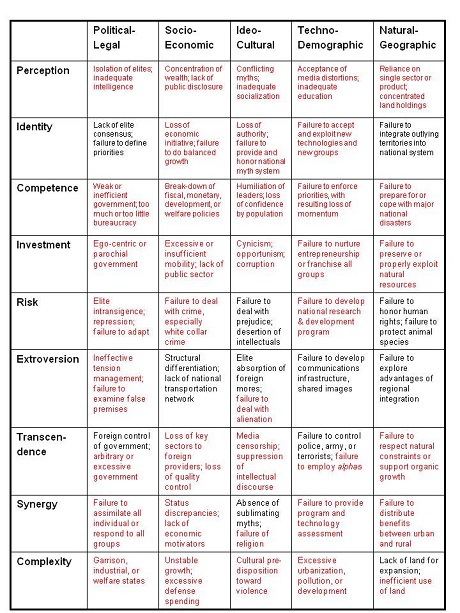
Former CIA officer's matrix on the preconditions for revolution
It's not just the US, he adds. "The preconditions of revolution exist in the UK, and most western countries. The number of active pre-conditions is quite stunning, from elite isolation to concentrated wealth to inadequate socialisation and education, to concentrated land holdings to loss of authority to repression of new technologies especially in relation to energy, to the atrophy of the public sector and spread of corruption, to media dishonesty, to mass unemployment of young men and on and on and on."
So why isn't it happening yet?
"Preconditions are not the same as precipitants. We are waiting for our Tunisian fruit seller. The public will endure great repression, especially when most media outlets and schools are actively aiding the repressive meme of 'you are helpless, this is the order of things.' When we have a scandal so powerful that it cannot be ignored by the average Briton or American, we will have a revolution that overturns the corrupt political systems in both countries, and perhaps puts many banks out of business. Vaclav Havel calls this 'The Power of the Powerless.' One spark, one massive fire."
But we need more than revolution, in the sense of overthrow, to effect change, surely. How does your manifesto for 'open source everything' fit into this? "The west has pursued an industrialisation path that allows for the privatisation of wealth from the commons, along with the criminalisation of commons rights of the public, as well as the externalisation of all true costs. Never mind that fracking produces earthquakes and poisons aquifers – corrupt politicians at local, state or province, and national levels are all too happy to take money for looking the other way. Our entire commercial, diplomatic, and informational systems are now cancerous. When trade treaties have secret sections – or are entirely secret – one can be certain the public is being screwed and the secrecy is an attempt to avoid accountability. Secrecy enables corruption. So also does an inattentive public enable corruption."
Is this a crisis of capitalism, then? Does capitalism need to end for us to resolve these problems? And if so, how? "Predatory capitalism is based on the privatisation of profit and the externalisation of cost. It is an extension of the fencing of the commons, of enclosures, along with the criminalisation of prior common customs and rights. What we need is a system that fully accounts for all costs. Whether we call that capitalism or not is irrelevant to me. But doing so would fundamentally transform the dynamic of present day capitalism, by making capital open source. For example, and as calculated by my colleague JZ Liszkiewicz, a white cotton T-shirt contains roughly 570 gallons of water, 11 to 29 gallons of fuel, and a number of toxins and emissions including pesticides, diesel exhaust, and heavy metals and other volatile compounds – it also generally includes child labor. Accounting for those costs and their real social, human and environmental impacts has totally different implications for how we should organise production and consumption than current predatory capitalism."
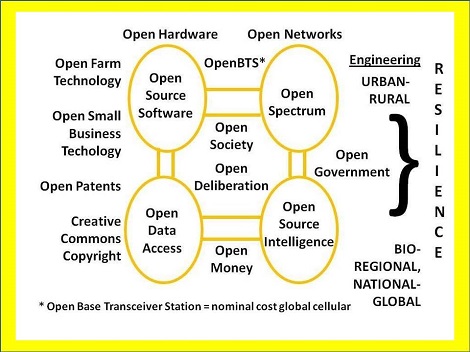
So what exactly do you mean by open source everything? "We have over 5 billion human brains that are the one infinite resource available to us going forward. Crowd-sourcing and cognitive surplus are two terms of art for the changing power dynamic between those at the top that are ignorant and corrupt, and those across the bottom that are attentive and ethical. The open source ecology is made up of a wide range of opens – open farm technology, open source software, open hardware, open networks, open money, open small business technology, open patents – to name just a few. The key point is that they must all develop together, otherwise the existing system will isolate them into ineffectiveness. Open data is largely worthless unless you have open hardware and open software. Open government demands open cloud and open spectrum, or money will dominate feeds and speeds."
Robert Steele
Robert Steele's vision for open source systems
On 1st May, Steele sent an open letter to US vice president Joe Biden requesting him to consider establishing an Open Source Agency that would transform the operation of the intelligence community, dramatically reduce costs, increasing oversight and accountability, while increasing access to the best possible information to support holistic policy-making. To date, he has received no response.
I'm not particularly surprised. Open source everything pretty much undermines everything the national security state stands for. Why bother even asking vice president Biden to consider it? "The national security state is rooted in secrecy as a means of avoiding accountability. My first book, On Intelligence: Spies and Secrecy in an Open World – which by the way had a foreword from Senator David Boren, the immediate past chairman of the Senate Select Committee for Intelligence - made it quite clear that the national security state is an expensive, ineffective monstrosity that is simply not fit for purpose. In that sense, the national security state is it's own worst enemy – it's bound to fail."
Given his standing as an intelligence expert, Steele's criticisms of US intelligence excesses are beyond scathing – they are damning. "Most of what is produced through secret methods is not actually intelligence at all. It is simply secret information that is, most of the time, rather generic and therefore not actually very useful for making critical decisions at a government level. The National Security Agency (NSA) has not prevented any terrorist incidents. CIA cannot even get the population of Syria correct and provides no intelligence - decision-support - to most cabinet secretaries, assistant secretaries, and department heads. Indeed General Tony Zinni, when he was commander in chief of the US Central Command as it was at war, is on record as saying that he received, 'at best,' a meagre 4% of what he needed to know from secret sources and methods."
So does open source mean you are calling for abolition of intelligence agencies as we know them, I ask. "I'm a former spy and I believe we still need spies and secrecy, but we need to redirect the vast majority of the funds now spent on secrecy toward savings and narrowly focused endeavors at home. For instance, utterly ruthless counterintelligence against corruption, or horrendous evils like paedophilia.
"Believe it or not, 95% of what we need for ethical evidence-based decision support cannot be obtained through the secret methods of standard intelligence practices. But it can be obtained quite openly and cheaply from academics, civil society, commerce, governments, law enforcement organisations, the media, all militaries, and non-governmental organisations. An Open Source Agency, as I've proposed it, would not just meet 95% of our intelligence requirements, it would do the same at all levels of government and carry over by enriching education, commerce, and research – it would create what I called in 1995 a 'Smart Nation.'
"The whole point of Open Source Everything is to restore public agency. Open Source is the only form of information and information technology that is affordable to the majority, interoperable across all boundaries, and rapidly scalable from local to global without the curse of overhead that proprietary corporations impose."
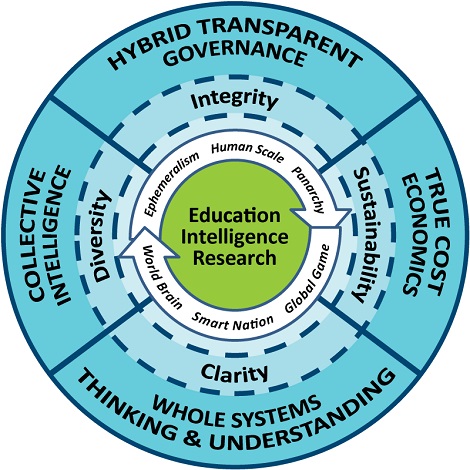
Robert Steele's graphic on open source systems thinking
It's clear to me that when Steele talks about intelligence as 'decision-support,' he really does intend that we grasp "all information in all languages all the time" – that we do multidisciplinary research spanning centuries into the past as well as into the future. His most intriguing premise is that the 1% are simply not as powerful as they, and we, assume them to be. "The collective buying power of the five billion poor is four times that of the one billion rich according to the late Harvard business thinker Prof C. K. Prahalad – open source everything is about the five billion poor coming together to reclaim their collective wealth and mobilise it to transform their lives. There is zero chance of the revolution being put down. Public agency is emergent, and the ability of the public to literally put any bank or corporation out of business overnight is looming. To paraphrase Abe Lincoln, you cannot screw all of the people all of the time. We're there. All we lack is a major precipitant – our Tunisian fruit seller. When it happens the revolution will be deep and lasting."
The Arab spring analogy has its negatives. So far, there really isn't much to root for. I want to know what's to stop this revolution from turning into a violent, destructive mess. Steele is characteristically optimistic. "I have struggled with this question. What I see happening is an end to national dictat and the emergence of bottom-up clarity, diversity, integrity, and sustainability. Individual towns across the USA are now nullifying federal and state regulations - for example gag laws on animal cruelty, blanket permissions for fracking. Those such as my colleague Parag Khanna that speak to a new era of city-states are correct in my view. Top down power has failed in a most spectacular manner, and bottom-up consensus power is emergent. 'Not in my neighborhood' is beginning to trump 'Because I say so.' The one unlimited resource we have on the planet is the human brain – the current strategy of 1% capitalism is failing because it is killing the Golden Goose at multiple levels. Unfortunately, the gap between those with money and power and those who actually know what they are talking about has grown catastrophic. The rich are surrounded by sycophants and pretenders whose continued employment demands that they not question the premises. As Larry Summers lectured Elizabeth Warren, 'insiders do not criticise insiders.'"
But how can activists actually start moving toward the open source vision now? "For starters, there are eight 'tribes' that among them can bring together all relevant information: academia, civil society including labor unions and religions, commerce especially small business, government especially local, law enforcement, media, military, and non-government/non-profit. At every level from local to global, across every mission area, we need to create stewardship councils integrating personalities and information from all eight tribes. We don't need to wait around for someone else to get started. All of us who recognise the vitality of this possibility can begin creating these new grassroots structures from the bottom-up, right now."
So how does open source everything have the potential to 're-engineer the Earth'? For me, this is the most important question, and Steele's answer is inspiring. "Open Source Everything overturns top-down 'because I say so at the point of a gun' power. Open Source Everything makes truth rather than violence the currency of power. Open Source Everything demands that true cost economics and the indigenous concept of 'seventh generation thinking' – how will this affect society 200 years ahead – become central. Most of our problems today can be traced to the ascendance of unilateral militarism, virtual colonialism, and predatory capitalism, all based on force and lies and encroachment on the commons. The national security state works for the City of London and Wall Street – both are about to be toppled by a combination of Eastern alternative banking and alternative international development capabilities, and individuals who recognise that they have the power to pull their money out of the banks and not buy the consumer goods that subsidise corruption and the concentration of wealth. The opportunity to take back the commons for the benefit of humanity as a whole is open – here and now."
For Steele, the open source revolution is inevitable, simply because the demise of the system presided over by the 1% cannot be stopped – and because the alternatives to reclaiming the commons are too dismal to contemplate. We have no choice but to step up.
"My motto, a play on the CIA motto that is disgraced every day, is 'the truth at any cost lowers all other costs'", he tells me. "Others wiser than I have pointed out that nature bats last. We are at the end of an era in which lies can be used to steal from the public and the commons. We are at the beginning of an era in which truth in public service can restore us all to a state of grace."
Dr. Nafeez Ahmed is an international security journalist and academic. He is the author of A User's Guide to the Crisis of Civilization: And How to Save It, and the forthcoming science fiction thriller, ZERO POINT. ZERO POINT is set in a near future following a Fourth Iraq War. Follow Ahmed on Facebookand Twitter.

Sunday, 24 November 2013

IRISH TIMES Sunday, November 24, 2013 Heritage Revolution


The Men(Women) who Began the Revolution

The Irish Volunteers formed a century ago to support Home Rule in the face of UVF opposition. But what, precisely, they achieved before the disastrous treaty split that led to civil war is a contentious question

Sat, N


ov 23, 2013, 01:00


First published:Sat, Nov 23, 2013,


In their coverage of the launch of the Irish Volunteers organisation, in Dublin on November 25th, 1913, newspapers provided much detail about what transpired in the crowded Rotunda Rink, then the biggest hall in Dublin, in a temporary building in the grounds of the Rotunda Gardens.

Attendance was estimated at more than 5,000, and overflow meetings had to be held in the concert rooms and the gardens. The Freeman’s Journal reported that the crowd was shepherded by “a big brigade of stewards . . . wearing green and orange badges”, and “the St James’s Brass and Reed Band discoursed a selection of national airs, the refrains of which were joined in by many in the assemblage. By far the greatest number of those in attendance were young men.”

But when Laurence Kettle, a moderate nationalist who became joint secretary of the Volunteers’ Provisional Committee, rose to read the manifesto of the new organisation, a call of “Cheers for Larkin” was raised by a small section of the crowd, and “Mr Kettle’s voice was completely drowned”.

This was a reminder that the launch occurred in the midst of the long-drawn-out Dublin Lockout, after 400 employers had locked out more than 20,000 workers for belonging to, or supporting, the Irish Transport & General Workers’ Union, led by James Larkin. Two weeks previously, the Irish Citizen Army (ICA) had been formed as a militia to protect the workers.

The ICA was now part of a melting pot of organisations that was about to get bigger still. At the Rotunda gathering, moderate nationalists and trade unionists were joined by cultural and language activists, GAA stalwarts, representatives of the Ancient Order of Hibernians and the secret, oath-bound Irish Republican Brotherhood (IRB), as well as a large body of students from the National University of Ireland.

The meeting was chaired by the University College Dublin historian Eoin MacNeill, who had written an article three weeks earlier in An Claidheamh Soluis, the newspaper of the Gaelic League, calling for a nationalist force that would emulate the formation of theUlster Volunteer Force (UVF), in January 1913. The UVF had threatened rebellion to oppose the introduction of Home Rule, and this gathering was the Irish nationalist response.

MacNeill began the proceedings “in the name of God” and claimed that “every section of Irish national opinion” was represented and what was now required to get the movement launched was “courage, vigilance and discipline”.

It was reported that 3,000 people were enrolled that inaugural night, and Bulmer Hobson, a member of the IRB who was one of those who had persuaded MacNeill to launch the Volunteers, recalled that those “equipped with pads of enrolment forms were mostly members of the IRB”. There was also the opening of a public subscription list and a promise that “there would be work for the women”. MacNeill also maintained, “We are commencing a united Ireland,” and, in relation to the cheers for Larkin, insisted that “we will recognise no sections”.


Manifesto
The manifesto declared that the ranks were open to all able-bodied Irish men without distinction of creed, politics or social grade. Both MacNeill and Pádraig Pearse, the educationalist and champion of the Gaelic League, who was moving in a more radical direction politically, maintained in their speeches that the new Volunteer force was not being founded in opposition to the UVF and that they would welcome the opportunity for the two forces to work together for the common good of Ireland.

The manifesto stated that the duties of the Volunteers “will be defensive and protective and they will not contemplate either aggression or domination”.

Various launches were held in other parts of the country, and by the middle of 1914, police reports estimated, membership of the organisation had reached 150,000. It was an extraordinary mobilisation, and much credit was given to the UVF for providing the inspiration.

MacNeill had said at the Rotunda, “We of the Irish Volunteers must admit candidly that it is the Ulster Volunteers who have opened the way for the Irish Volunteers.” According to the historian Michael Laffan, the example of the UVF “was contagious, and their parading of emotion, their posturing and their oratory all helped to eradicate the national fear of looking ridiculous”.

But there was more to it than that. At the time of the formation of the Volunteers, Europe was riven with conflict and labour unrest; civilian militarism was taking place in Germany, Britain and Poland; and independent military action by smaller nations was evident in the Balkan wars of 1911 and 1912 and the emerging nation states of Serbia, Bulgaria and Greece – developments that did not go unrecorded in Ireland.


The formation of the Volunteers was an Irish manifestation of the rise of the “generation of 1914” whose rhetoric embraced the prospect of heroic conflict. It was a time of transition and dislocation, predictions of the end of empire, the promotion of the cult of manliness as the gateway to public virtue, and demands for suffrage and equality for women.

The ICA admitted women and spoke the language of equality, but the Volunteers were not as enlightened; Cumann na mBan was launched in 1914 as a female auxiliary force to the Volunteers, although its rhetoric and membership badge were militaristic.

A number of things were apparent from the early stages of the Volunteers’ existence: although the electric atmosphere enthralled many, the sheer variety of nationalist opinions and organisations involved meant the potential for internal dissension was strong.

A crucial question was whether the Irish Parliamentary Party would seek to control the Volunteers; its leader John Redmond was of high standing in Ireland but relatively weak in Westminster, given the unionist and Tory opposition to the implementation of Home Rule. MacNeill sought to resist any Redmondite takeover, but, fearing a split if there was no compromise, eventually accepted Redmond’s nominees to the Volunteers’ Provisional Committee.


There was an uneasy tolerance for a period, but growing distrust was inevitable, and the outbreak of the Great War complicated things further. Redmond’s call in September 1914 for the Volunteers to enlist in the British army as a moral imperative was met with accusations of treachery from MacNeill and his allies.

But Redmond’s standing was such that when the movement split that month, he took the vast majority of Volunteers – more than 90 per cent, now styled the National Volunteers – with him. Contemporary estimates of the number of Irish Volunteers who stayed with MacNeill were in the region of 9,000.

As shown by the mobilisation of Redmond’s National Volunteers to join the British army – by December 1914 Irish enlistments had exceeded 40,000, and by the end of the war Ireland’s total male contribution to the wartime forces was an estimated 210,000 – concepts of loyalty were multifaceted during this period.

For some, social and economic factors and traditions of military service were relevant, as were group and family loyalty and peer example and pressure. But for others British army service in the first World War was itself a declaration of Irish nationalism.

The Irish Times in April 1915, for example, reported on the enlistment of three brothers, all married and in employment. In response to the question of why they were joining the British army, they declared: “Because Mr Redmond said that this was as much Ireland’s fight as England’s and we want to fight for Ireland.”


Even without the outbreak of the Great War, the actions of Redmond and the dispute over participation in the British war effort, there was little chance that the original defensive ethos of the Irish Volunteers would have survived because of the way in which IRB infiltrators were determined to skew its original purpose of existing to defend the introduction of Home Rule.

In his thoughts on what the Volunteers could become, Pádraig Pearse went much further than MacNeill; in the words of the historian Joe Lee, Pearse was increasingly “extolling bloodshed as a spiritual value in itself”. He wanted to see all nationalist and labour groups armed: “Bloodshed is a cleansing and a sanctifying thing, and the nation which regards it as the final horror has lost its manhood. There are many things more horrible than bloodshed; and slavery is one of them.”

In making such declarations, Pearse was hardly representative. Even after the split in 1914, although their general rhetoric became more militant and threatening, most of the rank and file of the slimmed-down Irish Volunteers would not have shared Pearse’s flights of fancy. MacNeill was certainly in the pragmatists’ camp, and was described by a sympathetic contemporary, John J Horgan, as “that most tragic political phenomenon – an idealist enmeshed in reality”.

Like Pearse, other IRB members, including Seán Mac Diarmada and Tom Clarke, had been pleased about the formation of the Volunteers and the subsequent split in its ranks for their own reasons. Although it was the case that the longer the war endured the more dissatisfied nationalist Ireland became, the IRB was still a dedicated elite and the Irish Volunteer movement on the eve of the 1916 Rising was still only 15,000 strong.


Fearghal McGarry, one of the historians who have looked at many of the statements of the Bureau of Military History, which collected testimony in the 1940s and 1950s from those involved in the Irish revolution, has highlighted the diverse range of factors that influenced the political formation of the Volunteer generation.

They included “family background and childhood influences, local and communal influences, intergenerational tensions, education, popular traditions of Irish history, print culture and associational culture. But there is little discussion of ideology in the statements . . . Volunteering did not popularize republicanism.”

They saw themselves as existing to counter the unionist threat to Home Rule, not to fight for Irish independence. The Volunteer movement had not built its base on the back of the ideology of the IRB, and even within the much smaller Irish Volunteers group after the split there was considerable opposition to the IRB.

The Easter Rising shocked most Irish Volunteers in 1916, which is hardy surprising given the clandestine way it was organised by the IRB, which used planned Volunteer mobilisations as a cover for its revolt.

Most of the Rising’s participants were Volunteers, and there was also a strong ICA contribution, but, overall, fewer than 1,500 mobilised in Dublin over the course of the week. After the post-Rising executions and deportations came a change in public opinion and, by the summer of 1917, the release of most prisoners.

The building of a new republican movement on the back of the now hardened separatist sentiment was largely driven by the Irish Volunteers, and after Éamon de Valera was elected Sinn Féin MP for East Clare in July 1917, he deliberately appeared in Volunteer uniform. He was subsequently elected president of the Volunteers in October 1917, the day after he had been elected president of Sinn Féin, which underlined the desire for unity of command.

The conscription crisis of 1918, when the British government was forced to abandon its plan to introduce conscription in Ireland because of united nationalist opposition, was also a factor in solidifying support for the now increasingly visible and assertive Volunteers, as was their involvement in the general election of December 1918 that witnessed the triumph of Sinn Féin.

The Volunteers’ general headquarters was established in Dublin in March 1918, and most Volunteers took an oath to defend the Republic. The first edition of the Volunteer’s journal, An tÓglách, appeared in August 1918, and what was striking was its insistence that it was “the agent of national will” and its excoriation of the notion of passive resistance.

The message was that, unlike in 1916, the Volunteers were poised for success and determined that it would be more profitable to kill than to die for Ireland. The British government banned the Volunteers in November 1919, and the increasing use of the initials IRA was apparent.

It subsequently organised throughout the country, and historians have done much in recent years to underline the degree to which it was affected by local nuances, feuds, resilience, triumphs and weaknesses.

Much of what sustained the revolution was youthful exuberance rather than military brilliance; before 1919 the average age of a rank-and-file Volunteer was 23 and of an officer 25; after that, the average age rose by about a year.


State of war
The relationship between the IRA and the underground Dáil government established in 1919 was never straightforward; not every Volunteer took an oath of loyalty, local leadership was highly variable and IRA GHQ was not always in control. But as the republicans moved towards a more focused and effective military strategy, Britain struggled in response, doing little to encourage moderate nationalists.

It was only in March 1921, however, that the Dáil agreed to an acceptance of a state of war with England and took responsibility for the military operations of the Volunteers. Around the same time Richard Mulcahy, IRA chief of staff, recognised that the IRA’s room for manoeuvre was narrowing.

Later that year, with the truce between the IRA and British forces and the negotiation of the Anglo-Irish Treaty, Mulcahy sought to head off the anticipated republican rejection of the treaty by arguing that “any good Irishman, if assured that by dying he would secure for Ireland the benefits included in the treaty, would have died without hesitation”.

This was far fetched, if not delusional, but what was also instructive was that the republican view of public opinion was and remained dismissive; they did not define their fight in terms of democracy.

What had the Irish Volunteers achieved from 1913 to 1921 before the disastrous treaty split that led to civil war? Given that the organisation evolved into the IRA during the war of independence, and that about 7,500 people were killed or injured because of violence in Ireland from 1917 to 1923, and because of the more recent Troubles from 1969 and the continued existence of republican paramilitary groups that claim the Volunteers’ title and continuity with their war-of-independence mission, this is one of the more contentious questions of modern Irish history.


Wishful thinking
There is little doubt about the central role of the Volunteers in bringing down the quest for Home Rule that the constitutional nationalists had promoted since the 19th century, and in forcing Britain to negotiate, thus speeding up the process of a limited Irish independence.

Although there are those who claim that violence was unnecessary to create the Free State in 1922, this may be wishful thinking rather than objective analysis: the historian Ronan Fanning has insisted that “there is not a shred of evidence” that David Lloyd George’s Tory-dominated government would have moved from limited Home Rule “to the larger if imperfect generosity of the Treaty, if they had not been impelled to do so” by the IRA.

What the Volunteers could not do was prevent the partition of Ireland; indeed, they may have increased its likelihood, making the original 1913 aspiration towards unity with the UVF seem hollow, but unionist and British action and inaction were also relevant in that regard.

The rhetoric of 1913 needs to be viewed through the lenses of 1913, and it is the job of the historian not to romanticise or to bring a corrosive cynicism to what was, 100 years ago, a seminal moment at the beginning of the Irish revolution but to try to understand the complex layers, allegiances and notions of loyalty and disloyalty that propelled its instigators.


Diarmaid Ferriter is professor of modern Irish history at University College Dublin


TomHawker
25 minutes ago

Very well written and interesting article. It goes to show the depth and confusion abound during that time. There was of course a lot of boisterous rebellion, which is something we now consider part of our historical DNA but can't replicate in modernity, however the political manouvres and subterfuge were I think something of greatness. History is always romanticised through the eyes of retrospective elegists, the harsh truths are just that for some..too harsh.


ShareReply


JohnNagle
7 hours ago

What a pity they could not have finished the job.Look at the crowd we have running the country.
1


ShareReply


JohnnyDoyle
9 hours ago

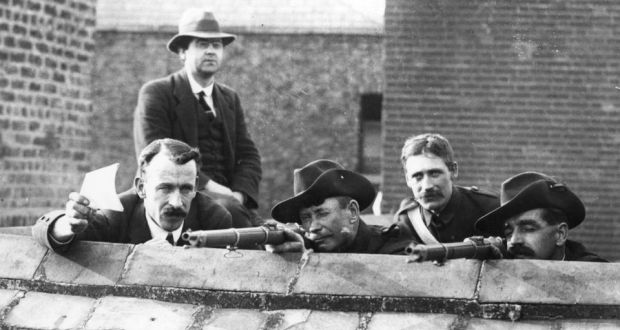
the photo of "Irish Volunteers" with rifles is a photo of members of the Irish Citizen Army on top of Liberty Hall. You've done a better job than the Easter 1916 site which has them as British soldiers blasting Republican strongholds/watching from the rooftops.http://www.easter1916.ie/index.php/gallery/
1


ShareReply


SteveMoran
10 hours ago

Thanks for an excellent article. I happen to believe that no independence at all would have been better than partition. I want to be independent, but not without my head.
2


ShareReply


GovInfos
13 hours ago

We can thank the men and women of the IRB and IRA that we didn't get the Home Rule that the majority of Irish people - outside Ulster - wanted in 1913. It goes to show that just because a majority want something, it may not always be the right thing. The Celtic Tiger experience has surely taught us this once again.
2


ShareReply


OwenMac
10 hours ago

"outside Ulster"?
There is nothing to suggest that there was not a majority in Ulster. There was a unionist majority in four of the counties of what was to become Northern Ireland.
There was a substantial non unionist majority in the three Ulster counties that remained in the new Irish Free State.


ShareReply


MártanÓConghaile
14 hours ago

Feirtéar betrays himself, with expressions such as "moderate nationalists".


ShareReply

OwenMac
Good history lesson. And to think that there are those who think that this subject is not important.